
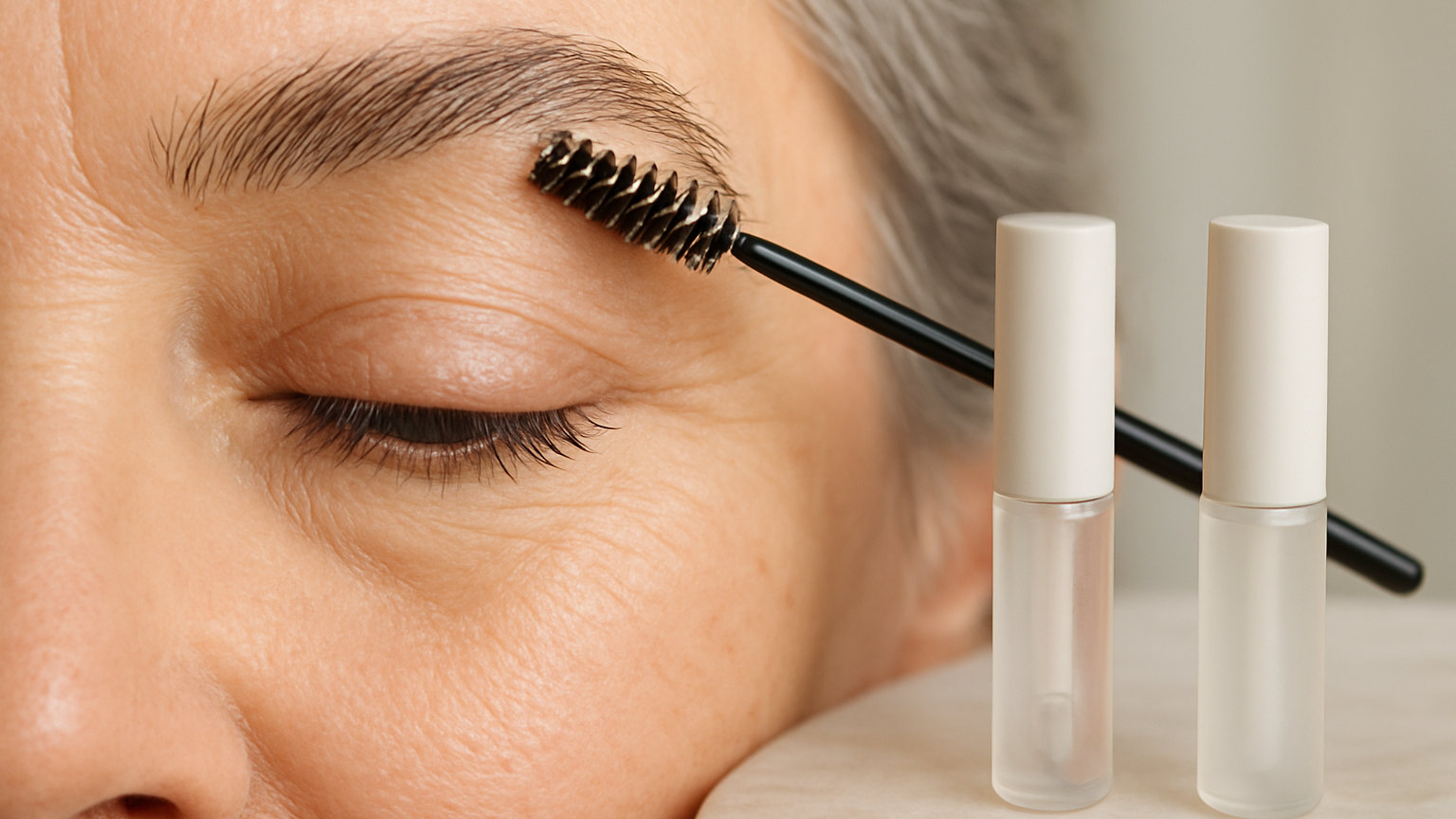
Brow gel is the most under-used product in this category and the one that does most for anyone with reasonable brow hair. It shapes and holds rather than colours, which is a different job from everything else on the shelf.
What are the types?
Clear gel, which holds hairs in place without adding colour. Suits anyone whose brows are the right colour and simply unruly.
Tinted gel, which coats the hairs and darkens them. Suits fair, grey or patchy brows, and frequently does the whole job on its own.
Laminating or lifting gel, a stronger hold formula designed to brush hairs upward and keep them there, mimicking the effect of a brow lamination treatment.
Fibre gels, which contain small fibres that cling to hairs and add apparent density.
Brow soap or wax, a solid product activated with a damp brush, which gives the strongest hold of all.
Why does it do more than filling?
Because for anyone with a reasonable amount of brow hair, the problem is usually direction and evenness rather than absence.
Hairs growing downward or sideways leave visible gaps that disappear the moment they are brushed upward and held.
A tinted gel also darkens the fine pale hairs that are present but invisible, which increases apparent density without adding anything.
The result frequently looks fuller than the same brows filled with pencil, and considerably more natural.
How should you apply it?
Brush upward and outward at the front, following the natural growth direction through the arch and tail.
Use a small amount, wiping excess off the wand, since too much makes brows look crunchy and can flake.
Work quickly before it sets, particularly with laminating formulas.
Hold the hairs in position for a few seconds with a fingertip if you want a strong lift.
Apply after any filling product rather than before, since it blends everything together.
What does brow soap do?
A solid soap-like product worked into a damp spoolie and brushed through the brows.
It gives the strongest hold available and creates a very lifted, fluffy, laminated look.
It is cheap, lasts a long time and can leave a slight sheen or, with too much water, a visible white residue.
Use very little water, since a wet brush is what causes the residue.
It is drying with daily use, so a brow oil at night is worth pairing with it.
How does it compare with lamination?
Lamination is a chemical treatment that resets the direction the hairs grow for six to eight weeks.
Gel and soap achieve a similar look daily with no chemistry, at the cost of a minute each morning.
For anyone whose brows behave with gel, lamination is difficult to justify on cost or on risk, since it uses perming chemistry and can cause breakage on fine brows.
For genuinely unruly, coarse or downward-growing brows, lamination does something gel cannot sustain all day.
Who does it suit?
Anyone with full brows, where a tinted gel alone is frequently the entire routine.
Anyone with unruly or downward-growing hairs.
Anyone with fair or grey brows, where a tint adds definition without the risk of a filling product looking drawn.
Anyone wanting a three-minute face, since it is the fastest brow product to apply.
Who does it suit less?
Anyone with very sparse brows, where there is little hair to coat and the gaps remain.
Anyone wanting a defined, sculpted shape, which gel does not provide.
Anyone whose brows are already flat and well-behaved, where a clear gel adds nothing.
How do you stop it flaking?
Use less product, which is almost always the cause.
Let any filling product set fully before applying gel over it.
Avoid layering gel over powder that has not been brushed through, since the two mix and ball up.
Replace it when it thickens in the tube, typically after six to twelve months, since a drying formula flakes regardless of technique.


