
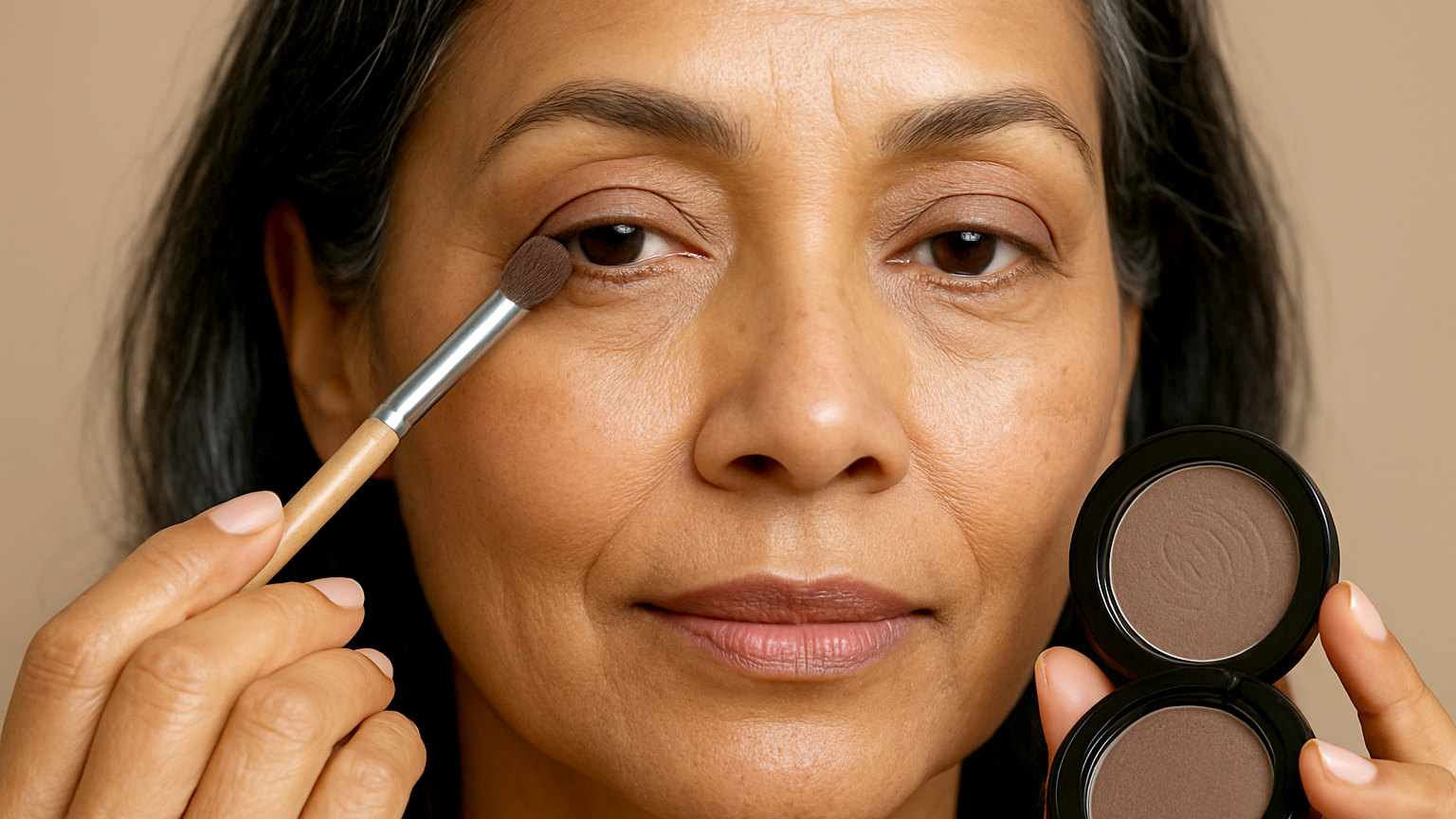
Eye shape charts list six or eight categories and most people do not fit neatly into one. Two principles cover almost all of the useful advice, and applying them to your own eyes works better than matching yourself to a diagram.
What are the two principles?
Light and shimmer bring an area forward; dark and matte push it back.
Whatever you emphasise draws the eye, so placement determines apparent shape more than colour does.
From those two, everything below follows, and you can work out what suits an eye shape not listed here.
How do you work out your shape?
Look straight ahead in a mirror, relaxed.
If you cannot see your crease, the lid is hooded. If there is no visible crease at all, it is a monolid.
If the outer corner sits lower than the inner, the eye is downturned; higher, and it is upturned.
If the eyes sit further back with a prominent brow bone, they are deep-set; if the lid protrudes, they are prominent.
If the gap between your eyes is narrower than one eye width, they are close-set; wider, and they are wide-set.
Most people are a combination, which is why the charts frustrate.
What suits hooded eyes?
Place the crease shade above the natural fold so it is visible with the eye open, which is the central adjustment.
Apply with the eye open, looking straight ahead, rather than closed.
Keep the lid matte or lightly satin, since heavy shimmer on a lid that is largely hidden is wasted and can emphasise the hood.
Extend shadow slightly upward and outward at the outer corner to lift.
Tightline rather than using thick liner above the lashes, which disappears under the hood. A very thin line or a smudged one works better than a bold wing.
What suits monolids?
Gradient application, with the darkest shade at the lash line fading upward, which creates depth where there is no natural crease.
Apply with the eye open, and take the shadow higher than feels natural, since it needs to be visible.
Slightly thicker liner than on a creased lid, since it will be partially covered.
Shimmer at the centre of the lid brings it forward.
Curling lashes makes a considerable difference.
What suits downturned eyes?
Concentrate depth and definition at the outer corner and lift everything upward toward the tail of the brow.
A winged liner angled upward, and avoiding any line that follows the natural downward drop.
Stop lower lash liner at the outer third rather than taking it to the corner.
Highlight at the inner corner and along the top of the outer corner.
What suits deep-set eyes?
Light and shimmer on the lid, which brings it forward.
Keep the crease shade light, since a dark crease on an already recessed eye deepens the shadow further.
Avoid heavy dark shadow across the whole lid.
Highlight the brow bone lightly rather than heavily, since a prominent brow bone does not need emphasising.
What suits close-set and wide-set eyes?
For close-set, keep the inner corner light and place all depth at the outer third, extending outward. Avoid heavy inner-corner highlight, which brings the eyes closer.
For wide-set, bring darker shadow further inward toward the inner corner and avoid extending it far outward. Liner along the full lash line including the inner corner helps.
What works for almost everyone?
A transition shade to soften edges, which prevents any crease colour looking like a stripe.
Curled lashes and mascara, which opens the eye more than any shadow.
A light shade at the inner corner, unless eyes are close-set.
Blending upward and outward rather than downward.
Defined brows, which frame the eye and do more than most eyeshadow.
And applying with the eye open at least part of the time, which is the single most useful habit regardless of shape.
Do brows and lashes change it?
Considerably, and both do more than eyeshadow for apparent eye shape. A brow with the tail sitting slightly higher lifts a downturned eye more effectively than any liner.
Curled lashes open a hooded or deep-set eye, and a lengthening mascara concentrated at the outer corner extends a round one.
Anyone finding that eyeshadow does not achieve what they want is frequently working on the wrong feature.
Does eye shape change over time?
Yes. Lids lose elasticity and become more hooded with age, so a placement that worked at thirty may be invisible at fifty, which is a change in the eye rather than in technique.


