
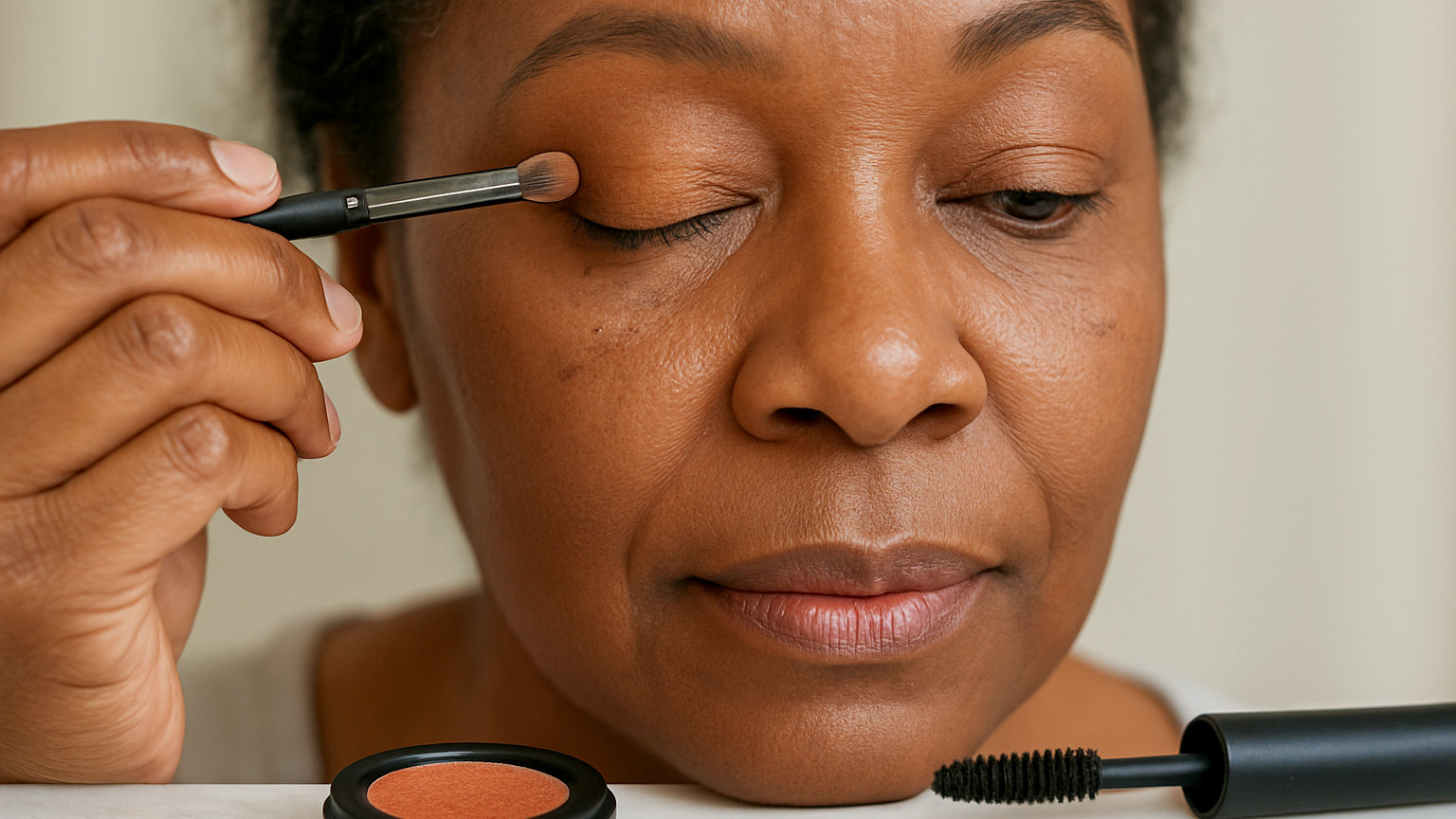
A hooded eye has a fold of skin covering part or all of the mobile lid when the eye is open. Most eye makeup instruction assumes a visible crease and a lid that shows, which is why following it produces work that disappears entirely.
How do you know if you have them?
Look straight ahead, relaxed. If you cannot see much or any of your eyelid, or if your crease is hidden under a fold, the eye is hooded.
It is a normal variation present from birth in many people, and it also develops with age as the lid loses elasticity.
Many people who followed tutorials happily for years find them stopping working in their forties for exactly this reason.
What is the central adjustment?
Place everything higher than the tutorial says, and apply with the eye open.
The crease shade goes above the natural fold, in the space that remains visible when the eye is open, rather than in the fold itself.
Look straight ahead into a mirror held below eye level, and mark with a light dot where the shadow needs to sit. That point is your working crease.
Applying with the eye closed and finding it invisible when open is the single most common frustration here, and it is entirely avoidable.
How do you build the shape?
A transition shade first, taken up higher than usual, well above the natural fold.
A deeper shade in a soft V at the outer corner, angled upward toward the tail of the brow, which lifts.
Blend upward and outward. Never downward, which drags the hood lower.
Keep the mobile lid, the part that shows, relatively light so it does not disappear.
A light shade at the inner corner and on the brow bone, which opens the area.
What finish works on the lid?
Matte or a soft satin on the visible lid.
Heavy shimmer on a hooded lid is largely hidden when the eye is open, so it delivers little, and it emphasises texture on the hood itself.
Shimmer works better as a small point in the centre of the visible lid or at the inner corner than across the whole eye.
What liner works?
Thin rather than thick, since anything substantial is covered by the hood.
Tightlining the upper waterline, which defines the eye without using visible lid space, is the most reliable option.
For a wing, extend it upward at a steeper angle than usual and check with the eye open. A wing that looks correct closed frequently disappears or points downward when open.
Some people draw the wing with the eye open entirely, which is awkward and gives an accurate result.
Avoid a thick line along the full lash line, which closes the eye.
How do you stop liner transferring to the crease?
This is the defining practical problem with hooded lids, since the lid rests directly against the liner.
Set the liner immediately after applying by pressing a matching powder shadow over it with a small brush.
Use a waterproof or tubing formula, which transfers considerably less.
Primer on the entire lid, including the hood, not just the mobile part.
Keep the line thinner, since less product means less to transfer.
Blot the lid with tissue before starting if it is oily.
What about a cut crease?
It can be done and needs adapting. A traditional cut crease follows the natural fold, which on a hooded eye is invisible.
Place the cut line above the fold, at the point visible with the eye open, and keep it soft rather than sharp.
Check repeatedly with the eye open throughout, since the shape changes completely between open and closed.
A softly diffused version generally suits better than a hard graphic line.
What else helps?
Curling lashes, which lifts the shadow off the eye and reveals more lid. Arguably the highest-value step here.
A lengthening mascara concentrated at the roots and outer corner.
Brows kept clean underneath and with the tail slightly lifted, which creates space above the eye.
A nude pencil on the lower waterline, which opens the eye.
And accepting that the same look will read differently than it does on an unhooded eye, which is a matter of adaptation rather than of doing it wrong.


