
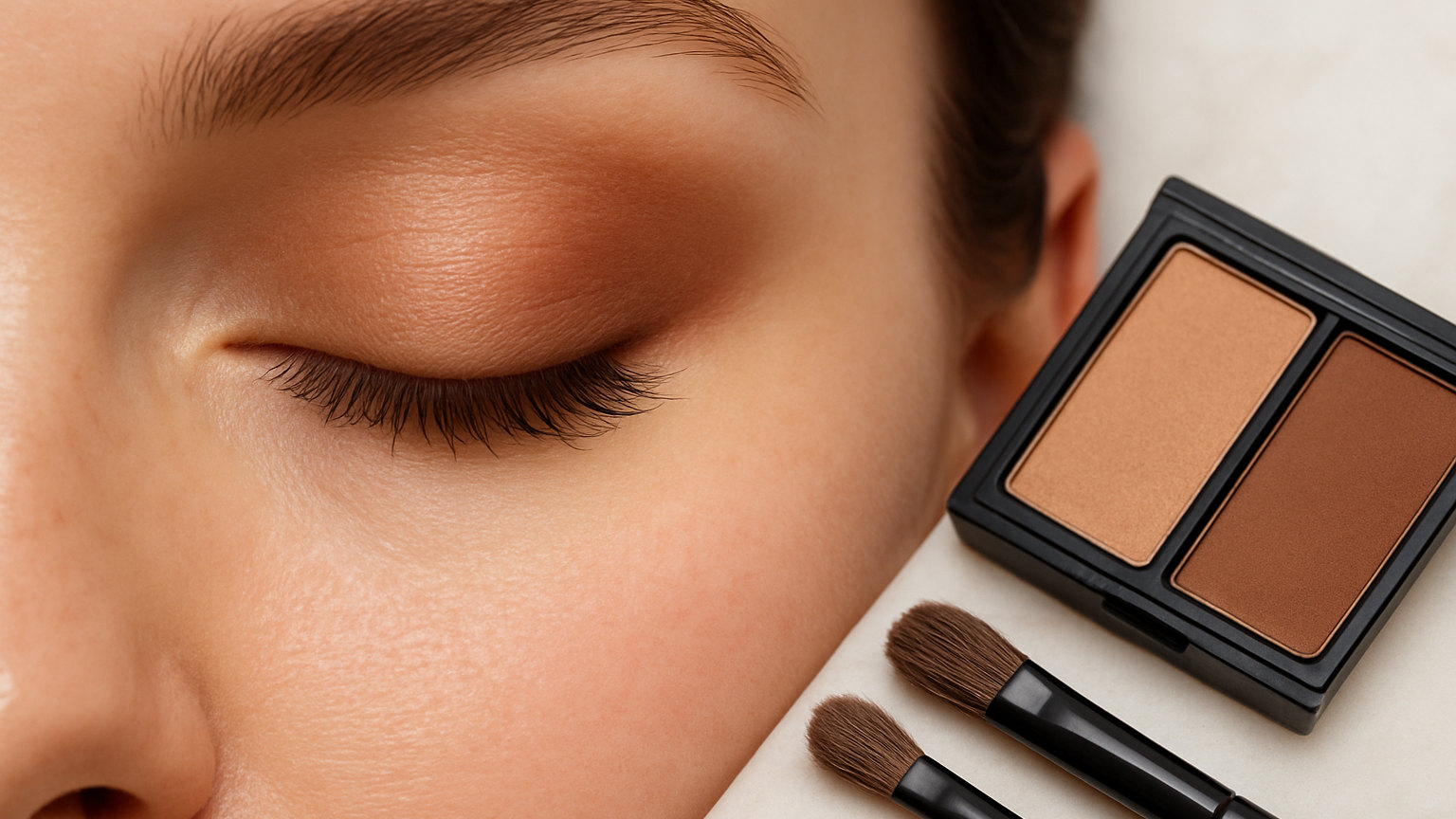
Eyeshadow looks complicated and reduces to three placements: something over the whole lid, something darker in the crease, and something light where you want to draw the eye. Everything else is variation.
What are the three placements?
A transition or base shade, applied across the whole lid up to and slightly above the crease. Usually a mid-tone close to your skin, and it softens everything applied afterwards.
A crease shade, darker, applied in and slightly above the natural crease, which creates depth and definition.
A lid shade, applied to the mobile eyelid, which is where colour or shimmer usually goes.
Optionally a highlight on the inner corner and under the brow, which opens the eye.
Those four steps produce a complete eye look, and everything more elaborate is built on the same structure.
Where is the crease?
The natural fold of the eyelid, visible when the eye is open on most people.
Apply with the eye open where possible, or looking straight ahead into a mirror held below eye level, since the crease sits differently when the eye is closed.
For hooded eyes, where the crease is hidden when the eye is open, apply the darker shade slightly above the natural crease so it remains visible. Looking straight ahead and marking where the shadow needs to sit is more reliable than following the fold.
For deep-set eyes, keeping the crease shade light and concentrating the lid shade on the centre of the lid brings it forward.
Which brushes do you need?
A flat shader brush for packing colour onto the lid, which deposits pigment rather than diffusing it.
A fluffy blending brush for the crease and for softening edges, which is the one that does most of the work.
A small pencil brush for detail: the outer corner, the lower lash line and precise placement.
Three brushes cover everything, and a fourth clean blending brush used with no product is the most useful addition.
How do you blend properly?
Small circular motions with a fluffy brush, using very little product.
Build in thin layers rather than applying a lot and trying to soften it, which is what produces a muddy result.
Blend the edges rather than the whole area, since blending across the lid removes the definition you created.
Use a clean brush with no product at the end, which softens edges without adding pigment. This single step improves most eye looks more than any technique.
Tap excess off the brush before every application, which is where most over-application starts.
Do you need a primer?
For anyone with oily lids, creasing shadow or a shadow that disappears by lunchtime, genuinely yes.
An eyeshadow primer, or a small amount of concealer set with powder, gives shadow something to grip and stops it collecting in the crease.
It also intensifies pigment considerably, particularly with shimmer shades.
For dry lids with a short wear time, it is optional.
How do you make colour more intense?
Use a flat brush and press rather than sweep, which packs pigment onto the lid.
Apply over a primer or a cream base in a similar colour, which anchors the pigment.
Dampen the brush slightly for shimmer and metallic shades, which intensifies them dramatically. Use a setting spray rather than water, and do not do this with matte shades, which go patchy.
Build in layers rather than trying to achieve intensity in one pass.
What suits different eye shapes?
Hooded: place the crease shade above the natural fold, keep the lid shade matte or lightly satin, and avoid heavy shadow directly on the lid, which disappears.
Downturned: concentrate depth at the outer corner and lift it upward toward the tail of the brow.
Round: elongate with shadow extended horizontally at the outer corner.
Close-set: keep the inner corner light and place depth at the outer third.
Wide-set: bring shadow slightly further inward toward the inner corner.
What are the common mistakes?
Too much product on the brush, which is the cause of most problems in this area.
Blending in the wrong place, either too high toward the brow or across the whole lid.
Skipping the transition shade, which is what makes a crease shade look like a stripe.
Applying with the eye closed and finding it invisible when open, particularly on hooded lids.
And buying palettes of twelve colours when three well-chosen shades do the work.


