
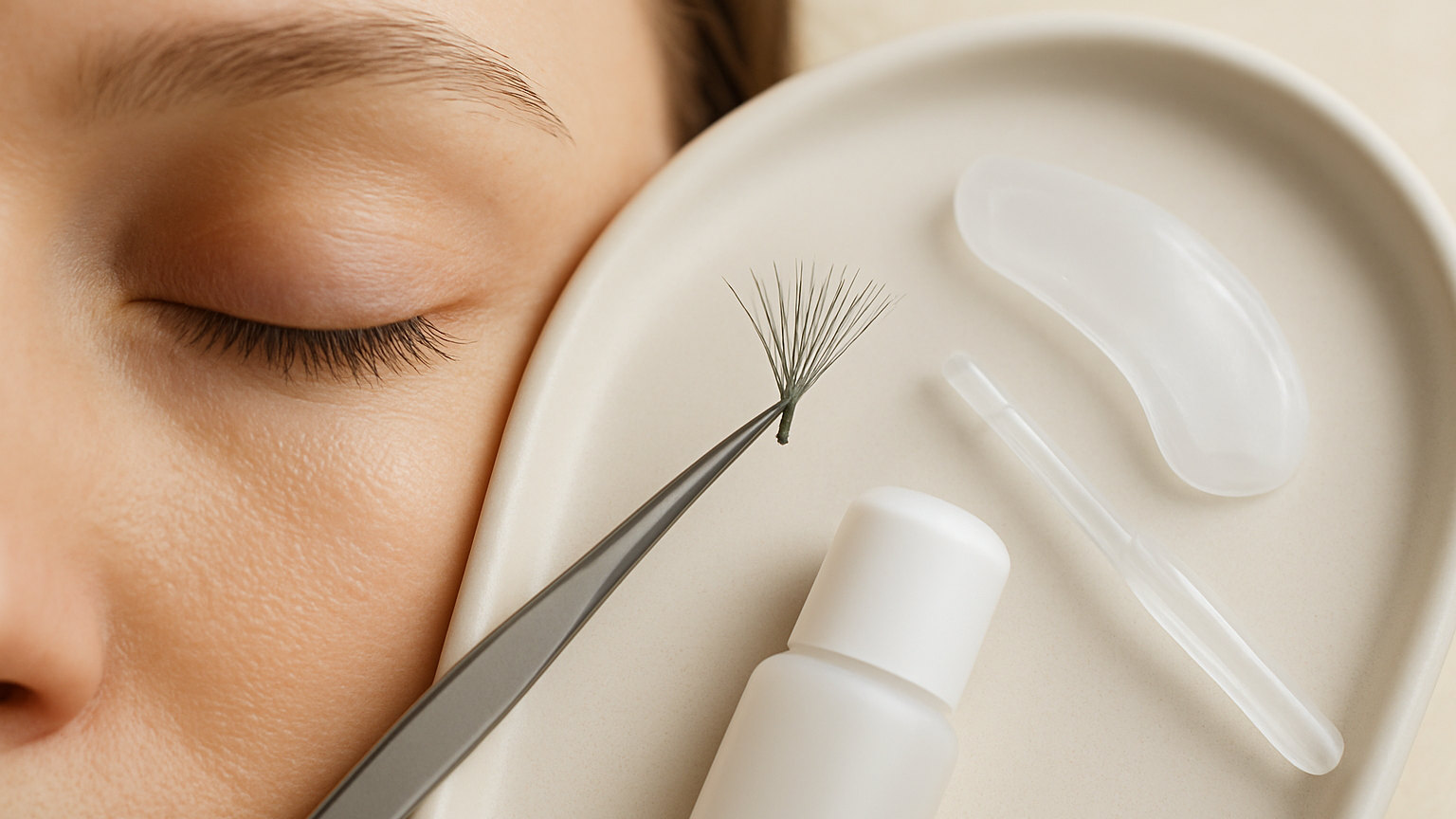
Lash extensions and lash lifts both remove a daily task, and they work differently and carry different risks. Extensions add hair; a lift curls what you have.
What are extensions?
Individual synthetic lashes attached to your own with a cyanoacrylate adhesive, one at a time, roughly a millimetre from the lid.
A full set takes around two hours, since each lash is isolated and attached individually.
Infills are needed every two to three weeks as natural lashes shed and are replaced.
An appointment finishing in forty minutes means lashes have been clustered rather than isolated, which is the main cause of damage.
What are the risks with extensions?
Allergic reaction to the adhesive, producing swollen, itchy, red eyelids. It can develop suddenly after several uneventful sets, since sensitisation builds with exposure, and once established it is generally permanent.
Traction alopecia of the lashes, where extensions too long or heavy for the natural lash put constant tension on the follicle. Over repeated sets, lashes grow back finer and eventually not at all.
Blepharitis and infection, since extensions make the lash line harder to clean.
Corneal injury from tweezers or adhesive during application.
The rule of thumb is that an extension should be no more than two to three millimetres longer than the natural lash. A technician offering dramatic length on fine lashes is offering damage.
What is a lash lift?
A perm for the natural lashes. They are lifted onto a silicone shield, a thioglycolate solution breaks the disulphide bonds, and a neutraliser reforms them in the curled position.
It lasts six to eight weeks, which matches the lash growth cycle. The curl does not drop out; the lashes carrying it shed.
A tint is frequently done at the same appointment, since curled lashes look considerably better dark.
Nothing is added, so there is no weight and no adhesive.
What are the risks with a lift?
Chemical irritation or burns, since a perming solution is used millimetres from the eye.
Over-processing, leaving lashes brittle, frizzy or kinked rather than smoothly curled.
Allergic reaction to the solution or to the tint applied alongside.
Solution running into the eye, which is a technician error and causes significant irritation.
Lower risk overall than extensions, and not zero.
How do you choose a technician?
Ask about training, insurance and how long they have been working.
Insist on a patch test at least twenty-four to forty-eight hours before a first appointment, for either treatment. Any salon that skips this is not one to use.
Ask what weight and length will be used for extensions, and why.
Check the appointment length. Two hours for a full set of extensions is right; considerably less is not.
Ask to see healed work rather than photographs taken immediately afterwards.
Who should avoid them?
Anyone with an eye infection, conjunctivitis, blepharitis or a stye.
Anyone with very fine, damaged or already brittle lashes.
Anyone with a known allergy to cyanoacrylate, thioglycolates or hair dye.
Anyone who has had recent eye surgery.
Pregnancy is generally advised against by salons as a precaution rather than on evidence.
What does aftercare involve?
For both: keep lashes dry for the first twenty-four to forty-eight hours, avoiding washing over them, steam, swimming and heavy sweating.
For extensions: clean daily with a dedicated lash cleanser and a soft brush, which is the step most people skip and what prevents blepharitis. Avoid oil-based products and waterproof mascara. Do not pick or pull.
For a lift: apply a conditioning serum or a small amount of castor oil nightly, since the process is drying. Brush daily with a clean spoolie.
What if something goes wrong?
Have extensions removed professionally rather than pulling them out, which takes natural lashes with them.
Over-curled lashes from a lift usually relax within a week or two, helped by conditioning and gentle downward brushing.
Seek medical advice for significant swelling, pain, vision changes or discharge.
And take a break: many technicians recommend several weeks off every six to twelve months for extensions, which lets the natural lashes recover.


