
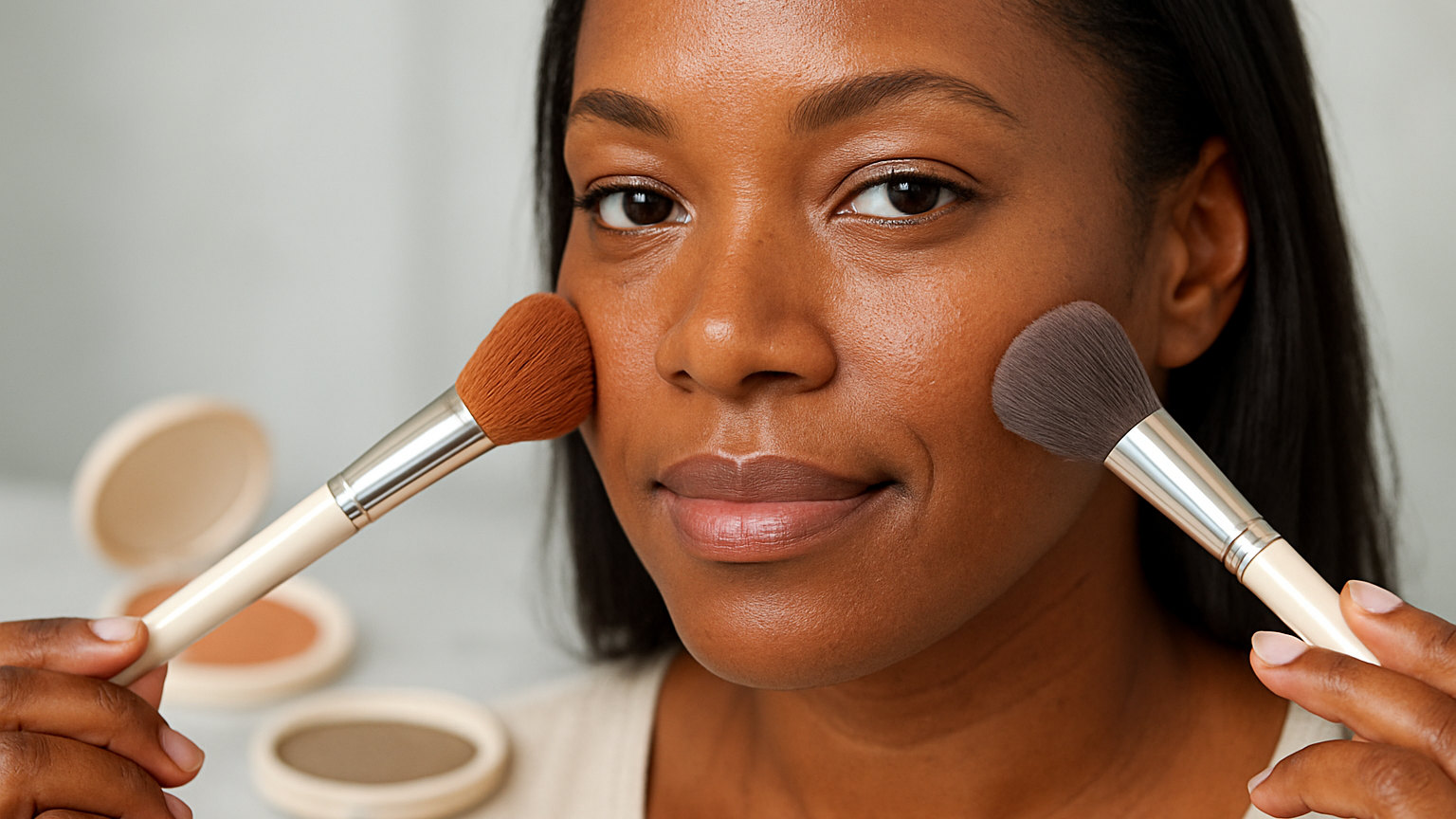
Bronzer and contour are frequently sold and used interchangeably, and they do opposite things. Bronzer adds warmth; contour creates shadow. The undertone required for each is what makes the difference.
What does bronzer do?
It adds warmth and colour, mimicking where the sun would naturally hit the face.
It should be warm-toned: golden, tan, peachy or orange-based depending on skin tone.
It goes on the high points and the perimeter: the forehead near the hairline, the temples, the tops of the cheekbones, the bridge of the nose and lightly along the jaw.
The aim is a face that looks like it has been outdoors rather than one that has been sculpted.
What does contour do?
It creates the illusion of shadow, which recedes and changes the apparent structure of the face.
It should be cool-toned or neutral: grey-brown, taupe or ashy, because real shadows are cool rather than warm.
A warm bronzer used as contour reads as a brown stripe rather than a shadow, which is the commonest reason contouring looks obvious and muddy.
It goes in the hollows: beneath the cheekbone, along the jawline, at the temples and along the sides of the nose.
How do you find the right shade?
For contour, one to two shades deeper than your skin with a cool or neutral undertone. Deeper than two shades reads as dirt rather than shadow.
For bronzer, one to two shades deeper with a warm undertone, and avoiding anything with visible shimmer if you have texture or are over about forty, since shimmer emphasises what it sits on.
On deeper skin tones, both need to be genuinely deeper rather than merely warm, and many ranges do not go far enough. Rich chocolate and espresso tones with the right undertone are what work.
On very fair skin, taupe contour and a light golden bronzer, since anything orange reads immediately.
Where exactly does contour go?
Under the cheekbone, starting from the top of the ear and stopping roughly in line with the outer edge of the eye. Continuing further inward drags the face down.
Along the jawline, blended down onto the neck so there is no line.
At the temples and around the hairline, which reduces the apparent size of the forehead.
Down the sides of the nose, very lightly, if you want to narrow it.
Feel for the actual hollow beneath the cheekbone rather than guessing, since it varies considerably between faces.
How do you blend it properly?
Upward and outward, never downward. Blending downward is what creates the muddy stripe.
Use a brush with no product on it after applying, which softens edges without adding pigment.
Cream formulas go over liquid foundation and before powder; powder formulas go after powder.
Build in thin layers, since removing contour without disturbing the foundation underneath is difficult.
Check in daylight, since bathroom lighting hides harsh edges that are obvious outside.
Do you need both?
No. Most people use one or the other, and bronzer is the more wearable and forgiving for daily use.
Contour suits photography, events and anyone who specifically wants to change apparent structure.
Using both is a full-makeup approach rather than a daily one, and bronzer alone with blusher gives most of the warmth and dimension with a fraction of the effort.
What about highlighter?
The third element, which draws light forward where contour pushes back.
It goes on the tops of the cheekbones above any contour, the brow bone, the bridge of the nose, the cupid's bow and the inner corners of the eyes.
Keep it away from areas with texture or enlarged pores, since it emphasises both. A satin finish is more flattering than a glittery one on most skin, and considerably more so on mature skin.
What are the common mistakes?
Using a warm bronzer as contour, which is the main one.
Applying contour too low or too far forward, which drags the face down and looks like a stripe.
Not blending onto the neck, which leaves a visible line at the jaw.
Too much shimmer, which reads as sweat in daylight and emphasises texture.
And contouring a face that does not need it, since the technique was developed for stage and camera where flat lighting removes natural shadow.


