
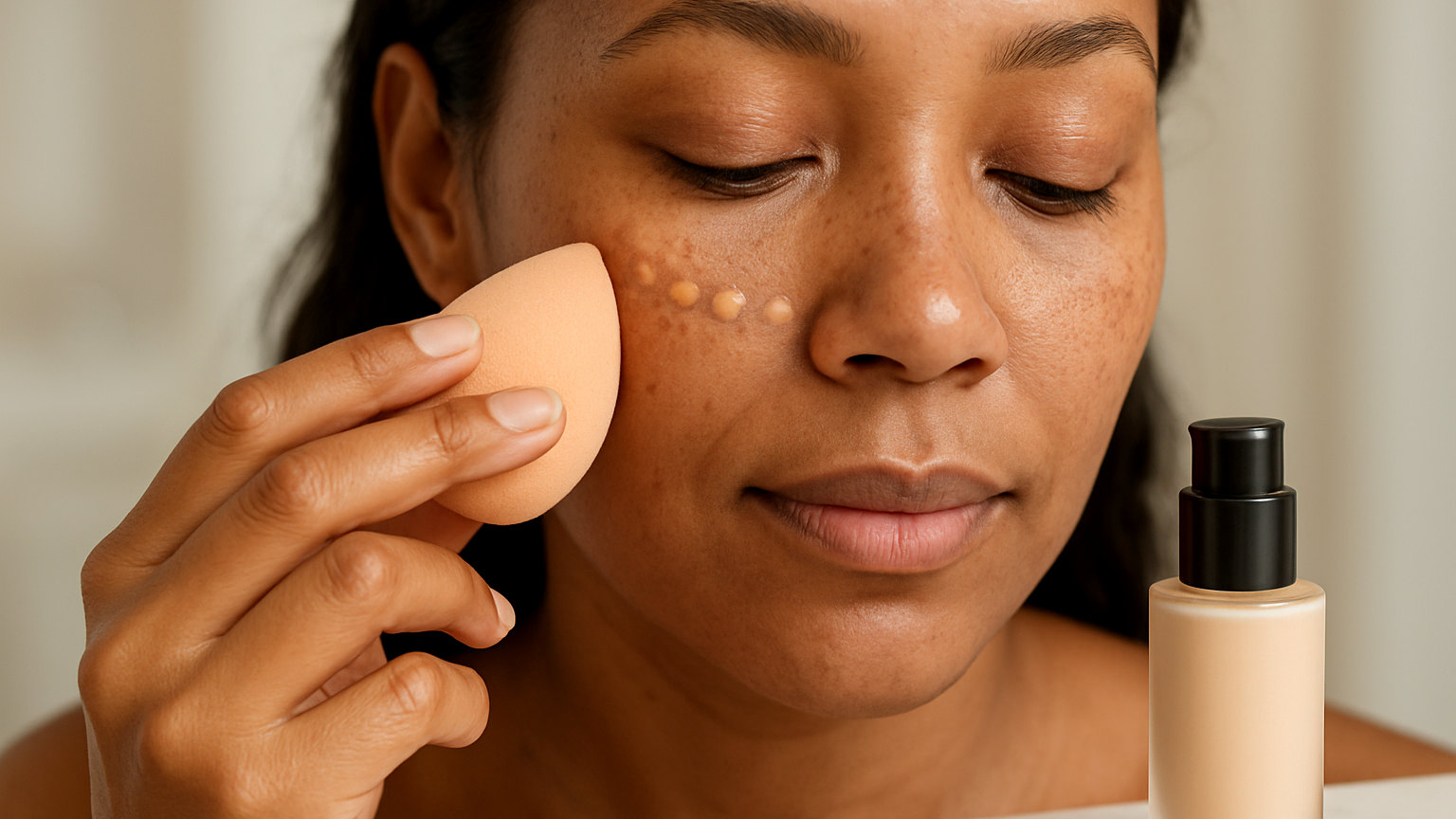
Foundation application goes wrong in the same few ways: too much product, starting in the wrong place, and applying it to skin that was not ready. The tool matters least of the three.
How should you prepare the skin?
Cleanse, and apply moisturiser suited to your skin type, then wait. Foundation applied over moisturiser that has not absorbed slides and separates.
Five minutes is usually enough, and anything with sunscreen needs longer.
Sunscreen goes on before foundation, as the last skincare step.
Primer is optional and genuinely useful for specific problems: a gripping primer for oily skin, a hydrating one for dry, and a blurring one for texture. It is not a necessary step.
Exfoliating the night before rather than the morning of gives a smoother base without irritation.
How much should you use?
Considerably less than most people. Roughly a pea to a five-pence sized amount for the whole face, built where needed.
Foundation is meant to even the skin rather than cover it entirely, and full coverage everywhere is what makes it look like makeup.
Start with a small amount and add only where you need it, which is usually the centre of the face.
Where should you start?
The centre of the face, working outward, which is the opposite of what most people do.
Redness and unevenness concentrate around the nose, chin and centre of the cheeks. Starting there puts the most product where it is needed and leaves progressively less for the outer face, which needs least.
Blending outward and downward toward the jaw and neck avoids a visible edge.
Starting at the outer cheek deposits the most product where the skin is usually most even, which is why foundation frequently looks heaviest in exactly the wrong places.
Which tool should you use?
Fingers, which warm the product and give the most natural finish. Good for sheer and hydrating formulas and for dry skin.
A damp sponge, which sheers out the product and gives a skin-like finish. Bounce or press rather than dragging. Dampen it thoroughly and squeeze out the excess, since a dry sponge absorbs most of the product.
A dense flat brush, which gives the highest coverage and can leave streaks if you drag.
A buffing brush, which blends well and gives medium coverage with a stippling motion.
Any of them works. Consistency of technique matters more than which you choose.
What causes a cakey finish?
Too much product, which is the main cause.
Applying over dry or flaky skin, where the foundation clings to the texture rather than sitting flat.
Too much powder over the top, particularly in areas that were not oily.
Layering more product over foundation that has already started to separate rather than blending what is there.
The fix is almost always less: less foundation, less powder, and better skin preparation.
What causes patchiness?
Skincare that has not absorbed, particularly silicone-heavy primers or sunscreens interacting with the foundation formula.
Dry patches, which grab colour unevenly.
Applying too slowly, so the product sets before it is blended.
Mixing incompatible formulas: a silicone-based primer under a water-based foundation frequently pills and separates.
Sticking to formulas with similar bases, or skipping primer, usually resolves it.
How do you set it?
A light dusting of translucent powder where you get oily, usually the T-zone, rather than the whole face.
Press rather than sweep, which keeps the foundation underneath undisturbed.
A setting spray afterwards melts powder into the skin and removes any powdery look, which is worth doing if you use powder at all.
Dry and mature skin frequently needs no powder at all beyond the sides of the nose.
How do you fix it during the day?
Blot with tissue or blotting paper before adding anything, which removes oil without removing foundation.
Add powder only after blotting, and only where needed.
For dryness, press a small amount of moisturiser or a hydrating mist over the top with clean fingers rather than adding foundation.
Adding more foundation over a face that has been worn for eight hours is what produces the heaviest-looking result.


