
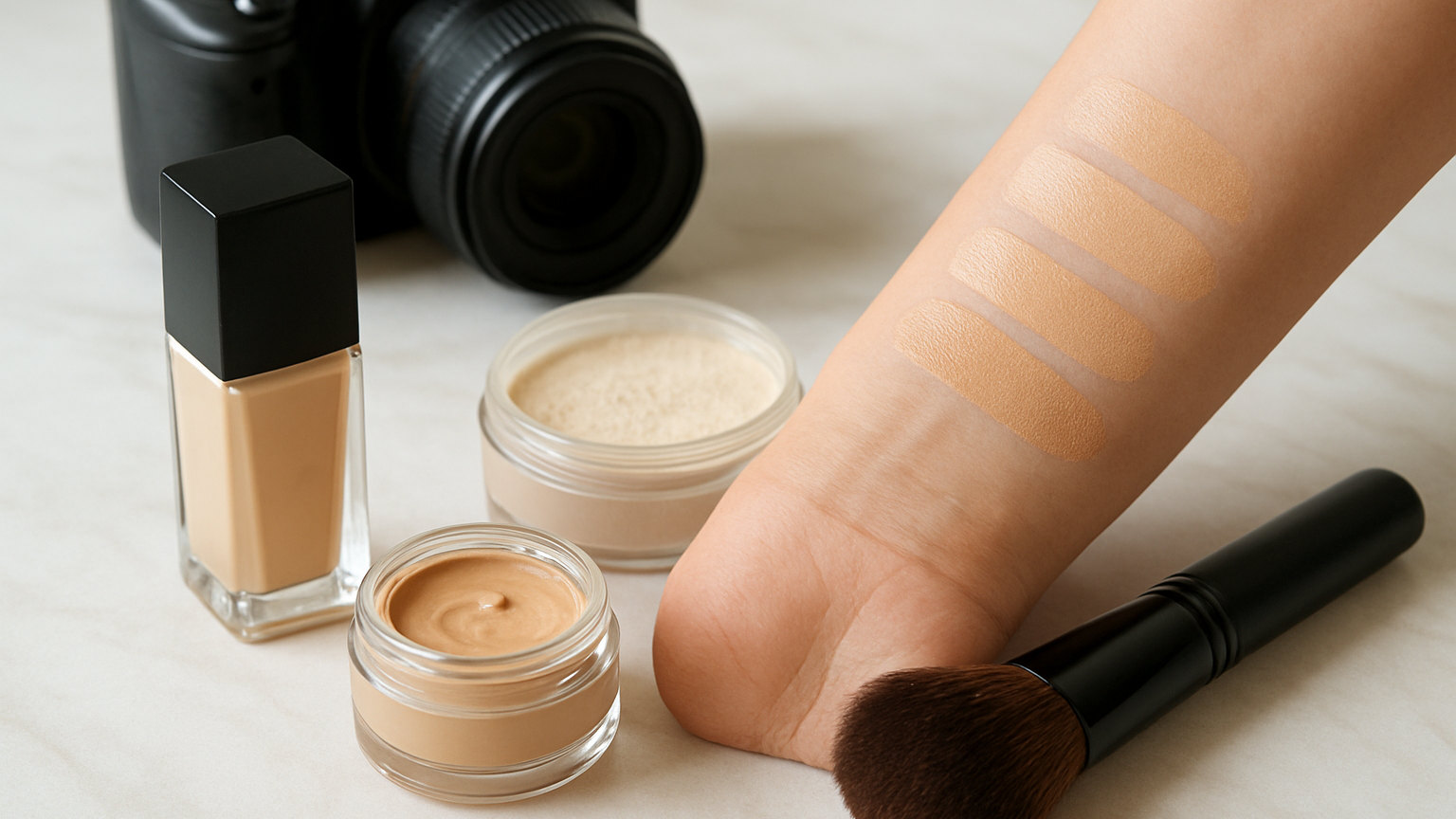
A camera does two things to a face: it flattens dimension, and it records light in ways the eye does not. Makeup that looks correct in a mirror can look flat, shiny or oddly pale in a photograph, and the adjustments are specific rather than a matter of doing more.
What is flashback?
A white or grey cast over the face in flash photography, where the makeup reflects the flash back at the lens.
It is caused by ingredients that scatter light: titanium dioxide, zinc oxide and silica, all common in sunscreens, setting powders and some foundations.
It only occurs with flash, which is why it is invisible until the photographs come back.
The result is a face noticeably paler than the neck and chest, sometimes described as a ghost effect.
How do you avoid it?
Avoid SPF in foundation and primer on days you will be photographed with flash, and use a chemical rather than mineral sunscreen underneath if you need protection.
Check setting powders for titanium dioxide and silica, and choose a translucent powder specifically marked as photograph-friendly or HD.
Use powder sparingly and only where needed, since the quantity matters as much as the ingredient.
Test in advance: take a flash photograph of yourself in the intended makeup, which takes seconds and settles the question entirely.
What does a camera flatten?
Dimension. Natural shadows and highlights that the eye reads as structure largely disappear under flat lighting.
This is why photographic makeup uses more definition than everyday makeup: slightly more contour, slightly more blusher, and more defined brows and eyes.
The amount that looks slightly too much in a mirror frequently looks correct in a photograph, which is uncomfortable to accept and generally true.
Applying in bright, even lighting rather than a dim bathroom gives a more accurate sense of it.
What does a camera exaggerate?
Shine, which reads as oiliness or sweat rather than glow.
Texture, including dry patches, flaking and enlarged pores.
Any harsh edge or unblended line, particularly at the jaw and around contour.
Shimmer and glitter, which catch the flash and can look like perspiration.
Colour differences between face, neck and chest, which are far more obvious in an image than in person.
What finish works best?
Satin or natural rather than fully matte or heavily dewy.
Fully matte reads as flat and lifeless in photographs. Heavily dewy reads as shine.
Keep any glow to the tops of the cheekbones and away from the T-zone, where the camera will read it as oil.
Blot the forehead, nose and chin immediately before photographs rather than powdering more.
What about colour?
Slightly more saturated than everyday, since cameras desaturate.
Blusher a shade more definite than usual, blended thoroughly.
Lips with a defined edge, since soft or unlined lips lose definition entirely.
Avoid very pale nude lips, which can read as washed out, and very frosted finishes.
Brows defined but soft, since harsh brows are one of the most obvious errors in photographs.
How should you prepare?
Skincare matters more than usual: exfoliate two or three days before, not the day of, and moisturise consistently in the week beforehand.
No new products in the fortnight before an important event, and no facials or treatments in the week before.
Match the base to the neck and chest, and take the foundation down onto both.
Have a trial in advance for anything significant, photographed with flash, which is the only reliable test.
What differs for video?
Video is less forgiving of powder, since movement shows it settling into lines.
A cream-based approach with minimal powder holds up better than a heavily set face.
Continuous lighting rather than flash means flashback is not an issue, so SPF is less of a problem.
Blotting between takes is more useful than powdering, for the same reason.
What about phone cameras and selfies?
Front-facing cameras use wide-angle lenses that distort proportions, enlarging whatever is closest, which is usually the nose and forehead. That is lens geometry rather than anything your makeup has done.
Phone flash is small and harsh, and it produces flashback as readily as a professional flash does, so the same SPF and powder considerations apply.
Natural light from a window facing you is more flattering than any filter or ring light, and holding the phone slightly above eye level counteracts most of the distortion.


