
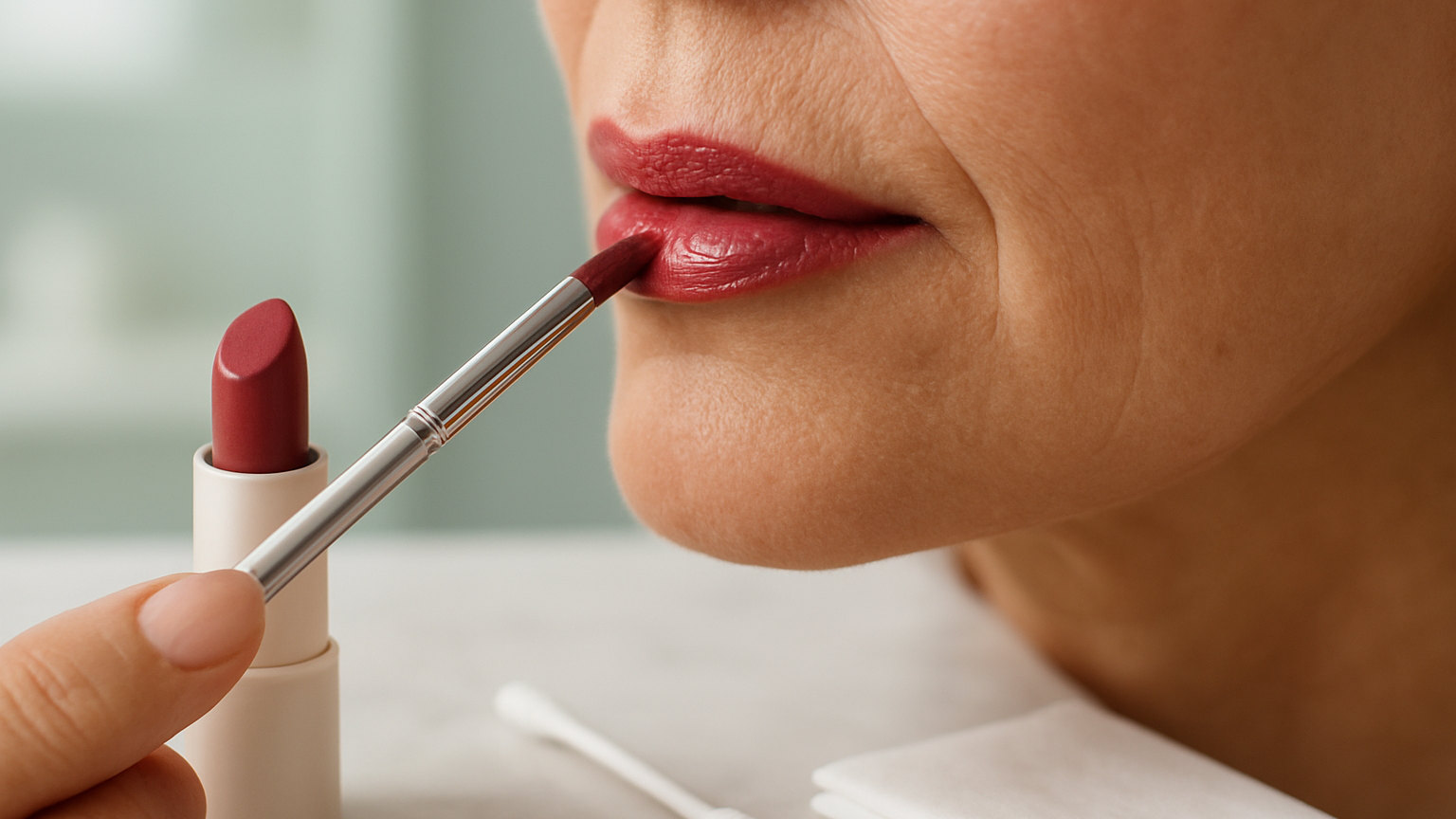
Lipstick applied to unprepared lips looks patchy regardless of the formula. Almost all of the improvement available comes before the lipstick goes on.
How should you prepare the lips?
Exfoliate gently if there is any flaking: a damp flannel, a soft toothbrush or a sugar scrub, used lightly rather than scrubbed.
Apply balm and let it absorb for several minutes, then blot away any excess. Lipstick applied over a wet layer of balm slides and will not last.
For matte formulas in particular, this step is the difference between smooth and cracked.
Overnight balm the night before does more than anything applied in the morning.
What does lip liner do?
Three things: it defines the edge, it stops colour bleeding into fine lines around the mouth, and it anchors the lipstick so it lasts considerably longer.
Fill in the whole lip with liner rather than just outlining, which is the step most people skip and the one that most affects longevity.
Match it to your lipstick or to your natural lip colour. A liner darker than the lipstick creates a visible ring as the colour wears away.
Apply after balm has absorbed and before lipstick.
Where should the line go?
Just on the natural lip line, following its shape rather than imposing a new one.
Start at the cupid's bow and work outward on each side, then the lower lip from the centre outward.
Slightly outside the natural line is acceptable for a fuller effect, and going more than a millimetre or so beyond it reads as obvious and the colour bleeds back to the true line as it wears.
Blend the inner edge of the liner inward so there is no hard boundary between liner and lipstick.
Should you use a brush?
For precision, yes, particularly with dark or bright shades where any error is visible.
A brush deposits a thinner, more even layer, which lasts longer and looks less thick.
Applying straight from the bullet is faster and works well for nudes, sheers and anything forgiving.
A brush also lets you use the last of a lipstick, which the bullet cannot reach.
Fingers work for sheer formulas and tinted balms, and give a soft blurred edge that suits a casual look.
What is the application order?
Balm, blotted. Liner, filled in across the whole lip. Lipstick applied from the centre outward.
Blot with a tissue, then apply a second thin layer, which is what makes it last.
Some people set with a translucent powder pressed through a tissue between layers for very long wear, which is effective and drying.
Clean the edges last with a small brush and concealer, which sharpens the line considerably.
How do you get a clean edge?
A small flat brush with a touch of concealer traced along the outer edge of the lip, which defines it and removes any bleed.
Use very little, since a visible pale outline is worse than a slightly soft edge.
A cotton bud is a workable substitute.
Blotting after the first layer also reduces bleeding by removing excess oil.
How do you stop it getting on your teeth?
The finger trick: after applying, put a clean finger in your mouth, close your lips around it and pull it out. It removes the product from the inner edge that would otherwise transfer.
It looks ridiculous and works reliably.
Blue-based reds also make teeth look whiter, which is a separate but related benefit.
What if your lips are uneven or thin?
Liner slightly outside the natural line on the thinner areas only, rather than all round, evens the shape without looking overdrawn.
A lighter or slightly glossy shade at the centre of the lower lip creates the impression of fullness.
Very dark and very matte shades make lips appear thinner; satin and sheer finishes do the opposite.
Overlining substantially is visible in daylight and in photographs even when it looks fine in a mirror, which is worth checking before committing to it.
How do you fix a mistake?
A cotton bud with micellar water removes a stray line without disturbing the rest, and a small brush with concealer sharpens an edge that has gone soft.
For a line that has gone too far outside on one side, it is usually better to remove the colour from that section entirely and redo it than to extend the other side to match.
If the colour has bled into fine lines, blot, then reline and apply a thinner second layer, since a thick layer is what bleeds in the first place.


