
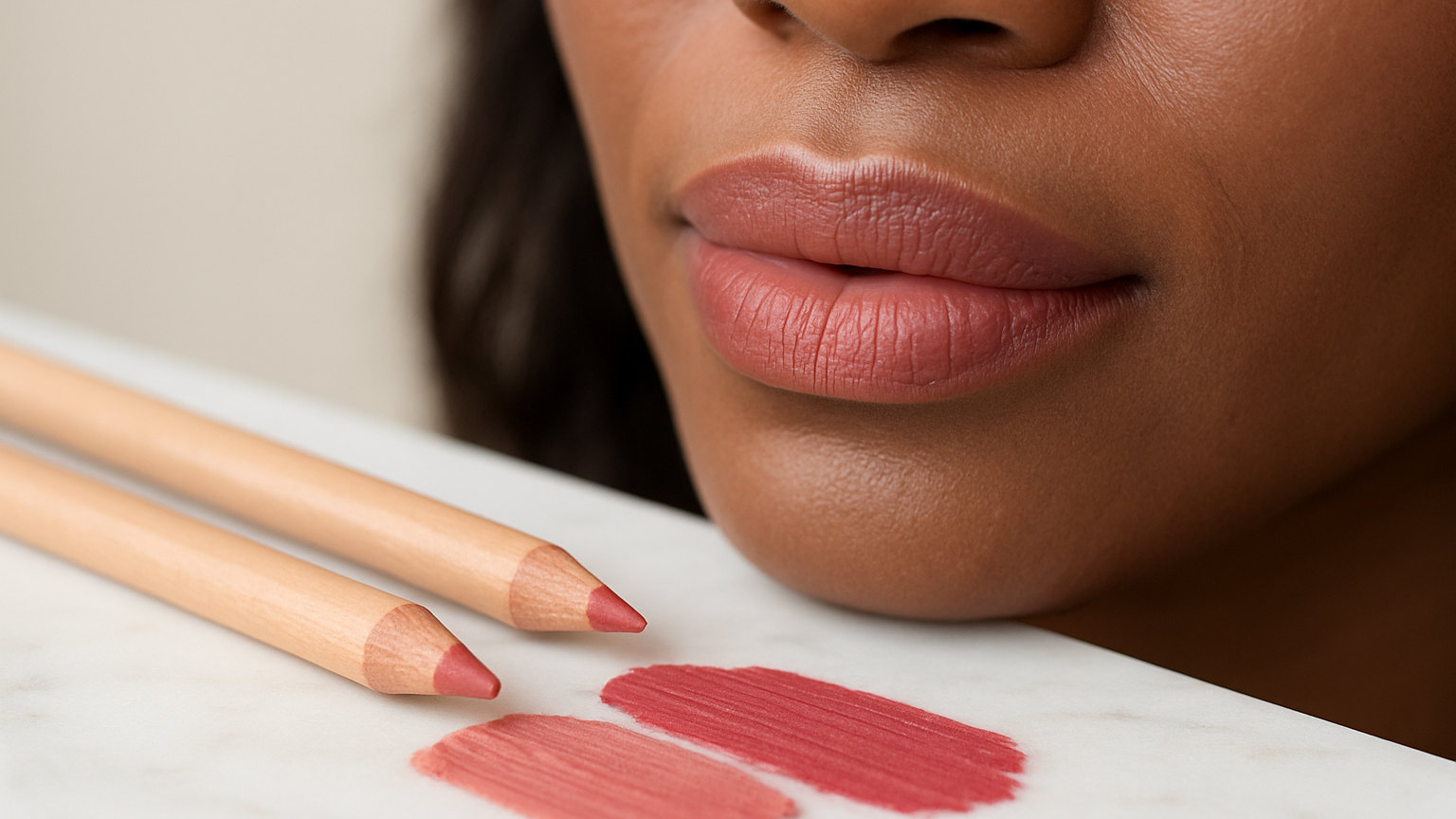
Lip liner does three jobs: it defines the edge, it stops colour bleeding into fine lines, and it anchors the lipstick so it lasts. Two shades cover almost every situation.
Which two should you own?
One matched to your natural lip colour, which works under almost any lipstick and can be worn alone or with balm.
One matched to whichever bold shade you wear most, usually a red or a berry.
That covers nudes, everyday shades and one statement look. A third in a deep brown or plum extends it further if you wear darker colours.
Collections of a dozen liners are largely unnecessary, since a liner close in tone works under a range of shades.
Should the liner match the lipstick or the lip?
The lipstick, or your natural lip colour, and never darker than the lipstick.
A liner darker than the lipstick produces a visible ring as the colour wears away from the centre, which is the most dated-looking outcome in this area and the reason liner acquired a poor reputation.
Matching the lipstick means the liner is invisible as it wears.
Matching your natural lip means it works under everything and disappears entirely when the lipstick fades.
What formula should it be?
A pencil that is firm enough to give a clean line but soft enough not to drag on the lip.
Very hard pencils tug and require pressure, which produces an uneven line and is uncomfortable.
Very soft ones smudge and lose their point, though they are easier to fill the whole lip with.
Retractable pencils never need sharpening and cannot be reshaped if the tip blunts. Traditional pencils sharpen to a fine point, which is better for precision.
Long-wear and waterproof formulas grip better and are harder to blend.
How do you use it as a base?
Fill in the entire lip surface with liner before applying lipstick, not just the outline.
This is the step that most affects longevity, and it is the one most people skip.
It creates a dry base the lipstick grips, and it means the colour remains as the lipstick wears away rather than leaving a bare centre.
A nude liner used this way extends the wear of any lipstick.
Can you wear it alone?
Yes, and it is a genuinely useful low-effort option.
Liner filled across the whole lip with a balm over the top gives a soft, long-wearing colour that looks like a stain.
Blend the outer edge inward with a fingertip so there is no hard line.
Choose a shade close to your natural lip for this, since anything much deeper looks harsh without lipstick to soften it.
How does it stop bleeding?
The waxy base acts as a physical barrier at the lip edge, preventing the oils in lipstick from travelling into the fine lines around the mouth.
This matters more with age, as the natural lip border softens and lines develop.
For heavy bleeding, a small amount of concealer or a colourless anti-feathering pencil traced just outside the lip line adds a further barrier.
Blotting the lipstick after the first layer also reduces it, since excess oil is what travels.
Where exactly should the line go?
Just on the natural lip line, following its existing shape.
Start at the cupid's bow and work outward on each side, then the lower lip from the centre out.
Blend the inner edge inward so there is no boundary between liner and lipstick.
Slightly outside the natural line is acceptable, up to about a millimetre, and beyond that it becomes visible in daylight and migrates back as it wears.
What about clear or invisible liners?
Colourless anti-feathering pencils create a waxy barrier at the lip edge without adding colour.
They work well for anyone whose only concern is bleeding, and for anyone who wears many different shades and does not want to match liners.
They do not provide the base coverage that a pigmented liner does, so they help with bleeding rather than with longevity.
Using both, a nude liner filled across the lip and a clear one at the edge, covers everything.


