
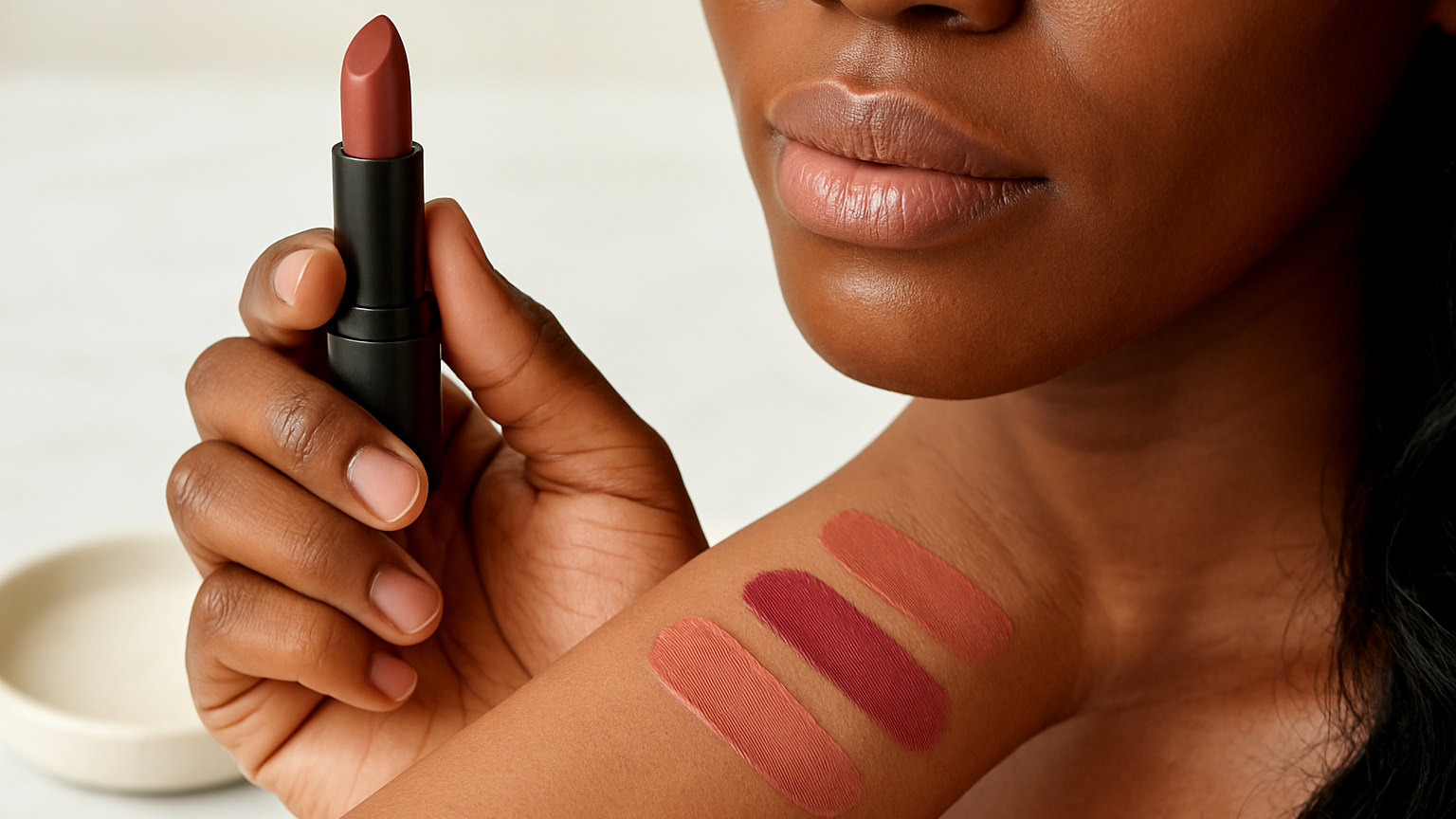
Lipstick shade selection is treated as complicated and reduces mostly to undertone. Matching the undertone of the lipstick to your own is what determines whether a shade flatters or drains.
How does undertone apply to lipstick?
Cool undertones suit lipsticks with blue, pink or purple bases: true reds, berries, plums, cool pinks and rose nudes.
Warm undertones suit orange, coral, peach and golden bases: brick reds, terracotta, warm corals and caramel nudes.
Neutral undertones can generally wear both, which is genuinely useful rather than a hedge.
Olive skin frequently suits warm browns, terracotta and deep berries, and can look sallow in pale pinks.
The same nominal shade, red for instance, exists in both families and behaves completely differently.
How do you find a red that suits you?
Reds divide into blue-based and orange-based.
Blue-based reds suit cool undertones and have the incidental benefit of making teeth look whiter, since blue counteracts yellow.
Orange-based and brick reds suit warm undertones and olive skin.
Deeper skin tones carry both, and richly saturated deep reds and berries typically read best.
Very fair skin can find a bright blue-red overwhelming, and a slightly softer cool red is more wearable.
If a red makes your teeth look yellow, it is orange-based on cool colouring.
How do you find a nude that suits you?
The commonest error is choosing a nude that is lighter than your natural lip, which produces a washed-out or concealer-lipped effect.
A nude should be roughly the same depth as your lips or slightly deeper, in your undertone family.
Fair skin suits soft pinks and beige-roses. Medium suits caramel, rose-brown and peachy nudes. Deep skin suits rich browns, chocolate and warm terracottas.
A useful shortcut is finding the colour of your lips slightly pinched, then matching or going one step deeper.
What is a your-lips-but-better shade?
The shade closest to your natural lip colour with slightly more depth or definition, which is the most universally flattering thing in this category.
It works with anything, needs no precision to apply, and suits every occasion.
Everyone has a different one, which is why a shade recommended by a friend frequently disappoints.
If you own one lipstick, this is the one to own.
How should you test it?
On your lips, not on the back of your hand, which is a different colour entirely and gives no useful information.
In daylight rather than counter lighting, which is strongly artificial.
Against a bare face, or at least without other strong colour, since blusher and eye makeup change how a lip reads.
Wear it for an hour before deciding, since some formulas shift as they settle and dry down.
If testers are not available for lips, swatching on the fingertip is closer to lip colour than the back of the hand.
Does hair colour matter?
Less than skin undertone, and it shifts the balance.
Warm hair colours pair naturally with warm lips. Cool and ash tones pair with cool.
Grey and white hair generally suits cooler, clearer shades, and can be aged by muted brownish tones.
Since hair colour changes and undertone does not, anyone finding their usual lipstick suddenly wrong after colouring their hair has found the explanation.
How does finish change the shade?
Matte formulas read deeper and more intense than the same shade in a satin or gloss.
Sheer and glossy formulas allow your natural lip colour through, so the result is a blend rather than the shade in the tube.
Metallic and frosted finishes reflect light and read lighter.
A shade that seems too dark in a matte may be exactly right in a satin, which is worth knowing before rejecting it.
What should you ignore?
Rules about which colours a person cannot wear, most of which are invented.
Matching lipstick to clothing, which dates a look faster than almost anything.
Universal shade claims, since no shade suits everyone.
And the assumption that a shade failed when the finish or the undertone was the problem rather than the colour itself.


