
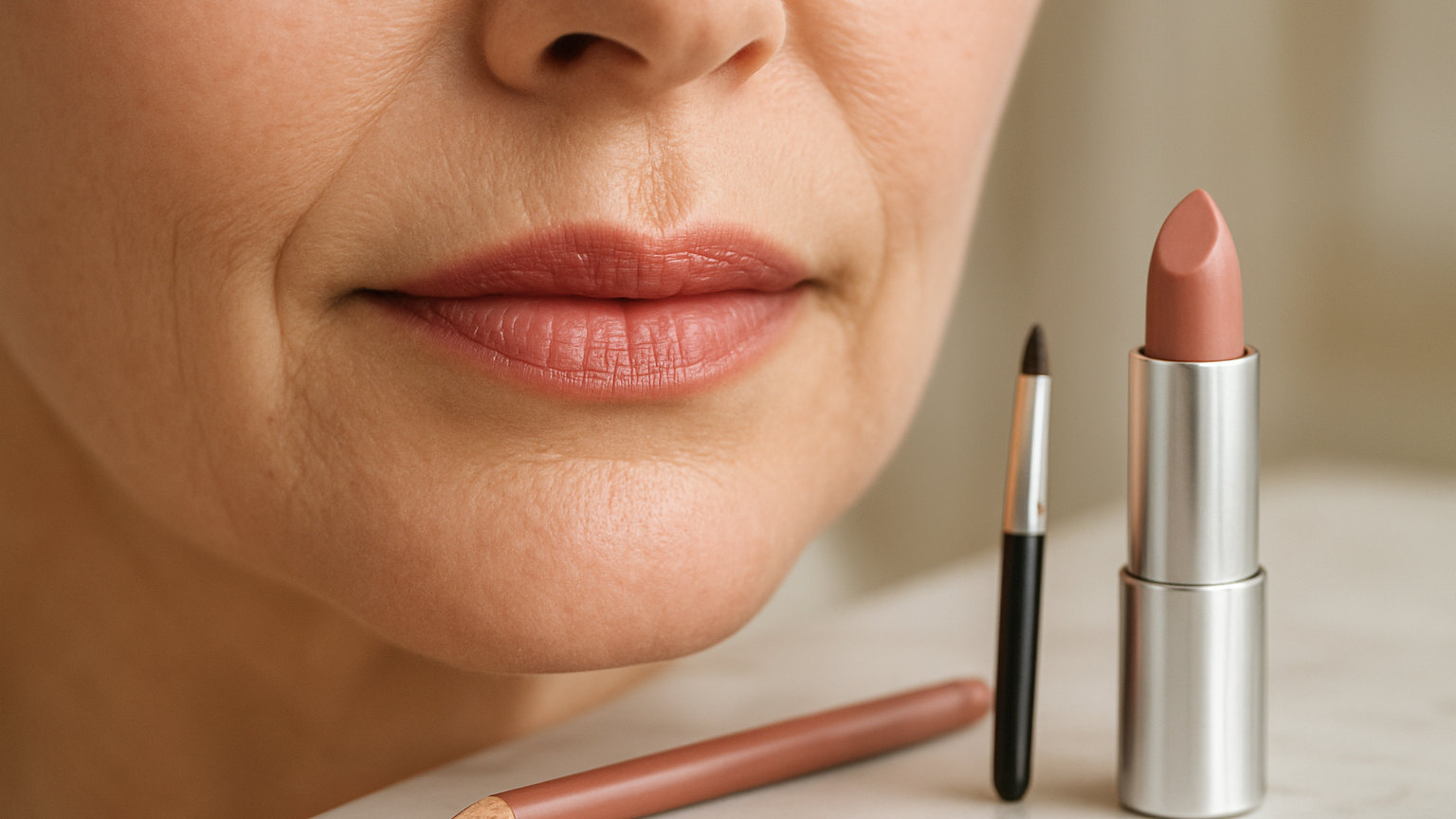
Lips lose volume gradually from the thirties onward, the border between lip and skin softens, and fine lines develop around the mouth. The useful adjustments are about finish and definition rather than about wearing duller colours.
What actually changes?
Volume reduces, so lips appear thinner, particularly the upper lip.
The vermilion border, the defined edge between lip and skin, becomes less distinct.
The philtrum, the groove above the upper lip, flattens and the distance between nose and lip lengthens.
Fine vertical lines develop around the mouth, into which lipstick travels.
Lips become drier, since they had no oil glands to begin with and the surrounding skin produces less.
Why does colour bleed?
Because the fine lines around the mouth act as channels, and the oils in lipstick travel along them.
A softened lip border means there is no longer a natural boundary stopping it.
Creamy and glossy formulas bleed more than drier ones, which is the one respect in which a matte performs better.
Applying too much product is the largest single factor.
What stops it?
Lip liner, which becomes genuinely important rather than optional. It creates a waxy barrier at the edge.
A colourless anti-feathering pencil traced just outside the lip line, which adds a further barrier without adding colour.
Concealer or foundation blended around the lip edge, which does something similar.
Blotting after the first layer, which removes the excess oil that travels.
Applying thinner layers rather than one thick one.
Which finishes suit?
Satin and cream, which reflect light and make lips look fuller.
Matte emphasises texture, dryness and lines, and makes lips appear thinner. It is not off-limits and it needs considerably better preparation.
Very glossy finishes bleed most, though a small amount of gloss at the centre of the lower lip adds dimension without the travel.
Sheer and buildable formulas are more forgiving than heavily pigmented ones, which settle into lines.
Which shades suit?
Mid-tones, generally. Very dark shades make lips look smaller and emphasise any unevenness; very pale shades wash out and can look draining.
Warm roses, soft berries, corals and mid-tone reds are widely flattering.
Blue-based shades make teeth look whiter, which becomes more relevant as teeth naturally darken.
Undertone matters more than depth, as at any age, and the shade that suited you at thirty usually still suits you.
How do you redefine the lip line?
Liner applied just on the natural line, or a fraction outside where the lip has thinned most, rather than all the way round.
The cupid's bow and the centre of the lower lip are where slight redefinition reads most naturally.
A small highlight on the cupid's bow defines the upper lip and lifts it.
Avoid substantial overlining, which is more visible in daylight than in a mirror and migrates back to the true line as it wears.
What preparation matters?
More than at any other age. Dry lips with any flaking make every formula look worse.
Overnight balm or ointment consistently, which does more than any change of lipstick.
Gentle exfoliation once or twice a week only when there is loose flaking.
SPF balm daily, since sun exposure contributes to both the lines around the mouth and to changes on the lip itself.
Blotting excess balm before applying colour, since a wet surface prevents anything sitting evenly.
What is worth remembering?
The commonest instinct is to stop wearing colour, and a defined lip does more to lift the face than almost anything else in makeup.
Preparation, liner and a satin finish resolve most of the practical problems.
And none of this is about correction. Different formulas simply behave differently on lips that have changed, which is a technical matter rather than a reason to wear less.
Do the lines around the mouth respond to anything?
Partially, and it is worth separating what makeup does from what skincare does.
A retinoid used consistently around the mouth improves fine lines over six to twelve months, and sunscreen prevents further development. Both work slowly and genuinely.
Smoking is the single largest contributor to vertical lip lines beyond sun exposure, through both the repeated pursing and the effect on collagen.
Filler and resurfacing treatments address established lines and are clinical procedures rather than anything a product achieves.


