
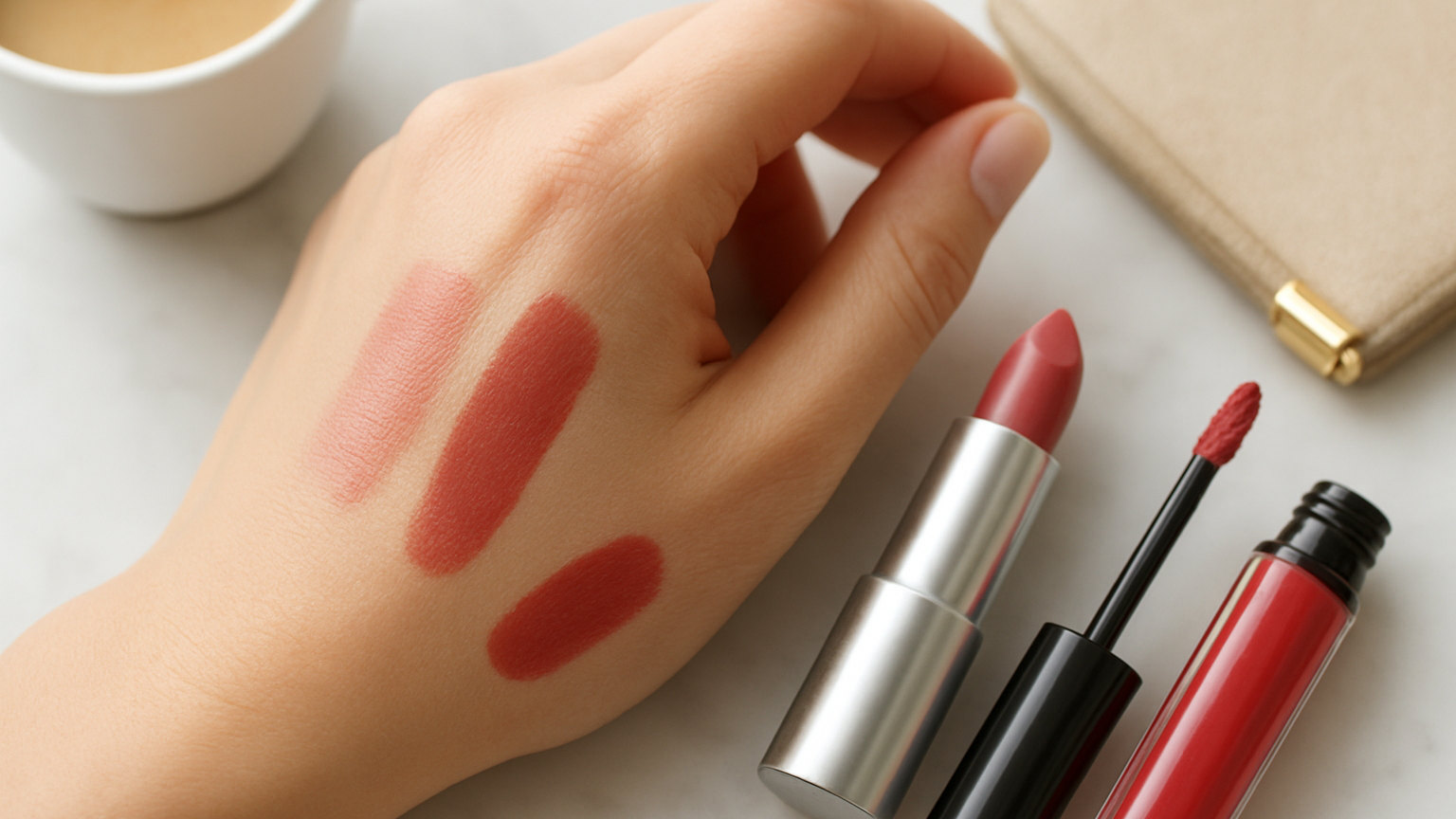
The commonest reason people abandon lipstick is wearing the wrong formula for the day rather than the wrong colour. A comfortable satin will not survive a wedding, and a liquid matte is unpleasant for a Tuesday.
What suits an ordinary day?
A tinted balm or a sheer satin in a shade close to your natural lips.
Comfortable enough to forget about, forgiving of imprecise application, and easy to reapply without a mirror.
These need reapplying every few hours, which is fine when you are not thinking about it.
The your-lips-but-better shade earns its reputation here more than anywhere.
What suits work?
A satin or cream bullet over a matching liner, which lasts through a morning and reads as deliberate without being loud.
Mid-tone shades: rose, berry, muted coral, warm nude.
Avoid heavy gloss, which transfers onto cups and requires attention, and very bold shades if your workplace is conservative and you would rather not think about it.
Keep the product in a bag rather than at home, since a midday reapplication is what keeps it looking intentional.
What suits a long day or an event?
The full layering method: balm blotted, liner filled across the whole lip, a thin layer of colour, blotted, then a second layer.
A long-wear or liquid matte formula if you will not be able to reapply.
A stain if you want colour that survives eating with no attention at all.
Carry the liner as well as the lipstick, since the inner edge wears first.
Balm in the bag for afterwards, since long-wear formulas leave lips dry.
What suits a wedding or something photographed?
A defined edge, since soft or unlined lips lose definition entirely in photographs.
Slightly more saturated than everyday, since cameras desaturate colour.
A satin rather than a heavy matte, which reads as flat, or a heavy gloss, which reads as shine.
Transfer-proof matters for anyone who will be hugging a great many people.
Test it in a flash photograph beforehand, which is the only reliable check.
What suits eating and drinking?
A stain, which sits in the surface layers and survives a meal.
Or a liquid matte fully set, which resists transfer once dry.
Neither survives greasy food entirely, and both do considerably better than a cream bullet.
Blotting before eating removes the layer that would have transferred, which is a small habit that makes a visible difference.
Drinking through a straw transfers less than drinking from a glass rim.
What suits hot weather?
Lighter formulas, since heat softens wax-based bullets and they slide and bleed.
Stains and tinted balms with SPF, which is worth having on lips in summer regardless.
Avoid heavy gloss, which attracts hair and dust in wind.
Reapply more often, since heat shortens the wear of every formula.
What suits cold weather?
Comfortable, hydrating formulas, since cold and wind chap lips and matte formulas emphasise every flake.
Satin and cream bullets over liner, or a tinted balm.
Avoid liquid mattes in winter unless the occasion demands it, since they will crack on lips that are already dry.
Overnight balm becomes more important than anything applied during the day.
What should you carry?
The lipstick, a plain balm and, for anything long, the liner.
A tissue for blotting, which is more useful for touch-ups than more product.
A small mirror, since a bold shade cannot be reapplied blind.
And for anyone who finds themselves reapplying constantly, the honest fix is a different formula rather than a bigger bag.
What suits exercise?
A tinted balm with SPF for anything outdoors, or a stain if you want colour that survives sweat.
Avoid gloss, which attracts hair and dust, and avoid heavy bullets, which soften and transfer.
Plain balm afterwards, since sweating and mouth breathing both dry the lips considerably.
What about travel?
Cabin humidity sits around ten to twenty per cent, which is lower than most deserts, so a heavy ointment is worth more than any colour on a flight.
A stain or tinted balm applied before landing gives colour without needing a mirror, and long-wear formulas are uncomfortable in that dryness.


