
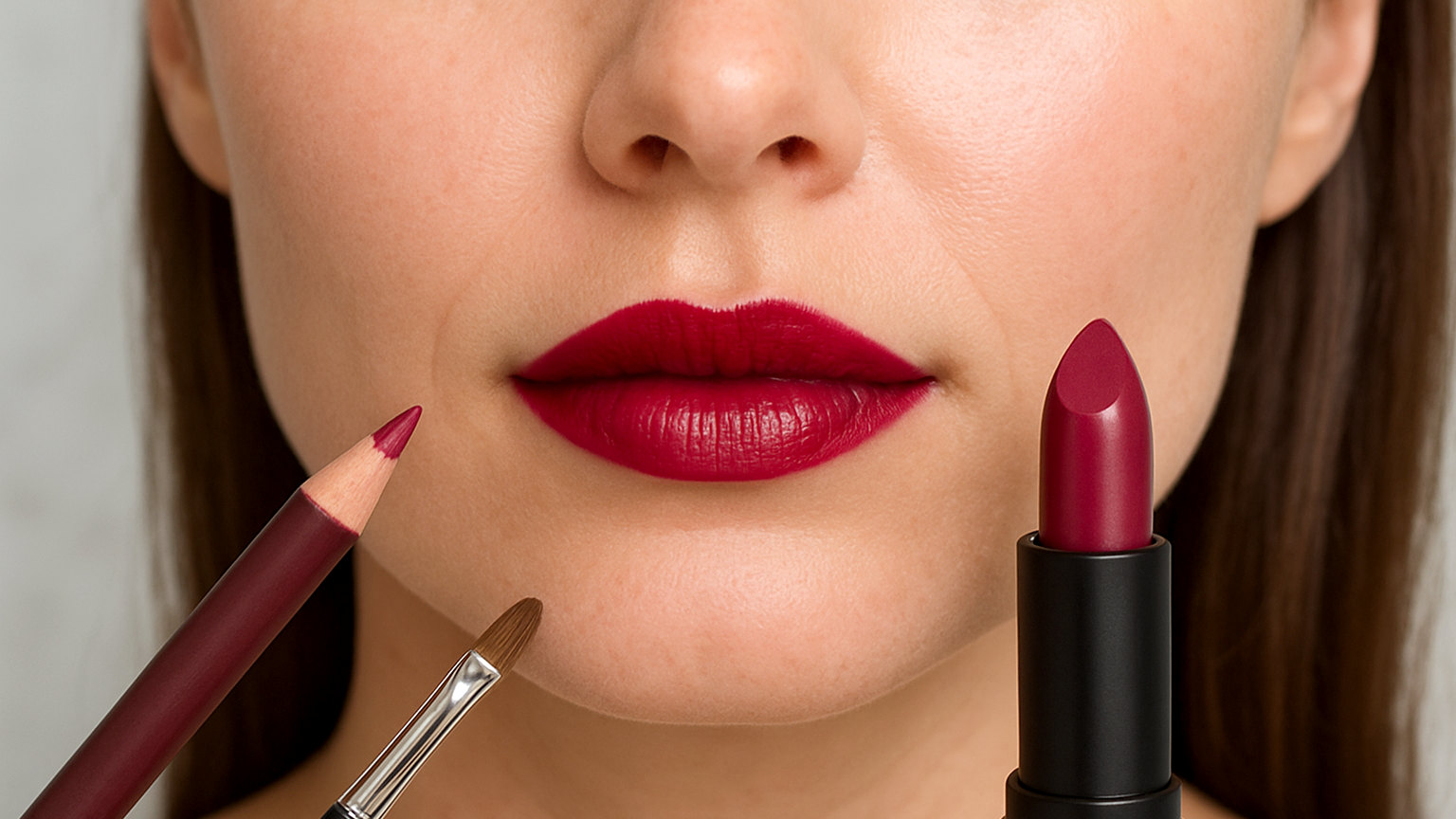
A bold lip is one of the fastest ways to look put together and one of the least forgiving of imprecision. The two things that make it work are a clean edge and restraint everywhere else.
How do you balance the rest of the face?
One focal point. A strong lip with a strong eye and heavy contour reads as a great deal at once.
With a bold lip: neutral eyes, a light wash of shadow at most, defined lashes and brows, and blusher kept soft.
Skin should be even rather than heavily made up, since a bold lip draws attention to the whole face.
A little more blusher than you think, since a strong lip can otherwise leave the rest of the face looking pale by comparison. Keep it in the same temperature family as the lip.
How do you get a clean edge?
Lip liner, matched to the lipstick, applied along the natural line and filled across the whole lip.
Apply with a brush rather than from the bullet, which gives considerably more control with dark and bright shades.
Clean up the outer edge with a small flat brush and a touch of concealer, which sharpens the line and removes any bleed.
Work in good light, since a bold lip shows every imprecision that bathroom lighting hides.
Blot after the first layer and apply a second, which reduces bleeding and increases wear.
Which shade should you start with?
A red matched to your undertone, since red is the most versatile bold shade and suits almost everyone in the right base.
Blue-based reds for cool undertones, which have the incidental benefit of making teeth look whiter.
Orange and brick-based reds for warm undertones and olive skin.
Deep skin tones carry richly saturated reds, berries and deep browns particularly well.
A satin finish is more forgiving than a matte for a first attempt, since it settles more evenly and is less unforgiving of dry patches.
What about darker shades?
Deep berries, plums and browns are more wearable than they look and need the same precision as red.
They make lips appear smaller, so a satin finish and a highlight at the centre of the lower lip counteracts that.
They also show wear more obviously, so blotting and layering matters.
Very dark shades can be sheered out with a fingertip for a stained effect, which is considerably easier to wear daily.
How do you make it wearable in daylight?
Sheer it out. Apply with a fingertip and blend outward rather than lining precisely, which gives a soft stain rather than a defined lip.
Blot heavily after applying, leaving colour without weight.
Choose a satin over a matte.
Keep the rest of the face minimal, which makes a strong colour read as deliberate rather than dressed up.
How do you keep it off your teeth?
The finger trick: after applying, put a clean finger in your mouth, close your lips around it and pull it out, which removes product from the inner edge.
Blue-based shades make teeth look whiter; orange-based shades emphasise any yellow.
Check in a mirror after eating or drinking, since the inner edge is where it migrates first.
What preparation matters?
More than for any other lip product. Bold shades show every flake, crack and dry patch.
Exfoliate gently the night before, apply balm overnight, and blot thoroughly before applying colour on the day.
Do not apply over a wet layer of balm, which prevents the colour setting evenly.
What if you feel self-conscious?
Start with a sheered-out version worn on an ordinary day rather than a full application for an event, which is how most people discover they are comfortable with it.
The perception that a bold lip is noticeable is usually correct and considerably smaller than it feels from behind your own face.
And a shade that suits your undertone reads as intentional rather than loud, which is why the undertone question matters more here than anywhere else in makeup.


