
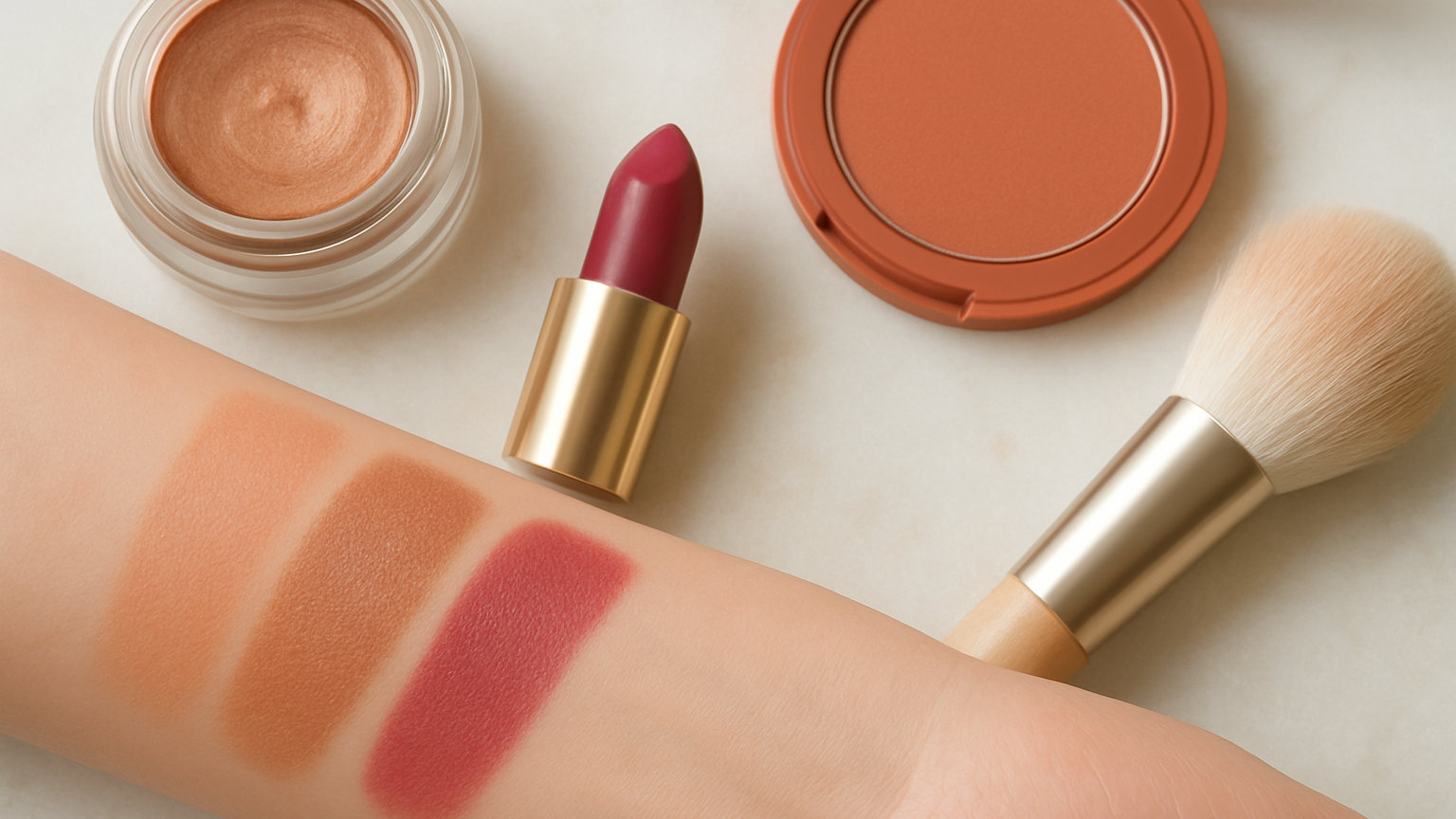
A makeup look that works is usually the result of two decisions made before anything is applied: where the attention goes, and whether the colours belong together. Everything else is execution.
Why choose one focal point?
Because a face with a strong eye, a strong lip and heavy contour has nowhere for the eye to settle, and reads as a great deal at once.
Choosing one feature to emphasise and keeping the others supporting gives the face a structure.
A bold lip with soft neutral eyes. Or a defined eye with a lip close to your natural colour. Both read as deliberate.
This is the single most useful principle in makeup and the one most often ignored when trying something new.
What does supporting mean?
Not absent. A bold lip with no eye makeup at all frequently looks unfinished rather than balanced.
Supporting features still need definition: brows shaped, lashes curled and coated, skin even, a soft flush of blusher.
The difference is between features that are present and features that compete.
Blusher in particular needs increasing rather than reducing alongside a bold lip, since a strong colour on the mouth otherwise leaves the rest of the face looking pale.
How do you keep colours harmonious?
Keep the temperature consistent. Warm blusher with warm lips and warm bronzer; cool with cool.
Mixing a cool pink blusher with a warm coral lip is the commonest reason a face looks slightly off without an obvious cause.
Neutrals sit with everything, which is why they dominate everyday makeup.
Undertone applies here as it does to individual products, and the same principle that governs shade choice governs how shades sit together.
How do you plan for the occasion?
Daylight and close conversation call for less: sheer coverage, soft definition, minimal shimmer.
Evening and artificial light call for more, since dim light flattens the face and washes out colour.
Photography calls for more definition than looks correct in a mirror, since cameras flatten dimension.
Long days call for formula choices rather than different colours: long-wear products, blotting papers and a plan for touch-ups.
Where should you start?
With the decision, not the products. Knowing whether the eye or the lip is the focus determines everything after it.
Then eyes first if you are using dark or shimmery shadow, since fallout is easier to clean before foundation.
Then base, then cheeks, then lips.
Starting with foundation and deciding afterwards is how faces end up with three focal points.
How do you adapt a look you have seen?
Identify what is actually creating the effect, which is usually placement rather than colour.
Check whether the person has similar colouring and features, since the same shade behaves differently on different undertones and the same placement behaves differently on different eye shapes.
Take one element rather than the whole thing, which is more likely to work and easier to correct.
And allow for the fact that most images have been photographed under controlled lighting and frequently edited, so the reference is not a realistic target.
How do you know when to stop?
Step back a metre and look at the whole face rather than at each feature.
Check in daylight, which reveals heaviness that bathroom lighting hides.
Ask whether anything is competing with the focal point, and remove or soften rather than adding to balance it.
The instinct when something looks wrong is to add, and the answer is usually to take away.
What should a beginner practise?
One look, repeatedly, until it is fast. Repetition is what makes makeup quick, and variety is what makes it slow.
Skin, brows and lashes first, since those three do most of the work and are the hardest to skip.
Add one new element at a time rather than attempting a full look from a tutorial.
And practise on a day when it does not matter, since learning under time pressure before leaving the house is how people conclude they are bad at it.


