
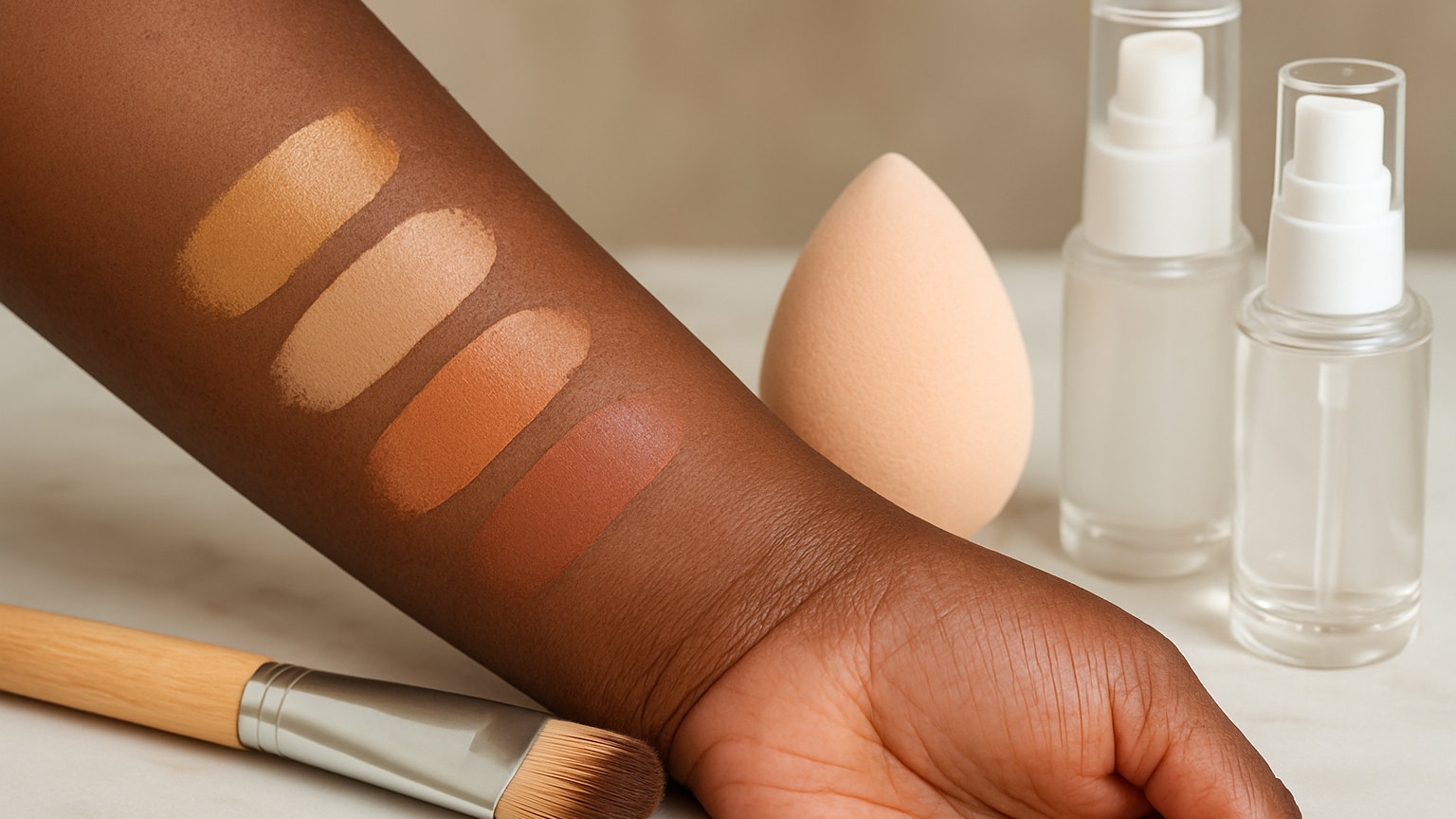
Shade ranges have expanded considerably, and the number of shades is not the same as the number of undertones. A range with forty shades that are all yellow-based serves fewer people than one with twenty spanning properly different undertones.
Why does undertone matter more than depth?
Because deeper skin has a wider range of undertones than lighter skin, including red, golden, olive, neutral and blue-based, and a foundation matched only on depth reads grey, ashy or orange.
Ashiness is the commonest complaint and results from a foundation lacking the red or golden warmth present in the skin.
Testing along the jawline in daylight is the only reliable method, and swatching three shades side by side shows which disappears.
Many deeper skin tones need a foundation with more red than expected, which is why yellow-only ranges disappoint.
What about oxidation?
It affects deeper shades particularly noticeably, since the pigment load is higher and any darkening or orange shift is more visible.
Test by applying a swatch and waiting thirty minutes rather than deciding at the counter.
If a shade matched perfectly on application and looks orange by lunchtime, oxidation is the explanation rather than a bad match.
How does colour correcting differ?
The correctors are deeper. Peach, which works on lighter skin, is too pale to counteract deeper under-eye pigmentation.
Orange, deep orange and red-brown correctors are what work, matched to the depth of the skin.
Green correctors for redness need to be deeper and more muted, since a bright green reads grey.
Applied thinly and covered with concealer, correctors do considerably more than concealer alone.
Which concealer shade?
Close to your skin tone for blemishes, since lighter concealer on a spot draws the eye.
Half a shade to one shade lighter under the eyes, and no more, since substantial lightening produces a grey cast on deeper skin rather than brightness.
The advice to go two or three shades lighter for brightening comes from lighter-skin practice and does not transfer.
Warm-toned concealers generally read more natural than neutral ones.
Which blusher and lip shades work?
Richly saturated pigment rather than muted pastels, which disappear or turn chalky.
Blusher: berry, brick, deep coral, plum, bright orange and terracotta, all of which read beautifully.
Lips: deep reds, berries, plums, brick, chocolate and rich browns for nudes.
Nude lip shades should be the same depth as your lips or slightly deeper, in a rich brown or caramel rather than a beige, which reads as concealer.
Pigment density matters, so a product that swatches faintly on the back of the hand will disappear entirely.
How do bronzer and contour differ?
Both need to be genuinely deeper rather than merely warm, and many ranges do not go far enough.
Contour should be cool or neutral and two shades deeper: rich espresso and deep cool browns.
Bronzer should be warm and deeper: deep amber, copper, rich terracotta.
Anything too light or too grey reads as dust rather than shadow, which is the equivalent of the ashy problem on the cheeks.
What about eyeshadow?
Deep skin carries saturated colour and metallics exceptionally well: jewel tones, bright pigments, gold, bronze and copper.
Very pale matte shades can look chalky, and a mid-tone works better than a very light one for the brow bone.
Pigment payoff matters more than shade name, since poorly pigmented formulas simply do not show.
Primer helps considerably, since it intensifies whatever goes over it.
What should you avoid?
Unregulated skin lightening products, which frequently contain mercury or potent steroids and cause lasting harm including skin thinning, permanent pigmentation changes and systemic effects. They are marketed hardest at exactly the people most affected by pigmentation.
Foundations chosen on depth alone without checking undertone.
Powders with a heavy white cast, which cause flashback in photographs and a grey finish in daylight. Look for translucent powders formulated for deeper skin.
And assuming a technique has failed when it was written for different colouring, since a good deal of standard makeup advice was.


