
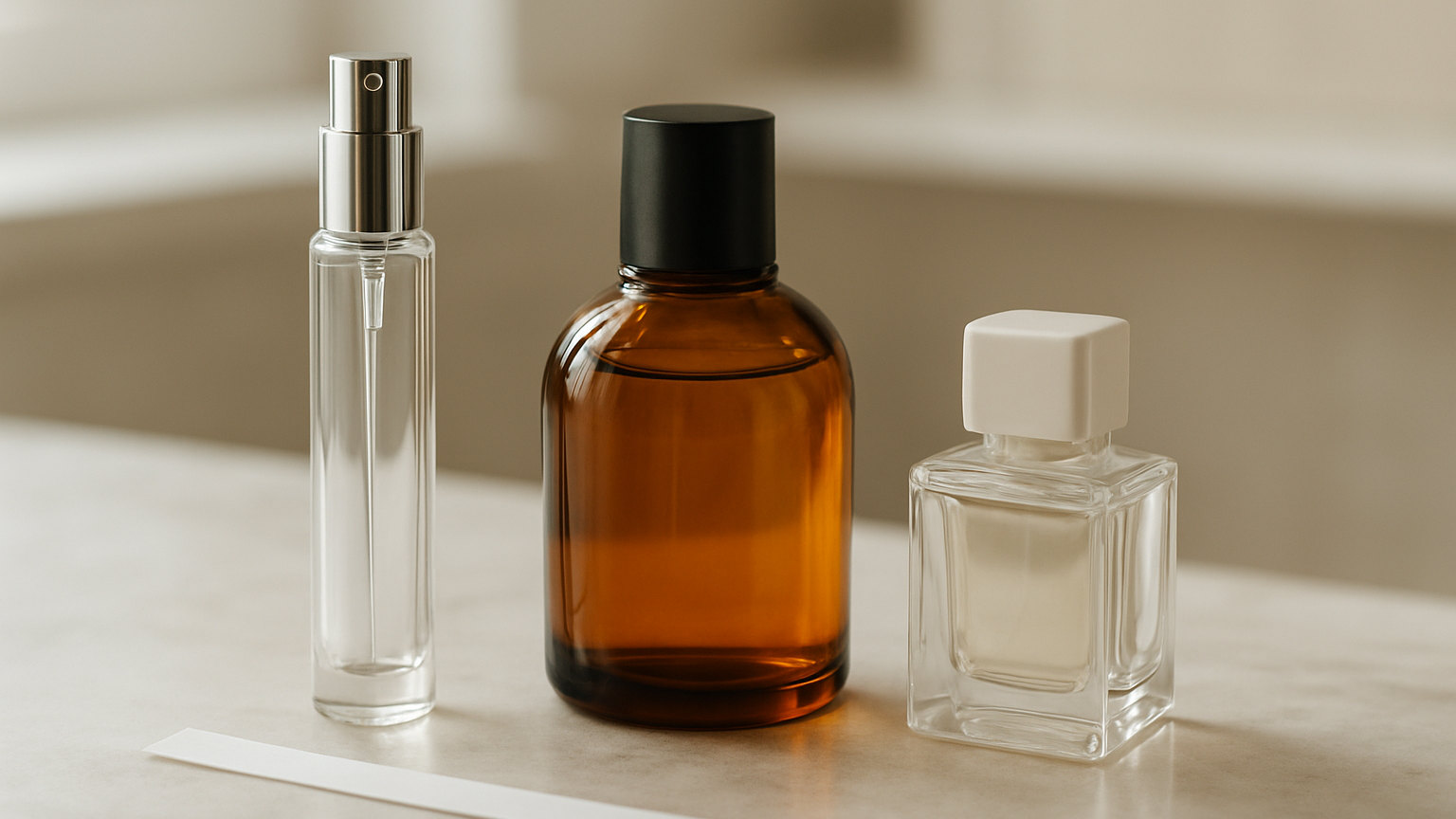
Fragrance collections grow faster than they are used, and the constraint people forget is that an opened bottle degrades over three to five years regardless of whether anyone wears it.
How many do you actually need?
Two or three covers most people: something light for daytime and work, something warmer for evening, and one you simply enjoy.
A fourth for hot weather and a fifth for cold refines it further.
Beyond about six, most bottles will degrade before they are finished, which is the practical limit rather than a matter of restraint.
Owning many is a hobby rather than a wardrobe, which is a legitimate thing to enjoy as long as that is what it is.
What size should you buy?
Thirty or fifty millilitres for anything but a genuine long-term favourite.
A hundred millilitre bottle of eau de parfum contains roughly a thousand sprays, which at two sprays a day is well over a year of daily wear.
For anything worn occasionally, a hundred millilitres will not be finished before it turns.
Larger bottles are better value per millilitre and worse value overall if half is wasted.
How do you identify a gap?
Look at what you reach for and when, rather than at what the collection lacks in theory.
Common genuine gaps: something light enough for the office, something that works in hot weather, something for evening that is not the same as daytime.
Common false gaps: another fragrance in a family you already own three of, or something bought because it was widely praised.
If you cannot describe the occasion a new fragrance would fill, it is not a gap.
How do you avoid duplication?
Note the dominant notes of what you own, which frequently reveals that four bottles are variations on the same theme.
Smell your existing collection before shopping, since olfactory memory is poor and people buy things very close to what they already have.
Take a sample of a candidate and wear it alongside the nearest thing you own, which shows whether it is genuinely different.
Fragrance databases list notes, which makes comparison straightforward.
How do you use what you have?
Rotate deliberately rather than defaulting to one, since olfactory fatigue means a fragrance worn daily stops registering.
Keep the bottles visible, since anything in a cupboard is forgotten, while balancing that against light exposure. A drawer you open daily is the compromise.
Use the body products, since layering extends what you have.
Use them on ordinary days rather than saving them, which is how bottles turn unopened.
What should you do with what you do not wear?
Be honest about whether you will. A fragrance untouched for a year usually will stay untouched.
Pass it on, since a bottle someone else will enjoy is worth more than one degrading in a drawer.
Use it on clothing, in drawers or on a scarf, where a less-loved fragrance still has a use.
Selling partially used fragrance is possible through specialist forums and is a hassle for modest return.
How do you explore without accumulating?
Discovery sets and decant services, which sell small quantities of many fragrances and are by a distance the most sensible way to try things.
Samples from counters, which most will provide if asked.
Splitting a bottle with someone, which is common in fragrance communities.
Wearing a sample for a full week before considering a bottle, which eliminates most impulse purchases.
What is worth spending more on?
The fragrance you wear most, where a higher concentration genuinely improves the experience.
Materials rather than packaging, which is why some niche houses offer better value than designer releases despite higher prices.
Where it is rarely justified: a large bottle of something unfamiliar, a limited edition bought for the bottle, or a fragrance bought because it is being heavily advertised.
And a fragrance you have not worn for a full day is not something to spend anything on yet.


