
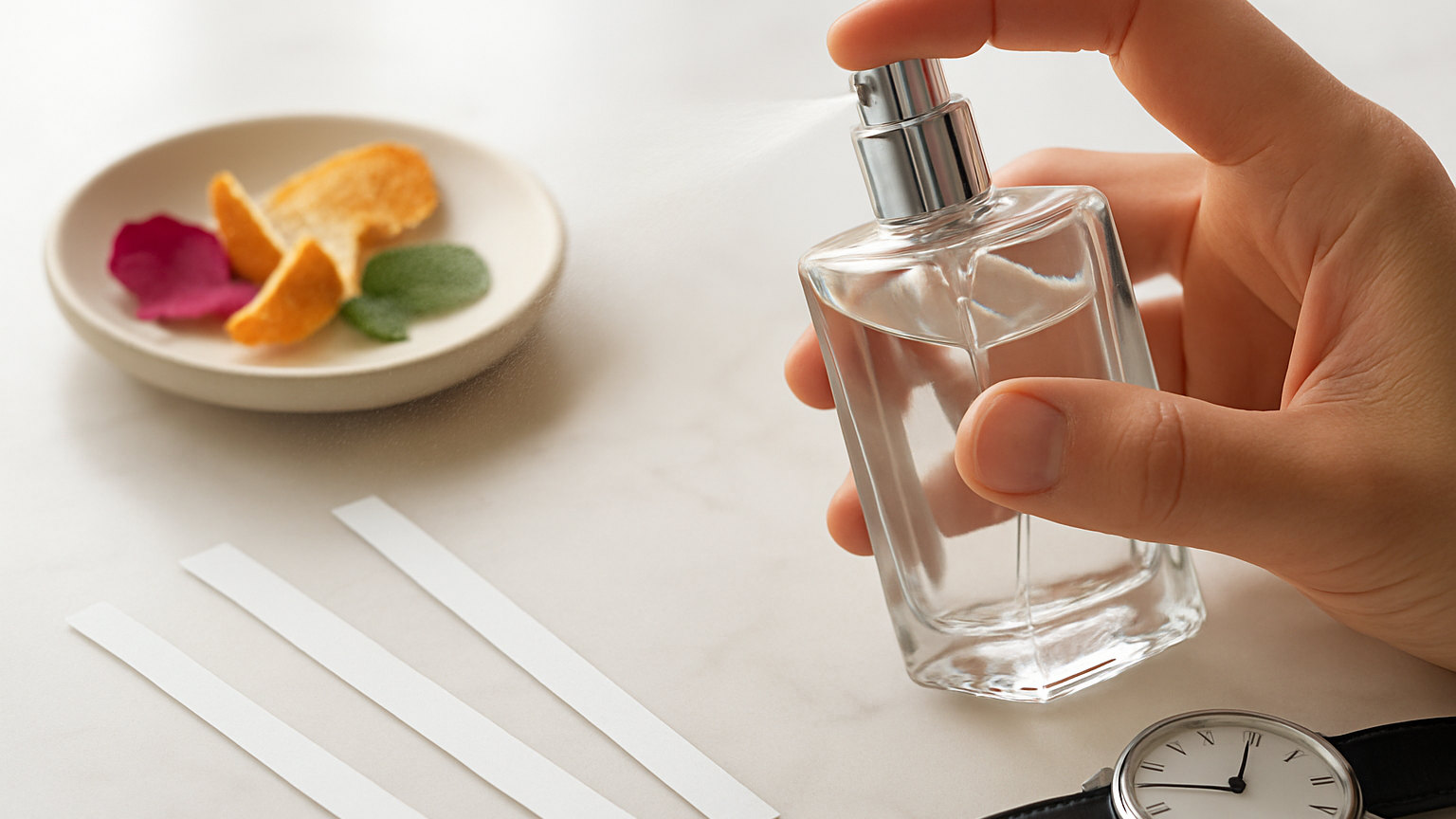
Perfume is bought in ten minutes and worn for years, which is the wrong way round. Almost every regretted bottle comes from deciding at the counter, on skin that has been sprayed four times already.
Why can you not decide at the counter?
Because top notes last fifteen to thirty minutes, and what you smell in the shop is almost entirely top notes.
The heart emerges over the following hours and the base after that, and the base is what you will actually be wearing most of the time.
Fragrances that are appealing in the first minute and unpleasant four hours later are extremely common.
The counter is also saturated with other scents, which distorts everything.
How should you test?
On skin, not paper. Blotters show the composition but not how it interacts with you.
One or two at a time, maximum, on different wrists or on a wrist and an inner elbow.
Leave it for at least four hours, and ideally a full day, before deciding.
Do not rub the wrists together, which crushes the molecules and distorts the development.
Go back to the shop another day rather than buying on the first visit.
How do you reset your nose?
Olfactory fatigue sets in after three or four fragrances, after which everything smells similar.
Step outside for a few minutes, which works better than anything in the shop.
Coffee beans are traditional and have little evidence behind them; smelling your own skin or clothing is more effective.
Limit yourself to three or four per visit and accept that the fifth will not register properly.
What should you know before going?
Which scent families you already like, since that narrows the field enormously.
The main families are floral, oriental or amber, woody, fresh and fougere, each with sub-groups.
Look at what you already own and enjoy, including candles and toiletries, and identify the common notes.
Saying to a counter assistant that you like woody and spicy scents and dislike heavy florals is more useful than asking what is popular.
How do samples work?
Most counters will give samples if asked, and it is worth asking rather than assuming they are for regular customers.
Decant services and sample sets sell small quantities of many fragrances, which is by far the most sensible way to explore.
Wearing a sample for several days in different conditions tells you considerably more than any counter visit.
A fragrance that survives a week of samples is one worth buying a bottle of.
What affects how it smells on you?
Skin chemistry: pH, oiliness, temperature and diet all change how a fragrance develops.
Oily skin holds scent longer and can amplify base notes. Dry skin releases it faster.
Medication and hormonal changes, including pregnancy, alter both how a fragrance smells and how you perceive it.
This is why a recommendation from someone else is a starting point rather than an answer.
What about buying online?
Reasonable for something you already know, and a gamble otherwise.
Sample first, from a decant service if the fragrance is not easily found in person.
Counterfeit perfume is widespread on marketplace sites, and it is a genuine safety matter as well as a quality one, since fakes have been found to contain unlisted allergens and contaminants.
Buy from the brand, a department store or an established retailer, and treat a heavily discounted current release with suspicion.
What should you avoid?
Buying on the first sniff, which is the main one.
Buying because it smells good on someone else.
Testing more than three or four in a session.
Buying a large bottle of something unfamiliar, since a thirty millilitre bottle of something you love is better than a hundred of something you tire of.
And buying blind from an online marketplace, which combines every risk on this list.
How many should you own?
Fewer than most collections contain, since an opened bottle lasts around three to five years and most people cannot get through several in that time.
Two or three covers most needs: something light for daytime, something warmer for evening, and one you simply enjoy.
Thirty or fifty millilitre bottles are more sensible than a hundred for anything but a genuine favourite.
What if you cannot wear fragrance?
Fragrance allergy and sensitivity are common, and headaches, sneezing and skin reactions are legitimate reasons to avoid it entirely.
Applying to clothing rather than skin reduces skin contact, and hair mists are gentler than direct application.
Many workplaces, particularly in healthcare, are fragrance-free for colleagues who react, which is a health matter rather than a preference.
Anyone with a reaction to a specific fragrance can ask for an ingredient breakdown, and patch testing through a GP referral identifies the allergen.


