
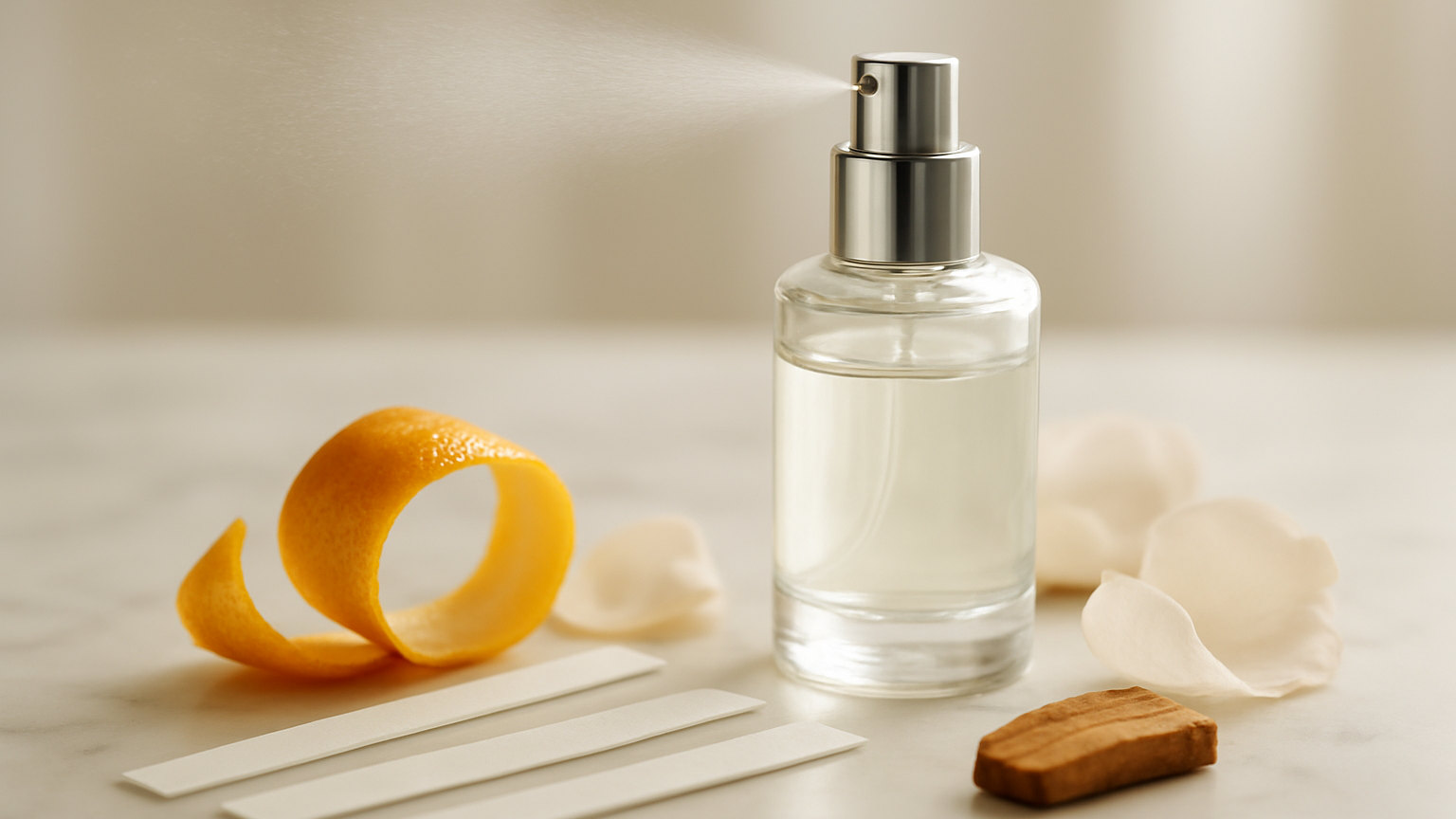
Perfume is a mixture of aromatic molecules dissolved in alcohol, and the reason a scent changes over the hours you wear it is that those molecules evaporate at different rates.
What are top, heart and base notes?
Top notes are the smallest, most volatile molecules, which reach you first and disappear within fifteen to thirty minutes. Citrus, light herbs and aquatic notes typically sit here.
Heart or middle notes emerge as the top notes fade and last two to four hours. Florals, spices and green notes usually.
Base notes are the heaviest molecules, evaporating slowest, lasting six hours or considerably longer. Woods, resins, musks, vanilla and amber.
This structure is called the fragrance pyramid, and it is why judging a perfume in the first two minutes tells you almost nothing about what you will be wearing.
What does the concentration mean?
The proportion of aromatic compounds dissolved in the alcohol, which determines both intensity and longevity.
Parfum or extrait, around twenty to thirty per cent, lasting six to eight hours or more.
Eau de parfum, around fifteen to twenty per cent, lasting four to six hours. The most common format.
Eau de toilette, around five to fifteen per cent, lasting two to four hours.
Eau de cologne, around two to five per cent, lasting up to two hours.
A higher concentration is not automatically better. The same name at different concentrations is frequently a different composition rather than simply a stronger one.
Why does it smell different on other people?
Skin chemistry, which is real rather than marketing.
Skin pH, sebum production, temperature, diet, medication and hormones all affect how molecules evaporate and interact.
Oily skin holds fragrance longer and can amplify base notes; dry skin releases it faster and can make a scent seem lighter and shorter-lived.
This is why testing on your own skin rather than on paper or on someone else is the only reliable method.
What are sillage and projection?
Projection is how far the scent travels from you at a given moment.
Sillage is the trail left behind as you move, from the French for wake.
Longevity is how long it lasts on skin, which is a separate property. A fragrance can last eight hours while projecting very little.
Heavy base notes such as oud, amber and musk generally produce more sillage; citrus and light florals less.
Why does it disappear on you?
Olfactory fatigue, most commonly. The nose stops registering a constant smell within minutes, which is a normal neurological adaptation.
Other people can still smell it clearly, which is why over-applying because you can no longer detect it is a common error.
Genuinely short longevity is more often a dry skin issue, a low concentration, or a composition dominated by top notes.
Applying to moisturised skin extends it considerably, since fragrance clings to oil rather than to dry skin.
What is a fragrance actually made of?
Natural materials: essential oils, absolutes and extracts from flowers, woods, resins and fruits.
Synthetic aroma molecules, which make up the majority of modern perfumery. They are not inferior; many notes cannot be extracted naturally, and synthetics allow scents that do not exist in nature.
Alcohol as the carrier, plus water and a small amount of fixative.
Some natural materials are restricted for sustainability or allergy reasons, which is why classic fragrances are periodically reformulated.
Why do fragrances get reformulated?
Regulation, principally. The industry body restricts materials found to cause allergic reactions, and some are limited or banned outright.
Sustainability and supply, since some natural materials have become scarce or protected.
Cost, which drives substitution of expensive naturals with synthetics.
The practical consequence is that a bottle bought today may smell different from one bought fifteen years ago under the same name, which is a common and genuine complaint rather than imagination.
Does perfume go off?
Yes, though slowly. An unopened bottle stored well lasts several years; an opened one typically three to five.
Light, heat and air are what degrade it, which is why a bottle on a sunny bathroom windowsill deteriorates far faster than one in a drawer.
Signs it has turned are a darker colour, a sour or metallic opening note, and top notes that have vanished entirely, leaving only the base.
Citrus-led fragrances turn fastest; heavy oriental and woody compositions last longest and occasionally improve.
How should you store it?
In the box, in a cool dark place, away from radiators, windows and the bathroom.
Upright, with the cap on, since air exchange is what oxidises the composition.
Decanting into a travel atomiser is fine for short-term use and shortens the life of what is decanted, so decant what you will use rather than half the bottle.


