
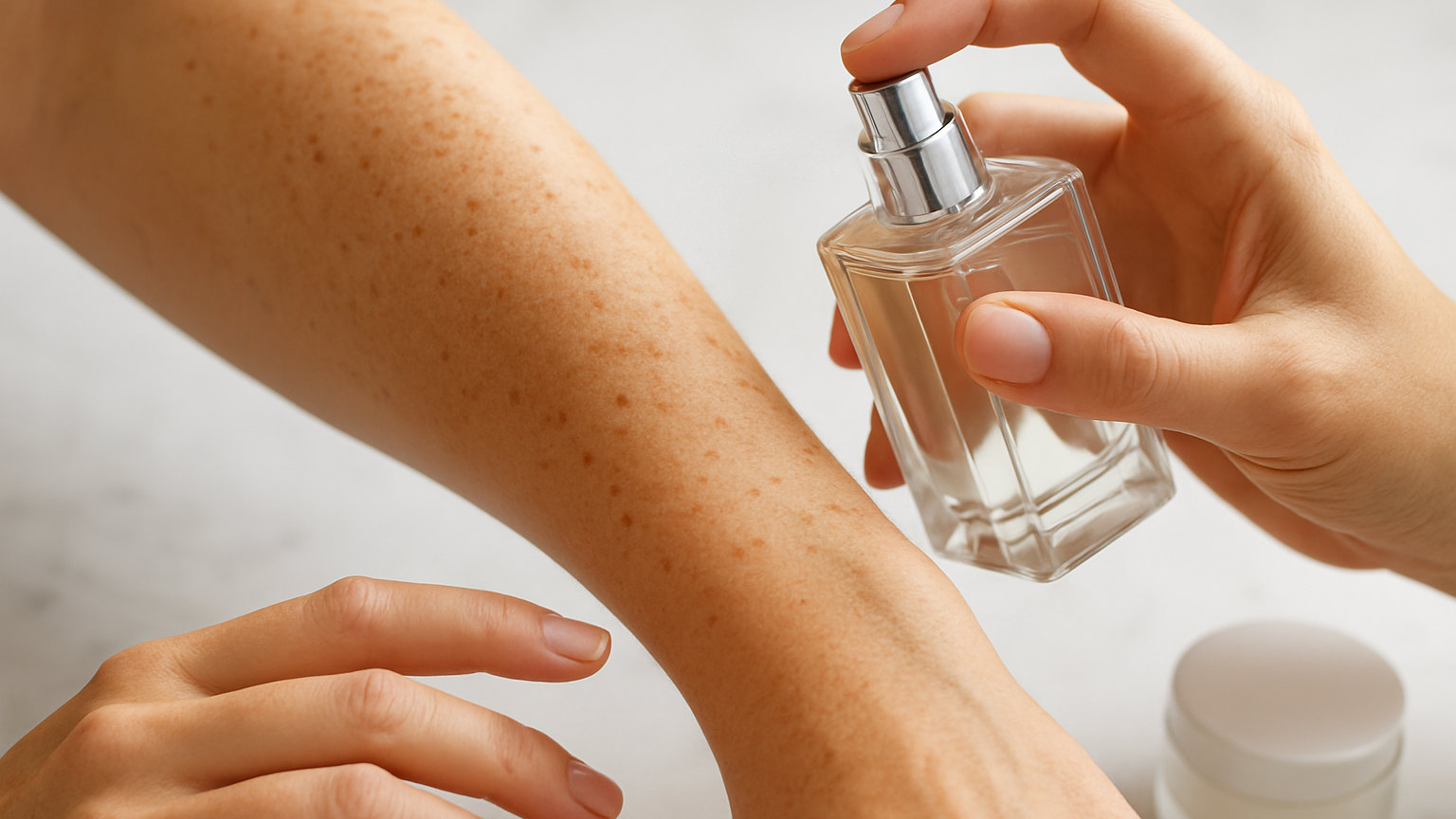
Perfume application is surrounded by habits, some of which help and one of which is actively counterproductive. The single largest factor is what the skin is like before you spray.
Where should you apply it?
Pulse points, where blood vessels sit close to the surface and warmth helps the fragrance diffuse: the wrists, the sides of the neck, behind the ears, the inner elbows and behind the knees.
Warmth is the mechanism, which is why these spots work rather than any mystical property.
Two or three spots is enough. More is not more effective, since fragrance diffuses outward from wherever it is applied.
Applying lower on the body, at the chest or inner elbows, means the scent rises through the day rather than sitting at nose height and fatiguing you immediately.
Why should you not rub your wrists together?
Because friction generates heat and crushes the molecules, accelerating the evaporation of the top notes and distorting how the fragrance develops.
The result is a scent that skips its opening and moves too quickly to the heart.
Spray and let it dry undisturbed, which takes seconds.
This is the most widespread perfume habit and the one worth abandoning.
How far away should you spray?
Around fifteen to twenty centimetres, which distributes an even mist rather than a concentrated wet patch.
Spraying too close soaks one spot, which evaporates unevenly and can irritate skin.
Walking through a cloud of it looks elegant and wastes most of the product on the air and the floor.
How much should you use?
Two to four sprays for eau de toilette, one to three for eau de parfum, one or two for parfum.
Olfactory fatigue means you stop smelling your own fragrance within minutes while others still can, which is why over-application is so common.
The test is whether someone would smell it at conversational distance rather than across a room. A fragrance others notice before you enter is too much.
Erring lighter is safer in shared spaces, offices, public transport and anywhere with people who react to fragrance.
How do you make it last?
Apply to moisturised skin, which is the single most effective step. Fragrance molecules cling to oil, so dry skin releases them far faster.
An unscented moisturiser or a plain balm applied to the pulse points first, or a matching body lotion if the range has one.
Apply after showering while skin is still slightly warm and the pores are open.
Apply before dressing rather than after, so the skin gets it rather than the fabric.
Choose a higher concentration if longevity matters, since eau de toilette will not last eight hours regardless of technique.
Should you spray it on clothes or hair?
On clothing, fragrance lasts considerably longer, since fabric holds it and there is no skin chemistry altering it.
The drawbacks are staining, particularly on silk and pale fabrics, and that the scent develops differently without skin warmth.
On hair it lasts well and the alcohol is drying, so a dedicated hair mist is a better option than perfume.
Spraying a scarf, a coat lining or a hairbrush is a reasonable middle ground.
What is layering?
Building the same scent through several products: shower gel, body lotion and then the fragrance, which extends longevity considerably.
Or combining two different fragrances deliberately, which works when they share a family or a note and rarely otherwise.
Unscented body products underneath are the simplest approach, since a scented moisturiser competes with whatever goes over it.
Start with the heavier, more persistent fragrance and add the lighter one over it if you are combining two.
When should you apply it?
After moisturising and before dressing, as the last step of getting ready rather than the first.
Allow a few minutes before putting on clothes, so it dries on skin.
For an evening event, applying an hour beforehand means the top notes have settled and what people meet is the heart of the fragrance, which is usually the intended effect.
Reapplying midday is reasonable and worth doing with a small decant rather than carrying the bottle.


