
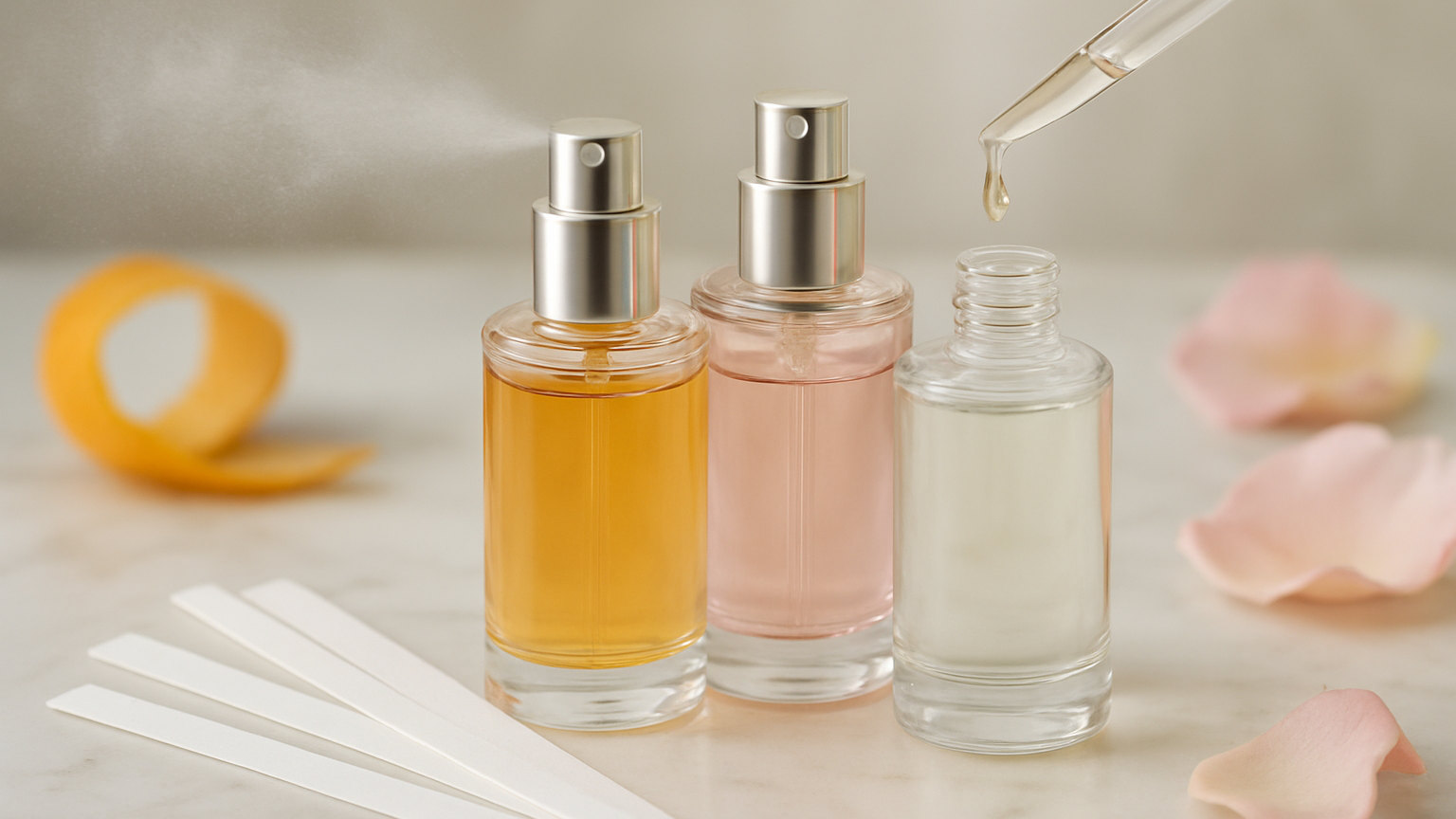
The labels on fragrance bottles describe concentration, meaning how much aromatic material is dissolved in the alcohol. That determines strength, longevity and price, and it does not describe the character of the scent.
What are the concentrations?
Parfum, also called extrait de parfum, around twenty to thirty per cent aromatic compounds, lasting six to eight hours or more. The most expensive.
Eau de parfum, around fifteen to twenty per cent, lasting four to six hours. The most common format and the usual default.
Eau de toilette, around five to fifteen per cent, lasting two to four hours.
Eau de cologne, around two to five per cent, lasting up to two hours.
Eau fraiche, around one to three per cent, the lightest of all.
Are the percentages regulated?
No, which is worth knowing. The terms are conventions rather than legal definitions, and houses apply them at their own discretion.
One brand's eau de toilette can be stronger than another's eau de parfum.
The ranges quoted are typical rather than guaranteed.
This is why testing rather than reading the label is the only reliable approach.
Is a higher concentration always better?
No, and this is the most useful point here.
The same fragrance at different concentrations is frequently a different composition rather than a diluted or concentrated version of one formula.
Houses reformulate across concentrations, adjusting the balance because a heavier version needs different proportions to work.
Many people prefer the eau de toilette of a fragrance to the eau de parfum, because the lighter version emphasises different notes.
Test each concentration separately rather than assuming the stronger one is the same thing with more of it.
What is a cologne?
Two different things, which causes confusion.
Eau de cologne is a concentration: a light citrus-led composition around two to five per cent, traditionally with bergamot, lemon and neroli.
Cologne is also used colloquially, particularly in the United States, to mean any fragrance marketed to men regardless of concentration.
A bottle labelled cologne may be either, so the concentration on the label is more informative than the word itself.
What about body mists and splashes?
Body mists are very low concentration, typically one to three per cent, designed to be applied liberally and lasting an hour or two.
They are inexpensive, pleasant and not a substitute for fragrance if longevity matters.
Splash bottles without an atomiser expose the whole contents to air with every use, so they degrade faster.
Aftershave in the strict sense is a low-concentration product designed to be applied to skin after shaving, though the word is now used loosely for any masculine fragrance.
Do oils and solids differ?
Perfume oil contains aromatic material in a carrier oil rather than alcohol, which means it sits closer to the skin, projects less and lasts longer.
It suits anyone who finds alcohol drying or irritating, and anyone wanting a scent that stays close.
Solid perfume in a balm base is convenient, travel-friendly and lower in projection.
Neither develops in quite the same way as an alcohol-based fragrance, since the alcohol carries the top notes outward.
What determines price?
Concentration, since more aromatic material costs more.
The materials themselves, since natural oud, iris and jasmine are extremely expensive and synthetics are not.
Packaging and marketing, which account for a large proportion of the price of designer fragrance.
Niche and artisanal houses frequently charge more for higher concentrations of more expensive materials with less spent on advertising, which is sometimes reflected in the bottle and sometimes not.
Which should you buy?
Eau de parfum for most purposes, which balances longevity and cost.
Eau de toilette for hot weather, work and anywhere projection should be modest.
Parfum for a fragrance you love and want to last, applied sparingly.
And test the specific concentration you intend to buy rather than a different one from the same range.
Is there a difference between men's and women's fragrance?
In composition, no. The molecules are the same and there is nothing inherently gendered about a woody or a floral note.
The distinction is marketing convention, and it varies by era and by country: lavender was considered feminine in Britain for much of the twentieth century and masculine in France.
Many houses, particularly niche ones, do not divide their ranges at all.
Testing across both counters doubles the field, which is worth doing rather than accepting the shelf as a guide.
What about unisex and niche fragrance?
Unisex simply means it has not been marketed to one group, rather than describing anything about the scent.
Niche generally means a smaller house with higher material costs, less advertising and more unusual compositions, and it is a positioning rather than a quality guarantee.
Some niche fragrances are extraordinary and some are expensive for their packaging, which is the same as anywhere else.


