
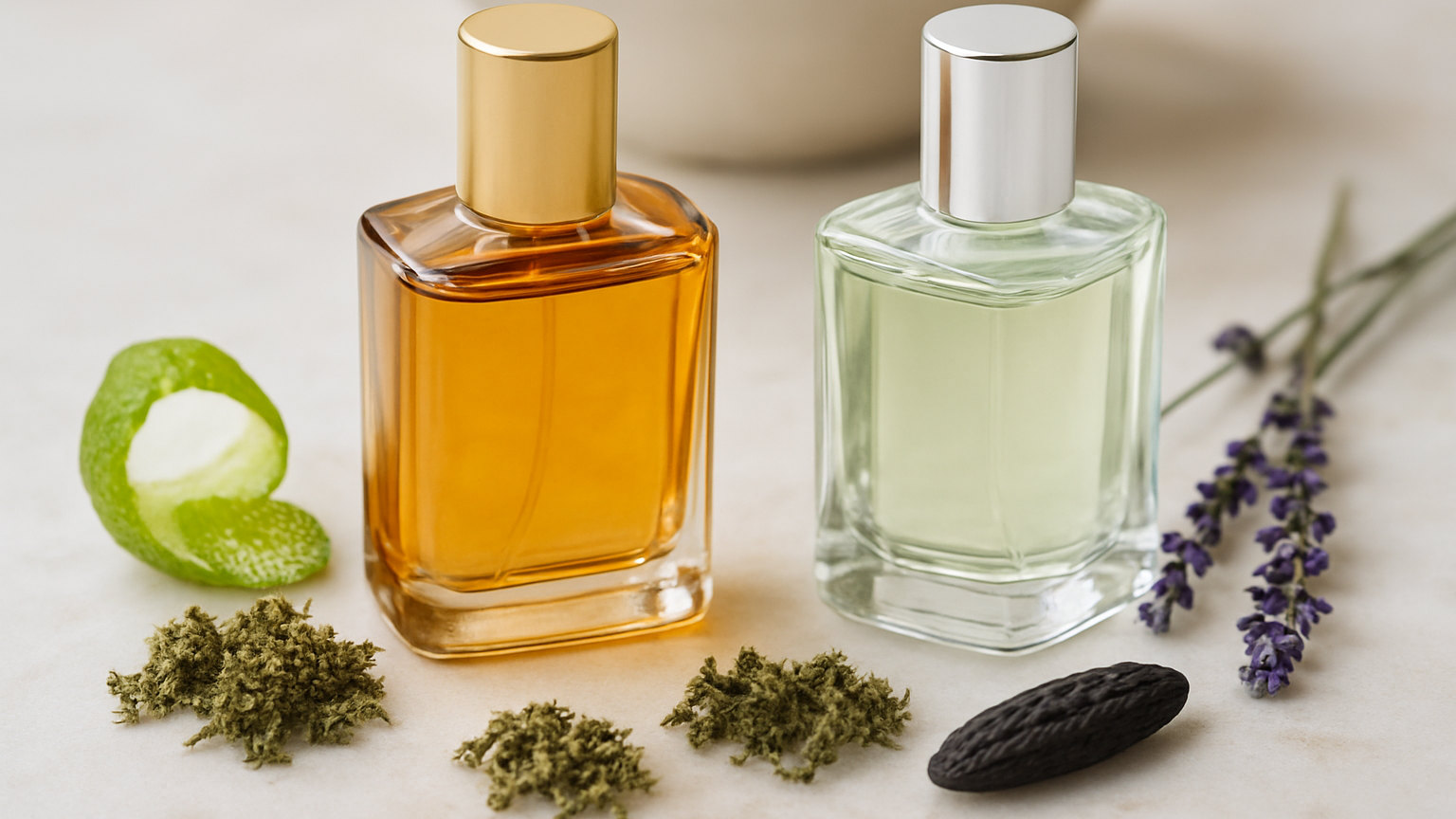
Chypre and fougere are structures rather than families in the modern sense. Both are named after specific nineteenth and early twentieth century fragrances, and both depend on a material now heavily restricted.
What is a chypre?
A structure built on a bright citrus opening, usually bergamot, over a base of oakmoss, labdanum and patchouli.
The effect is dry, mossy and slightly bitter, with a sophistication that reads as formal rather than casual.
It is named after Coty's Chypre of 1917, itself named after Cyprus, where the materials were traditionally sourced.
The heart can be anything: floral, fruity, leathery or green, which is why chypres vary enormously while sharing a recognisable skeleton.
What is a fougere?
Meaning fern in French, and named after Houbigant's Fougere Royale of 1882.
Built on lavender, coumarin and oakmoss, sometimes with geranium and a woody base.
Ferns have no smell, so the structure is an invention rather than a reproduction, which makes it one of the first abstract fragrances.
It produces the classic barbershop character, clean and slightly powdery, and it underpins an enormous proportion of traditionally masculine fragrance.
What is oakmoss?
A lichen growing on oak trees, harvested principally in the Balkans and central Europe.
It smells dry, earthy, inky and slightly leathery, with a depth nothing else provides.
It is what gives both chypre and fougere their characteristic dry base, and it is the reason both have been so profoundly affected by regulation.
Why was it restricted?
Oakmoss contains atranol and chloroatranol, which are potent contact allergens.
The industry body restricted permitted levels substantially, and further tightened them, so oakmoss can now only be used at a fraction of historical concentrations or in a treated form with the allergens removed.
This was a public health decision based on documented rates of allergic contact dermatitis, and it was necessary.
The consequence is that almost every classic chypre and fougere has been reformulated, some several times.
Do the reformulations smell different?
Yes, and this is a genuine loss rather than nostalgia.
Treated oakmoss and synthetic substitutes approximate the effect without the depth, and the difference is audible to anyone who knew the originals.
Some houses have reformulated skilfully and others have not.
Vintage bottles of classic chypres command high prices for exactly this reason, and buying them carries authentication and degradation risks.
What is coumarin?
The molecule at the heart of fougere, smelling of hay, almond and vanilla, with a sweet dried-grass character.
It occurs naturally in tonka bean and in new-mown hay, and it was one of the first synthetics used in perfumery, from 1882.
It is also a listed allergen, though restricted less severely than oakmoss.
Its combination with lavender is what produces the barbershop effect that most people recognise instantly without being able to name.
Who do these structures suit?
Chypre suits anyone who finds most fragrances too sweet, since it is among the driest and most bitter styles available.
Fougere suits anyone drawn to clean, classic, slightly old-fashioned scents, and it remains the backbone of traditional masculine perfumery.
Both are formal in character and read as considered rather than casual.
Neither is gendered inherently, despite fougere's marketing history.
Where do you start?
Modern interpretations rather than the classics, which have been reformulated and may not represent what they were.
Niche houses have produced good contemporary chypres using permitted materials.
Test on skin over several hours, since both structures develop considerably and the base is the point.
And be aware that anyone with a known oakmoss or fragrance allergy should approach both families cautiously, since even reduced levels can provoke a reaction in sensitised people.
Are these structures still being made?
Yes, though the terms appear less often on packaging, since neither means much to most buyers.
Contemporary chypres frequently substitute patchouli and synthetic mossy materials for the restricted oakmoss, producing something drier and cleaner than the originals.
Fougere remains extremely common in masculine fragrance, and most men wearing one would not recognise the word.
How do you recognise them?
A chypre feels bright at the top and unexpectedly dry and bitter underneath, with a clear contrast between the two.
A fougere reads as clean, herbal and slightly powdery, with the lavender and hay combination that most people associate with a barbershop or a shaving product.
Both are structures rather than smells, so the same skeleton supports fragrances that seem quite different on first encounter.


