
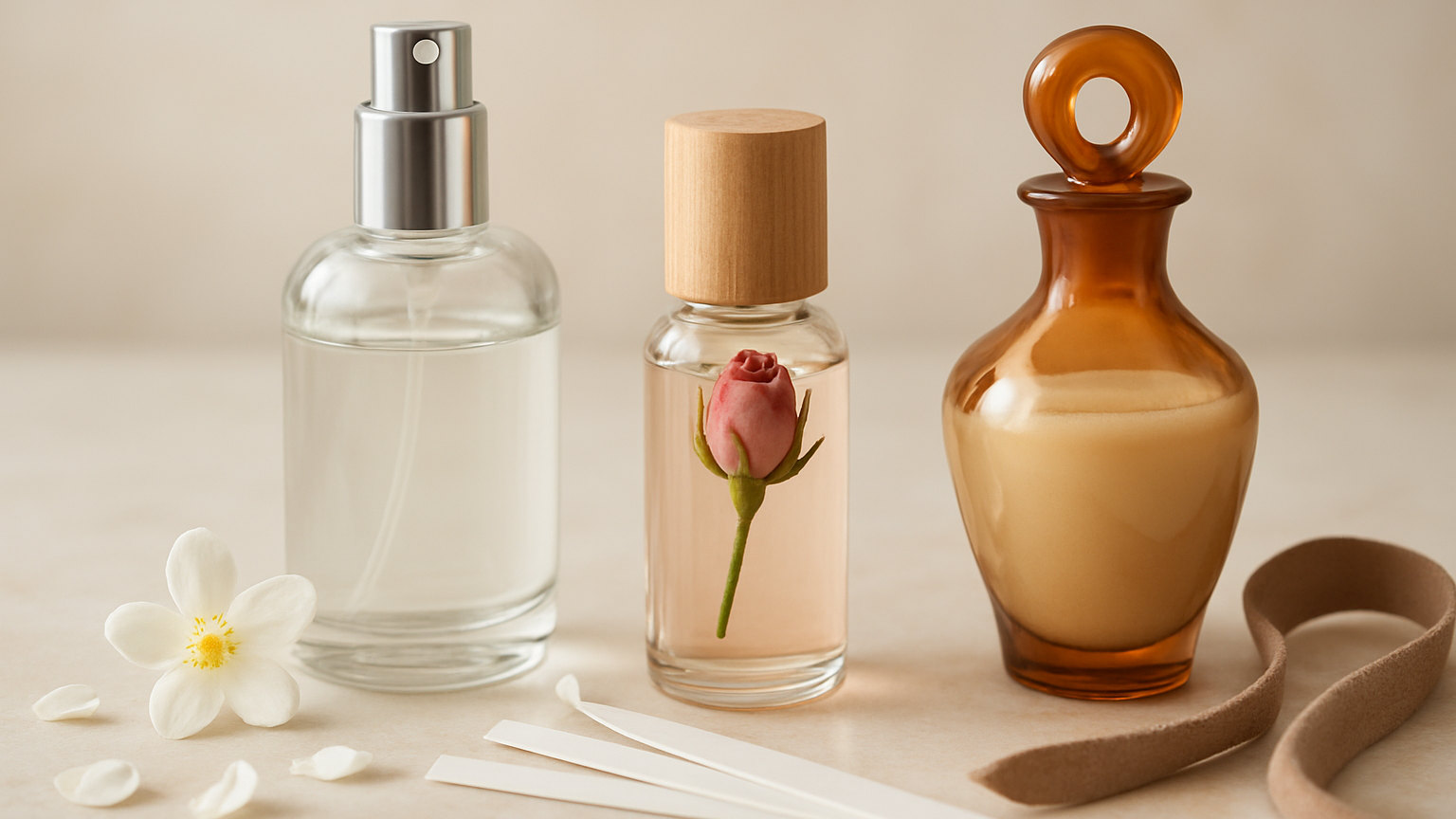
Floral is the largest fragrance family and the least useful single word in perfumery, since it spans everything from a fresh green stem to something heavy and almost animal. Disliking one floral tells you very little about the others.
What is a soliflore?
A fragrance built around a single flower, intended to capture it rather than to create a bouquet.
Rose, jasmine, tuberose, violet, lily of the valley and orange blossom are the most common.
They are a useful way to identify which flowers you actually like, since a bouquet obscures individual notes.
Many are technically impressive, since capturing a single flower convincingly is harder than blending several.
What does rose smell like in perfumery?
Not one thing. Rose ranges from fresh and dewy to jammy, spicy, tea-like or almost meaty depending on the material and treatment.
Rose damascena from Bulgaria and Turkey is rich and honeyed; rose centifolia from Grasse is greener and softer.
Modern rose fragrances are frequently paired with oud, patchouli or spice, which moves them a long way from anything a garden rose smells like.
Rose is one of the most expensive natural materials, and synthetic rose molecules are used extensively.
What are white florals?
Jasmine, tuberose, gardenia, orange blossom and ylang-ylang, which share a rich, creamy, sometimes narcotic character.
They are the most polarising group in perfumery: intensely loved and intensely disliked.
Tuberose is the most divisive of all, described as everything from intoxicating to like petrol or rubber.
They generally have significant projection and longevity, so restraint in application matters.
What does indolic mean?
Indole is a molecule occurring naturally in jasmine, orange blossom and tuberose, and also in decay and in human sweat.
At low concentrations it reads as warm, rich and floral; at higher concentrations it becomes animalic, slightly fecal or camphorous.
Indolic florals are the ones people describe as smelling almost dirty, and it is a deliberate effect rather than a fault.
If you have found a jasmine fragrance unexpectedly heavy or strange, indole is usually why, and cleaner synthetic jasmine avoids it.
What are the lighter florals?
Lily of the valley, or muguet, which is fresh, green and dewy and cannot be extracted naturally, so it is entirely synthetic.
Freesia, peony and magnolia, which are light and transparent.
Violet, which is powdery and slightly sweet, produced by ionones that also cause a curious anosmia where the smell seems to disappear and return.
Iris, made from the root rather than the flower, which is powdery, cool and expensive.
What are powdery and soft florals?
Florals combined with aldehydes, iris, violet or musk to produce a soft, cosmetic, slightly makeup-like effect.
Aldehydes are synthetics that add a sparkling, waxy, soapy brightness, and their use in the 1920s defined an entire era of perfumery.
The style reads as classic and formal to many people, and as old-fashioned to others.
It is worth testing rather than dismissing, since modern interpretations are considerably lighter than the originals.
What are fruity florals?
Florals with peach, berry, apple, pear or tropical fruit added, which dominate the mainstream market.
They read as young, bright and approachable, and are the most commercially successful style of recent decades.
The fruit notes are almost entirely synthetic, since most fruits cannot be extracted.
They tend to be sweeter and less complex than other florals, which is a feature rather than a shortcoming.
How do you find the floral that suits you?
Establish whether you prefer fresh and green, rich and creamy, or soft and powdery, which are three quite different directions.
Test soliflores first, since they identify individual preferences clearly.
Consider the season, since white florals are heavy in summer heat and light florals disappear in winter.
And test on skin over several hours, since florals develop considerably and a fragrance that opens sharp frequently softens into something quite different.
Are florals only for women?
No, and the association is a twentieth-century marketing convention rather than anything in the chemistry.
Rose has been worn by men across the Middle East and South Asia for centuries and remains a staple of masculine perfumery there.
Orange blossom, neroli and lavender appear throughout traditionally masculine fragrance, and lavender is botanically a flower despite being categorised as aromatic.
Testing across both counters roughly doubles the field available, which is worth doing rather than accepting the shelf as a guide.


