
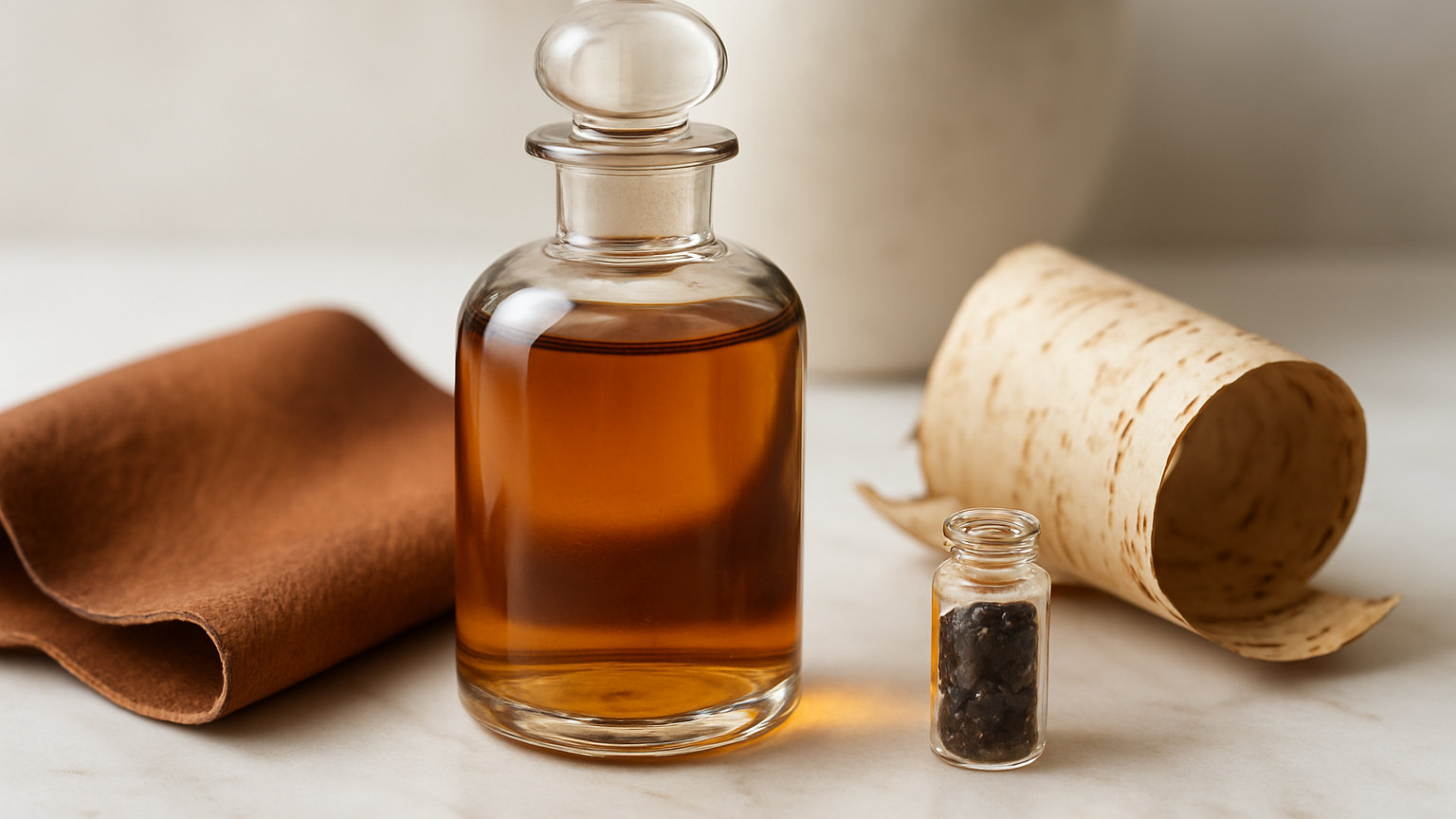
Leather is among the oldest ideas in perfumery and one of the most artificial in construction. No material smells of leather, so the effect is built from things that suggest it, and the results range from soft suede to something close to tar.
How is a leather accord built?
Birch tar, produced by heating birch bark, which smells of smoke, tar and burnt wood. It was historically used in tanning, which is why it smells of leather rather than the other way round.
Isobutyl quinoline, a synthetic that is dry, bitter and inky, and one of the defining leather materials.
Castoreum, originally from beaver and now synthetic, which is warm, animalic and slightly sweet.
Styrax and labdanum resins, adding warmth and depth.
Saffron and cumin in some compositions, which add a suede-like softness.
What are the different leather styles?
Dry leather, built on birch tar and quinolines, which is smoky, bitter and severe.
Suede, softer and powdery, frequently with iris, violet or saffron, which reads as gentle rather than harsh.
Floral leather, where a rose or violet heart sits over a leather base, a classic combination.
Sweet leather, with vanilla, tobacco or amber, which is warm and comfortable.
The range is wide enough that disliking one leather fragrance tells you little about the others.
What creates smoke?
Birch tar and cade oil, both produced by destructive distillation of wood, which smell directly of smoke and tar.
Guaiac wood, which is smoky and slightly rosy.
Incense resins, particularly frankincense and olibanum, which produce a cool, clean smoke rather than a bonfire.
Lapsang souchong tea notes, which are smoked in production.
Vetiver, which carries a smoky quality alongside its earthiness.
What does tobacco smell like in perfumery?
Not cigarettes. Tobacco absolute smells of dried leaves, hay, honey and a slight sweetness, closer to a pipe tobacco tin than to smoke.
It pairs naturally with vanilla, tonka and amber, producing warm gourmand-adjacent compositions.
Tobacco fragrances are among the most comforting in this group and considerably less severe than birch tar leathers.
They suit cold weather and evening particularly well.
What is oud in this context?
Agarwood sits between woody and smoky, with a dense, medicinal, sometimes barnyard character.
It pairs frequently with leather and rose, which is a classic Middle Eastern combination.
Natural oud is among the most expensive materials in perfumery, so most Western fragrances use synthetic reconstructions that are cleaner and simpler.
It is intensely persistent and projects strongly, so it requires a light hand.
Who do these fragrances suit?
Anyone who finds most fragrances too sweet, since this group is among the driest available.
Anyone wanting something distinctive, since these are the least generic compositions on the market.
Cold weather and evening, where the weight has room.
They suit shared and professional spaces least, since projection is substantial and the character is unmistakable.
What should you know before testing?
The opening can be alarming. Birch tar leathers frequently smell of petrol, rubber or smoke for the first ten minutes before settling into something quite different.
Wait at least an hour before forming a view, and ideally a full day.
These are the fragrances most often dismissed at the counter and most often loved by people who persisted.
Apply less than you would of anything else.
Where should you start?
A suede or a tobacco fragrance, both of which are gentle introductions.
A floral leather if you want the structure without the severity.
Avoid starting with a dry birch tar composition or a heavy oud, since both are demanding and easily misjudged on a first encounter.
And test on skin rather than paper, since these accords develop considerably with warmth.
Why do they smell like the past?
Because leather and smoke accords were staples of early twentieth century perfumery and appear in a great many classics, so the style carries associations for anyone who remembers them.
Birch tar was also used in shoe polish, saddle soap and traditional shaving products, which gives these fragrances a barbershop and workshop quality quite separate from perfumery.
The associations are strong enough that people frequently recognise a leather fragrance without being able to say why, which is part of the appeal.


