
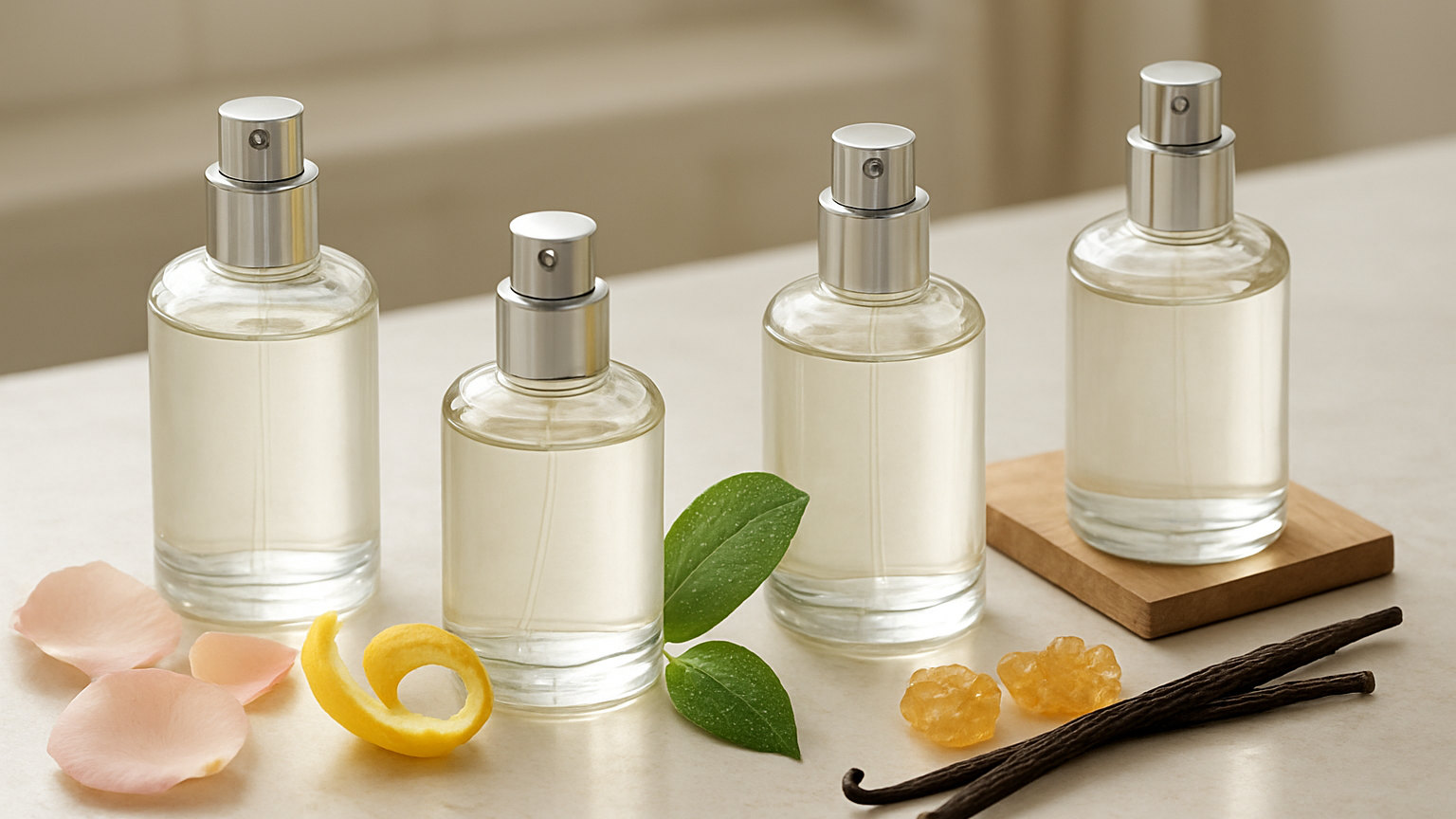
Fragrance classification exists to make a very large field navigable. Most systems reduce to four main families with sub-groups, and identifying which family you like is the single most useful step in finding anything.
What is the fragrance wheel?
A circular diagram grouping fragrance families by how they relate to each other, devised by Michael Edwards in the 1980s and now widely used.
Families sitting adjacent on the wheel share characteristics and blend well; those opposite each other contrast sharply.
The four main groups are floral, oriental or amber, woody and fresh, each divided into sub-families.
It is a useful map rather than a strict taxonomy, and most fragrances sit across two or three categories.
What is the floral family?
The largest family and the foundation of a great deal of perfumery.
Soliflores are built around one flower: rose, jasmine, tuberose, violet, lily of the valley.
Floral bouquets combine several.
Fruity florals add peach, berry or apple, which dominate the mainstream market.
Soft florals add aldehydes and powdery notes, producing the classic style of much twentieth-century perfumery.
Floral orientals sit between floral and oriental, adding spice and warmth.
What is the oriental family?
Increasingly called amber, since the older term has fallen out of favour.
Warm, rich and long-lasting, built on vanilla, resins, balsams, spices and animalic notes.
Soft oriental adds incense and gentle spice.
Woody oriental combines the warmth with sandalwood, patchouli and oud.
Gourmand is a modern sub-group built on edible notes: vanilla, caramel, chocolate, coffee, almond.
These are the heaviest and most persistent fragrances, which makes them evening and winter scents for most people.
What is the woody family?
Built on wood, resin and root materials, generally dry and long-lasting.
Sandalwood is creamy and soft; cedar is dry and pencil-like; vetiver is earthy and green.
Oud, or agarwood, is dense, smoky and medicinal, and is extremely expensive in natural form.
Mossy woods, historically the chypre style, combine citrus, oakmoss and labdanum.
Dry woods add smoke, leather and burnt notes.
Woody fragrances are among the most versatile and are worn across the year.
What is the fresh family?
Light, bright compositions built on volatile molecules, which is why they are the shortest-lasting.
Citrus: bergamot, lemon, orange, grapefruit, neroli.
Green: cut grass, galbanum, leaves and stems.
Aquatic or marine: the sea and rain accord, created largely by a synthetic called calone.
Fruity: non-citrus fruits, though these frequently sit within floral.
Aromatic: herbs including lavender, rosemary, sage and mint.
What are chypre and fougere?
Two classical structures rather than families in the modern sense, both named after specific fragrances.
Chypre is built on a citrus opening, a floral heart and a base of oakmoss, labdanum and patchouli. Sophisticated, dry and slightly bitter.
Fougere, meaning fern, is built on lavender, coumarin and oakmoss, producing the classic barbershop character. Traditionally masculine.
Both have been affected by allergen restrictions on oakmoss, which is why many classic examples have been reformulated.
How do fragrances combine families?
Most modern releases sit across two or three, which is why classification is a guide rather than a rule.
A floral woody musk, a fresh spicy oriental and a woody aromatic are all common descriptions.
Reading the family gives you a rough shape and the individual notes tell you more.
Identifying that you like woody florals but not fruity florals is the level of precision worth reaching.
How do you use this to shop?
Work out which family your existing favourites belong to, which frequently reveals a pattern you had not noticed.
Explore within that family and in the adjacent ones on the wheel, which share characteristics.
Tell a counter assistant the family rather than a specific fragrance, which produces better recommendations.
And try one thing from a family you have never explored, since preferences are frequently narrower than they need to be.
Do the families relate to season and occasion?
Loosely, through weight rather than through any rule.
Heat amplifies projection, so heavy oriental and smoky woody compositions become overwhelming in summer while fresh citrus works well.
Cold air suppresses projection, so light fresh fragrances can disappear entirely in winter while orientals come into their own.
Woody fragrances are the most consistent across the year, which is part of why they are so widely worn.


