
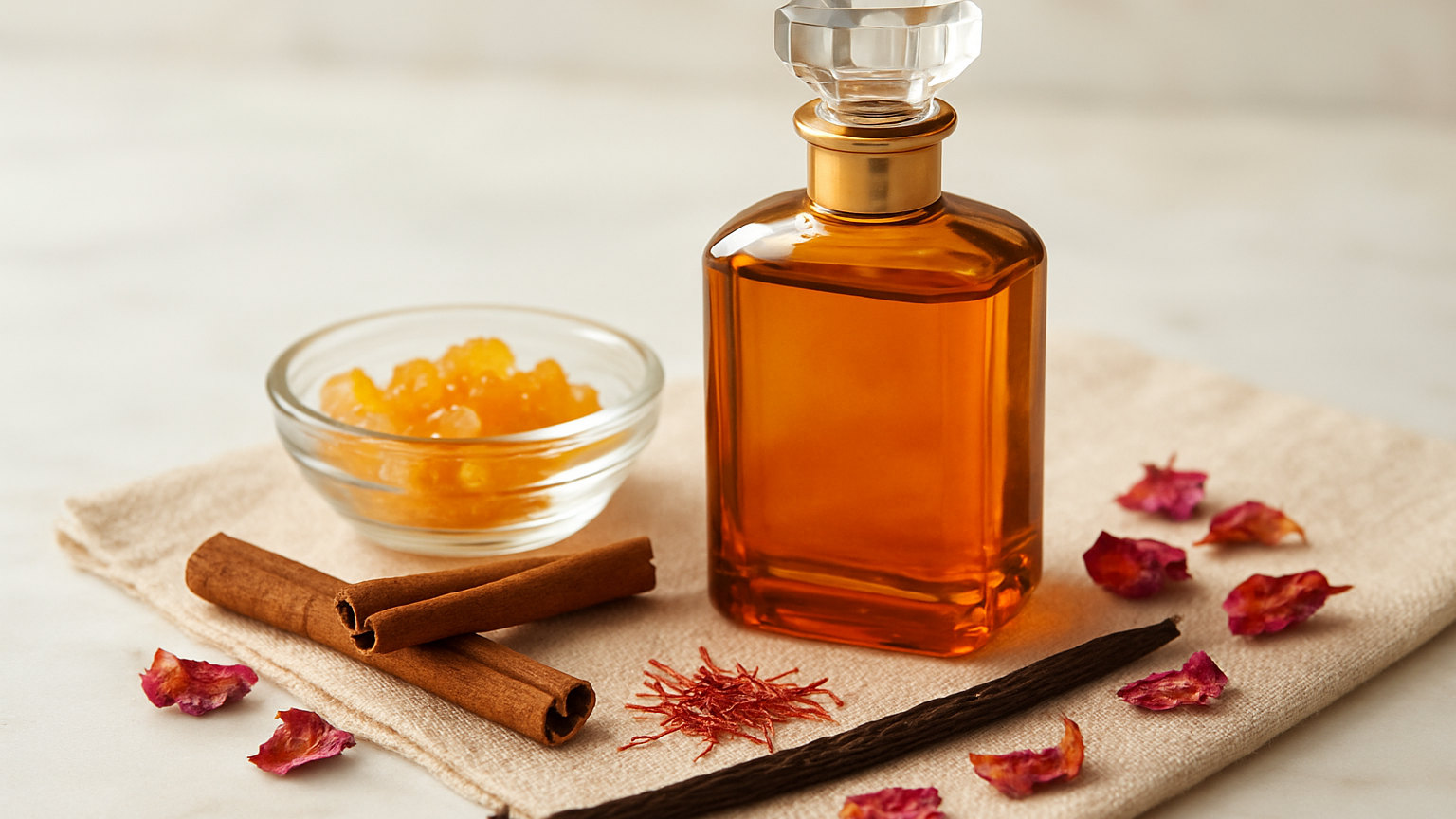
Oriental fragrances are the warmest and most persistent in perfumery, built on resins, vanilla, spices and balsams. The family name is increasingly being replaced by amber, and the reason is worth stating plainly.
Why is the name changing?
The term oriental derives from a colonial-era framing of the East as exotic and mysterious, and the industry has moved away from it.
Michael Edwards, whose fragrance wheel established the classification, formally renamed the family amber in 2021.
Most major houses and databases have followed, though the older term persists in general use and on older packaging.
The composition described is the same; only the label has changed.
What is amber?
Not a single material and not fossilised tree resin, which is a common misunderstanding.
It is an accord, a blend, traditionally built from labdanum, benzoin, vanilla and sometimes styrax.
The result is warm, sweet, slightly powdery and resinous.
Ambergris, from sperm whales, is a separate material entirely, now almost always synthetic, which is salty, marine and animalic rather than sweet.
What are the main materials?
Vanilla, which is warm, sweet and comforting, and one of the most expensive natural materials after saffron.
Labdanum, a resin from the rockrose, which is leathery, honeyed and slightly animalic.
Benzoin, sweet and balsamic with a vanilla character.
Frankincense and myrrh, resinous and cool with a slightly citrusy or bitter edge.
Tonka bean, containing coumarin, which smells of almond, hay and vanilla.
Spices: cinnamon, clove, cardamom, nutmeg and pepper.
What is a gourmand?
A modern sub-family built on edible notes: vanilla, caramel, chocolate, coffee, almond, honey and sugar.
The style is generally dated to Thierry Mugler's Angel in 1992, which introduced ethyl maltol, the molecule responsible for candyfloss and caramel effects.
Gourmands are sweet, warm and highly persistent, and they are polarising: adored by some and found cloying by others.
They suit cold weather and evening, and can become heavy in heat.
What are incense fragrances?
Built on frankincense, myrrh, elemi and related resins, producing a cool, smoky, slightly sacred character.
They read as austere rather than sweet, which distinguishes them from most of the family.
Strong associations with churches and ritual for many people, which is either the appeal or the objection.
They pair well with woods and are among the most distinctive fragrances available.
What are animalic notes?
Materials that smell of skin, fur and body: musk, civet, castoreum and ambergris.
All were originally animal-derived and are now almost entirely synthetic, both for ethical reasons and because the naturals are restricted.
Used in small quantities they add warmth, depth and a sense of skin rather than anything obviously animal.
Modern white musks are clean and soft, which is a very different effect from the traditional animalic musks.
Who do they suit?
Anyone wanting longevity, since these are the most persistent fragrances available.
Cold weather and evening, where heavy compositions have room to develop.
Anyone who finds fresh fragrances thin or forgettable.
They suit shared spaces least, since projection is substantial and a heavy amber in an open-plan office is imposed on everyone.
How should you wear them?
Sparingly. One or two sprays is frequently enough, and these are the fragrances people most often over-apply.
Applied low, at the chest or inner elbows, so the scent rises gently rather than announcing itself.
In cold weather rather than heat, since warmth amplifies projection considerably.
And tested over a full day before buying, since a fragrance that is appealing for ten minutes can be exhausting for eight hours.
Do they suit everyone?
They interact with skin chemistry more than most families, since sweetness and resins behave differently on different skin.
Oily skin amplifies them considerably, so someone with oily skin may need half what someone with dry skin uses.
Honey and some vanillas can turn sour or animalic on certain skin, which is worth discovering over several hours rather than after buying.
Where should you start?
A vanilla-led fragrance, which is the gentlest introduction to the family.
An incense or spice composition if you want the warmth without the sweetness, since these are dry rather than sugary.
A soft amber rather than a full oriental, which gives the character at lower intensity.


