
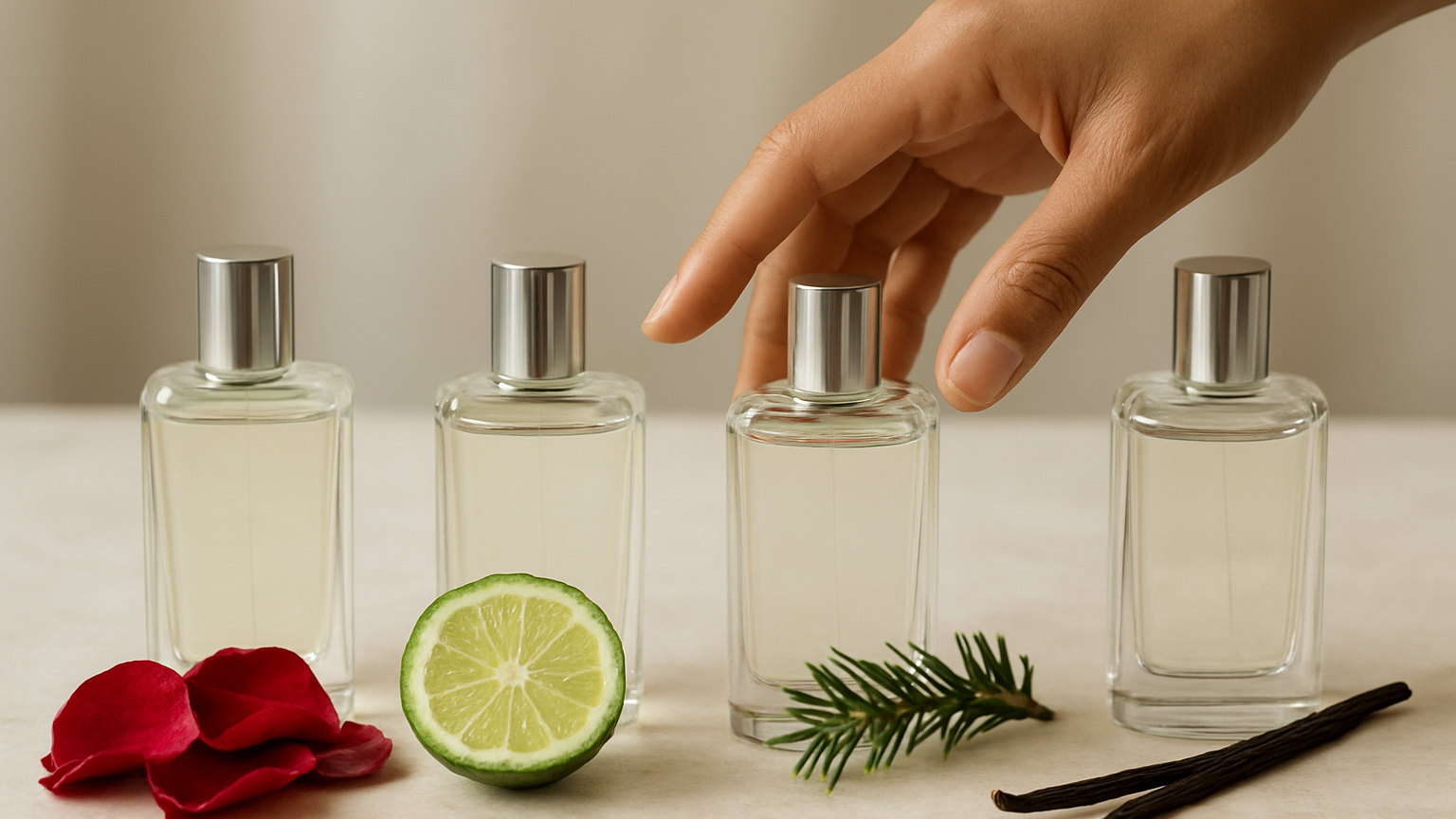
Identifying your family reduces a field of thousands to a manageable few dozen. The evidence for it is mostly already in your house rather than at a fragrance counter.
What should you look at first?
Every fragrance you have enjoyed, including ones finished years ago, and the notes they share.
Candles, shower gels, hand creams and laundry products you have chosen deliberately.
Smells you like that have nothing to do with perfumery: cut grass, sea air, old books, baking, woodsmoke, coffee, rain on pavement.
These point to a family more reliably than anything you will work out in a shop.
What questions narrow it down?
Do you prefer sweet or dry? This single question separates gourmand and amber from woody and chypre.
Warm or cool? Amber and gourmand against fresh and green.
Light or heavy? Fresh and light floral against oriental and oud.
Clean or complex? White musk and aquatic against chypre and animalic.
Familiar or unusual? Mainstream floral against incense and smoke.
Answering those five places most people within two families.
What if you like fresh and clean?
Start with citrus, aquatic and clean musk.
Expect short longevity, which is inherent rather than a fault, and look for compositions anchored with woods or musk.
Green notes if you want something drier and sharper.
Aromatic herbs, particularly lavender-led fougeres, if you want fresh with more structure.
What if you like warm and sweet?
Amber and gourmand, which are the warmest and most persistent families.
Vanilla is the gentlest starting point; caramel and chocolate are the most obvious.
If you like warmth but dislike sweetness, look at incense, spice and tobacco, which are warm and dry.
Expect substantial projection and apply sparingly.
What if you like dry and understated?
Woody, which is the most versatile family across seasons and occasions.
Sandalwood and cedar as gentle introductions; vetiver and oud if you want something more assertive.
Chypre if you want something drier still and slightly bitter.
These suit anyone who finds most fragrances too sweet.
What if you like florals but not obvious ones?
Green florals, which are sharp and stemmy rather than sweet.
Iris and violet, which are cool and powdery rather than pretty.
Floral woody or floral chypre compositions, which use the flower as a heart over a dry base.
Single-flower soliflores, which identify precisely which flowers you actually like.
What if nothing has ever appealed?
Try skin scents and soft musks, which read as an extension of your own smell rather than as perfume.
Consider that you may be anosmic to certain musks, which makes a great many fragrances smell empty.
Consider that fragrance sensitivity is common, and headaches or irritation are legitimate reasons to avoid it entirely.
Scented body products, hair mists and scented candles are all alternatives to wearing perfume.
How should you test from here?
Buy a discovery set within your identified family rather than testing at counters, which is cheaper and considerably more informative.
Wear each for a full day, in ordinary conditions.
Test three or four at most in any session, since olfactory fatigue sets in quickly.
Try one thing from a family you have dismissed, since preferences are frequently narrower than they need to be and a single bad experience shapes them disproportionately.
Does your family change over time?
Frequently, and more than people expect. Preferences shift with age, with the seasons and with what you have been wearing.
Wearing one family exclusively for years produces a degree of fatigue with it, which is one reason people return to something they had dismissed.
Hormonal changes, including pregnancy and the menopause, alter both how fragrance smells and how you perceive it, sometimes dramatically.
Can you like more than one?
Most people do, and the useful framing is occasion rather than identity.
Something fresh for work and heat, something warm for evening and winter, and something woody that works across both covers a great deal.
Treating a family as a fixed preference rather than a starting point is the main thing that narrows people unnecessarily.


