
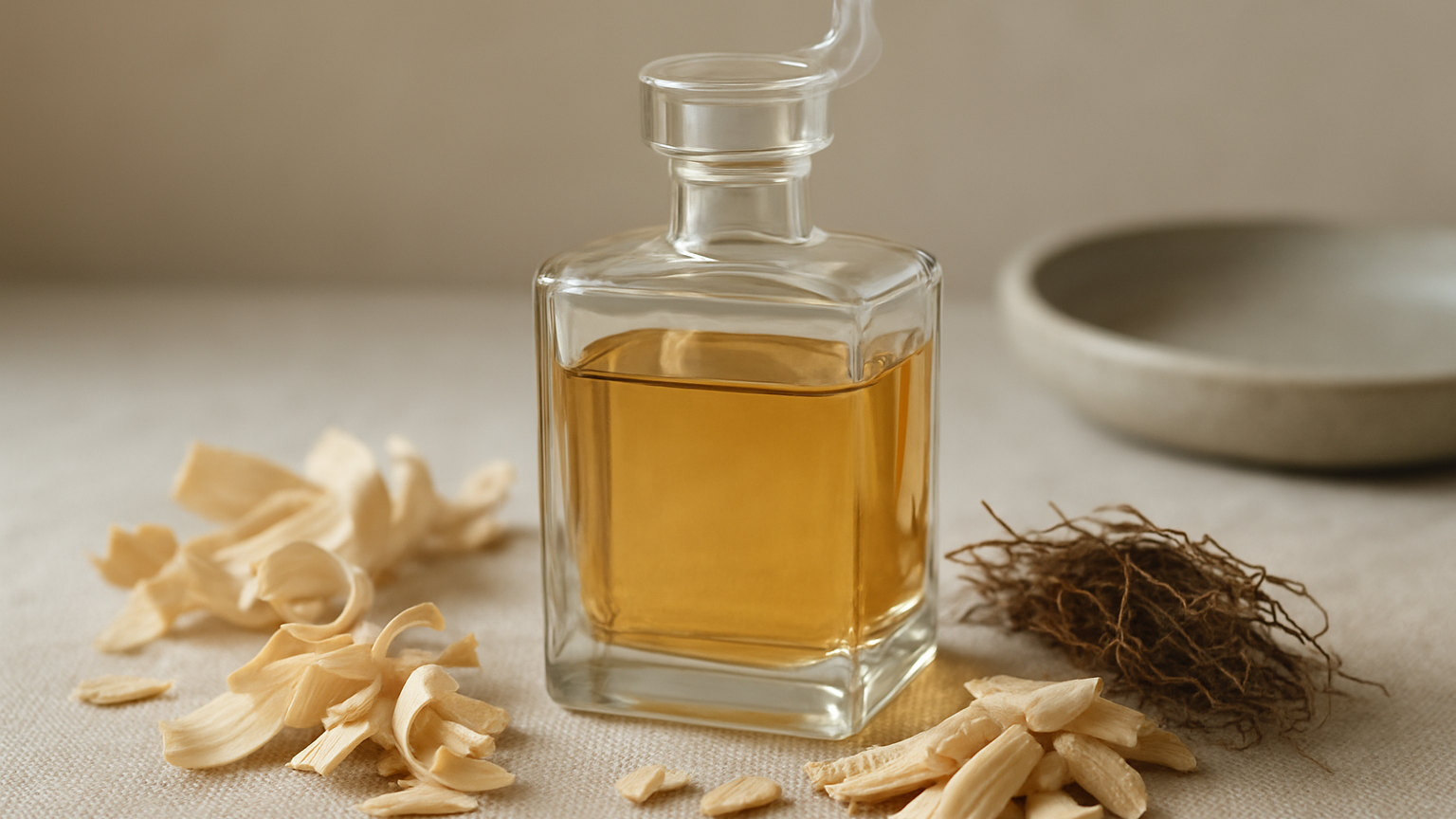
Woody fragrances are built on wood, root and resin materials. They are among the most persistent, since these are heavy base-note molecules, and among the most versatile across seasons and occasions.
What does sandalwood smell like?
Creamy, soft, milky and warm, with a slightly sweet character quite unlike other woods.
Mysore sandalwood from India was the standard for centuries and is now heavily restricted through overharvesting, so most modern sandalwood is Australian or synthetic.
The synthetics are good and differ from the original, which is why older fragrances containing Mysore sandalwood are prized.
It is one of the most comforting materials in perfumery and works well for anyone who finds other woods too dry.
What does cedar smell like?
Dry, sharp and pencil-shaving-like, with a clean, slightly astringent character.
Virginian cedar is drier and sharper; Atlas cedar is softer and slightly resinous.
It is used extensively as a structural material, giving backbone to compositions rather than dominating them.
Anyone who likes the smell of a freshly sharpened pencil or a wooden drawer will recognise it.
What does vetiver smell like?
Earthy, smoky and green, made from the root of a grass rather than from wood at all.
Haitian vetiver is smokier; Javanese is more earthy; Bourbon vetiver from Reunion is considered the finest and is nutty and rich.
It reads as dry and slightly bitter, and it is a classic material in masculine perfumery though there is nothing gendered about it.
It is one of the most polarising woods, described as smelling of damp soil by people who dislike it.
What is oud?
Agarwood, resin produced by a tree in response to a specific mould infection, which is why it is extraordinarily rare and expensive.
It smells dense, smoky, animalic and medicinal, sometimes with a barnyard or leathery quality.
It has been central to Middle Eastern perfumery for centuries and entered Western perfumery widely from the mid-2000s.
Most Western fragrances marketed as oud use synthetic reconstructions, which are cleaner and less complex than the natural material.
It is intense and long-lasting, so a light hand is essential.
What does patchouli smell like?
Dark, earthy, sweet and slightly camphorous, from the leaf of a plant rather than a wood.
It carries strong associations with the 1960s, which puts some people off before testing it.
Modern fractionated patchouli removes the harsher camphorous elements, producing a cleaner, chocolatey material used widely in contemporary perfumery.
It appears in a great many fragrances people would not identify as patchouli at all.
What are dry and smoky woods?
Compositions built on birch tar, guaiac wood, cade and incense, producing smoke, leather and burnt notes.
Birch tar smells of tar and leather and was the traditional basis of leather fragrances.
Incense or frankincense is resinous, cool and slightly citrusy, with strong associations with churches.
These are among the most distinctive fragrances available and are worth testing before buying, since the character is unmistakable.
What are mossy woods?
The chypre structure: a citrus opening over a base of oakmoss, labdanum and patchouli.
Oakmoss is dry, earthy, slightly inky and unmistakable, and it is now heavily restricted as an allergen.
This is why many classic chypre fragrances have been reformulated and no longer smell as they did, which is a genuine and widely noted loss.
Modern chypres use synthetic substitutes that approximate rather than replicate it.
Who do woody fragrances suit?
Anyone wanting longevity, since these are heavy base-note materials and last well on most skin.
Anyone who finds florals too sweet or orientals too heavy.
They work across the year, unlike heavy orientals in summer or light citrus in winter.
They are also among the most workplace-appropriate of the persistent families, provided the composition is dry rather than smoky.
Start with sandalwood or cedar if you are new to the family, since both are gentle introductions.
Why are some woods so expensive?
Because the materials are slow-growing, restricted or both. Mysore sandalwood takes decades to mature and is protected after overharvesting.
Oud forms only when a tree is infected by a specific mould, which happens rarely in the wild, so natural oud is among the most expensive materials on earth.
Rosewood and some cedars are subject to trade restrictions for conservation reasons.
This is why synthetic reconstructions dominate, and they are not a cheapening so much as the only sustainable route to these scents at scale.


