
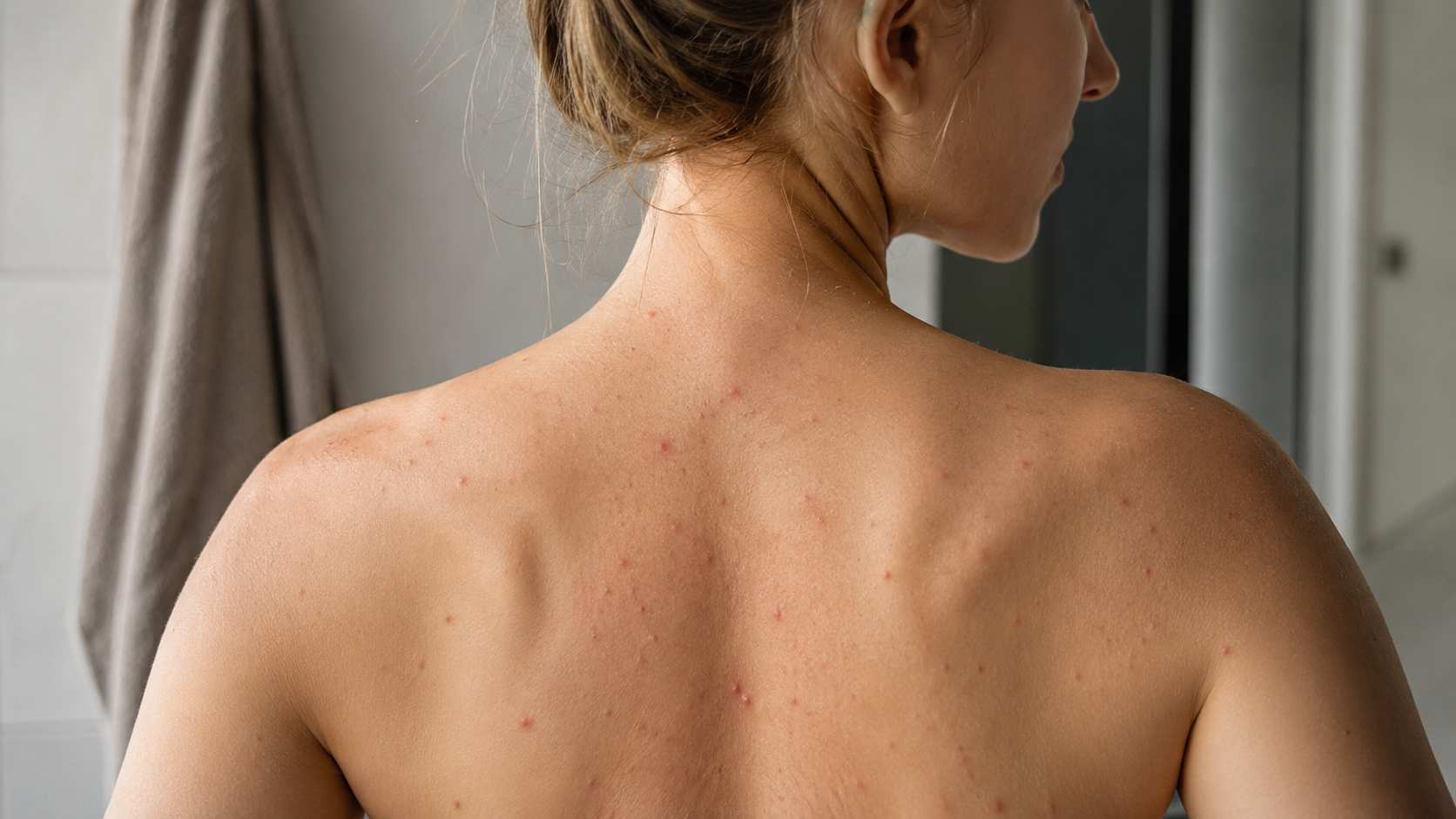
Acne on the back, shoulders and chest is common, frequently more stubborn than facial acne, and gets a fraction of the attention because it is easier to cover up. It also responds to a slightly different set of things, several of which are about routine rather than products.
Why these areas specifically?
Because of gland density. The back, shoulders and upper chest carry some of the largest and most numerous sebaceous glands on the body, which means more oil produced across a wide area.
Skin on the back is also considerably thicker than facial skin, so follicles are deeper. When one becomes inflamed, the lesion tends to be larger, more painful and slower to resolve, and it scars more readily. This is why back acne so often leaves marks even when it is treated reasonably.
What makes it worse?
Friction and trapped sweat, more than anything you put on it.
Sweat itself does not cause acne, but sweat left to dry under a tight garment creates a warm, occluded environment where bacteria multiply and softened dead cells block follicles. Add the mechanical rubbing of a backpack strap, a sports bra or a gym bench and you have the classic distribution: shoulders, upper back and the line where clothing sits.
Hair products are the underrated culprit. Conditioner, oils and styling products rinse down your back in the shower, and if you wash your hair last they remain on the skin. Long hair resting on the back through the day does the same.
Which routine changes help most?
Shower promptly after sweating. Not within the hour, within about fifteen minutes. This is the highest-value change available and it costs nothing.
Wash your hair first and your body afterwards, so conditioner residue rinses away rather than sitting on your back for the rest of the day.
Change out of damp gym clothing rather than travelling home in it. Wash bedding weekly, and pillowcases more often if you have long hair. Choose looser, breathable fabrics where you can, particularly for exercise.
What products actually work on the body?
Benzoyl peroxide wash is the most effective over-the-counter option by a clear margin. Apply it, leave it on for a full minute before rinsing so it has contact time, and use it daily. It will bleach towels, bedding and clothing permanently, so keep a white or old towel for the purpose.
Salicylic acid body washes and sprays help with congestion and blackheads across the shoulders. Spray formulations exist specifically because reaching the middle of your own back is a genuine practical problem, and a long-handled applicator solves it more cheaply.
An adapalene gel can be used on the body, though covering a large area gets expensive and irritation is more likely on skin that then rubs against clothing.
How do you know it is not fungal?
This matters, because the two are treated completely differently and one is commonly mistaken for the other.
Fungal folliculitis, caused by malassezia yeast, produces small bumps that are strikingly uniform in size, often itchy, clustered on the upper back, chest and shoulders, and without blackheads or whiteheads mixed in. It tends to worsen in heat and humidity, and it does not respond to antibiotics or benzoyl peroxide.
Acne varies in lesion size, includes comedones, and is rarely itchy. If you have been treating stubborn back acne for months with no response, ask a pharmacist or GP about an antifungal, since ketoconazole shampoo used as a body wash frequently clears it within a few weeks.
When should you see a GP?
Sooner than for facial acne. Body acne is more likely to be nodular, more likely to scar, and less likely to respond adequately to over-the-counter treatment because of the depth of the follicles and the size of the area involved.
If you have deep painful lumps, if it is leaving marks, or if three months of a benzoyl peroxide wash and sensible routine changes has not helped, an oral treatment is likely to be what shifts it.


