
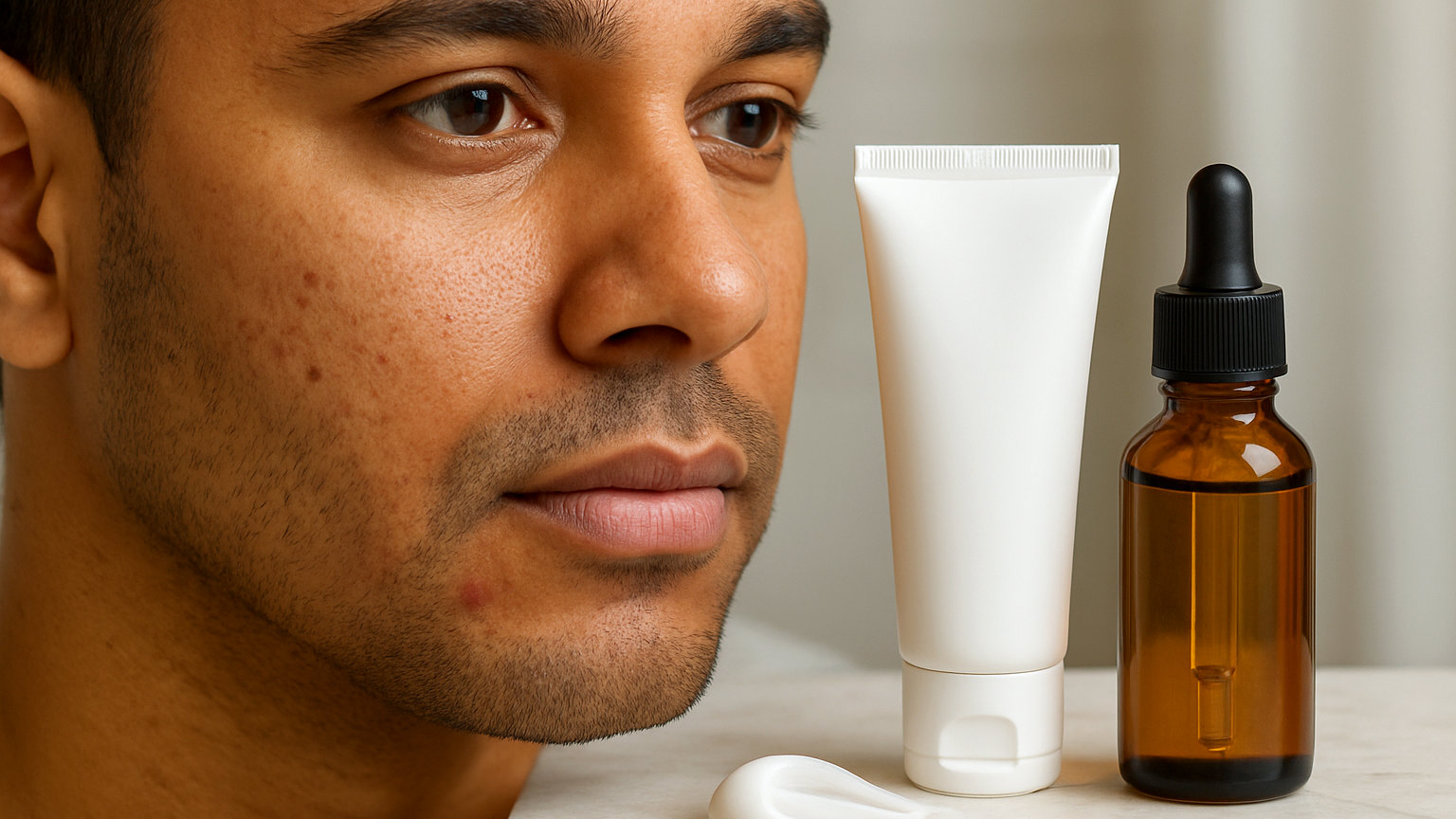
These are not two versions of the same product, and choosing between them is not a matter of which is stronger. They interrupt different stages of a breakout, so the useful question is not which is better but what your skin is actually doing.
What does each one do?
Salicylic acid is oil-soluble, so it gets inside the pore and loosens the plug of dead cells blocking it. It is working on the blockage.
Benzoyl peroxide releases oxygen into the follicle, which kills Cutibacterium acnes, and it reduces inflammation directly. It is working on the bacteria and the immune response that follows them.
Both are addressing acne, but at different points in the same sequence, which is why one can be transformative for a person the other did nothing for.
Which suits which kind of spot?
Look at what is actually on your face this week.
If it is mostly blackheads, whiteheads, small bumps under the surface, rough texture and congestion around the nose and chin, that is a blockage problem. Salicylic acid.
If it is mostly red, sore, raised spots, things that come to a head, and skin that looks angry rather than bumpy, that is an inflammatory problem. Benzoyl peroxide.
Most people have some of both, in which case start with whichever describes the majority. You can add the other later once you know how your skin responds to one thing at a time.
What strength should you buy?
For benzoyl peroxide, 2.5 per cent. Trials have repeatedly found it as effective as 5 and 10 per cent while causing substantially less dryness, peeling and irritation. Buying 10 per cent because it sounds more serious is the most reliable way to end up with skin too irritated to keep using it.
For salicylic acid, 0.5 to 2 per cent, and formulation matters as much as percentage. A leave-on serum outperforms a cleanser at the same strength because contact time does much of the work.
Can you use both together?
Yes, but not layered on the same skin at the same moment, which is a reliable route to a compromised barrier.
The straightforward approach is to alternate: salicylic acid one night, benzoyl peroxide the next. Alternatively, use them in different places, so a salicylic acid product across the congested areas and benzoyl peroxide as a targeted treatment on inflamed spots.
The other reasonable arrangement is by time of day, with one in the morning and one at night. What is not worth doing is applying both, plus a retinoid, plus a glycolic toner, and then concluding that acne treatments do not suit you.
What are the practical drawbacks?
Benzoyl peroxide bleaches fabric, and it does so thoroughly and permanently. Towels, pillowcases, collars and the front of a dressing gown are all at risk. White bedding and an old towel for your face solve it. It also causes dryness and flaking in the first fortnight for most people, which settles.
Salicylic acid is generally better tolerated but is drying in its own way, and it is one of the ingredients most likely to cause a purge in the first month. It should be avoided in pregnancy at high strengths, though the low concentrations in a wash are not usually a concern; a pharmacist can confirm for a specific product.
Which works faster?
Benzoyl peroxide, noticeably. Because it acts on bacteria and inflammation, an individual spot can look calmer within a couple of days, and overall redness often improves within two to four weeks.
Salicylic acid is slower because it is clearing blockages that formed before you started. Texture changes at four to six weeks, spot count at eight to twelve.
That difference in speed is worth knowing before you start, because it is easy to conclude that the slower one is the weaker one when it is simply working on a longer timescale.
When is neither the right answer?
If you have deep, painful lumps that never come to a head, neither of these will be enough on their own. Cystic acne needs prescription treatment, and it scars, so it is not worth spending six months working through the chemist shelf first.
The same applies if you have used one of them properly for three months and nothing has changed. That is the point at which a GP has better options rather than the point at which to try a third brand of the same thing.


