
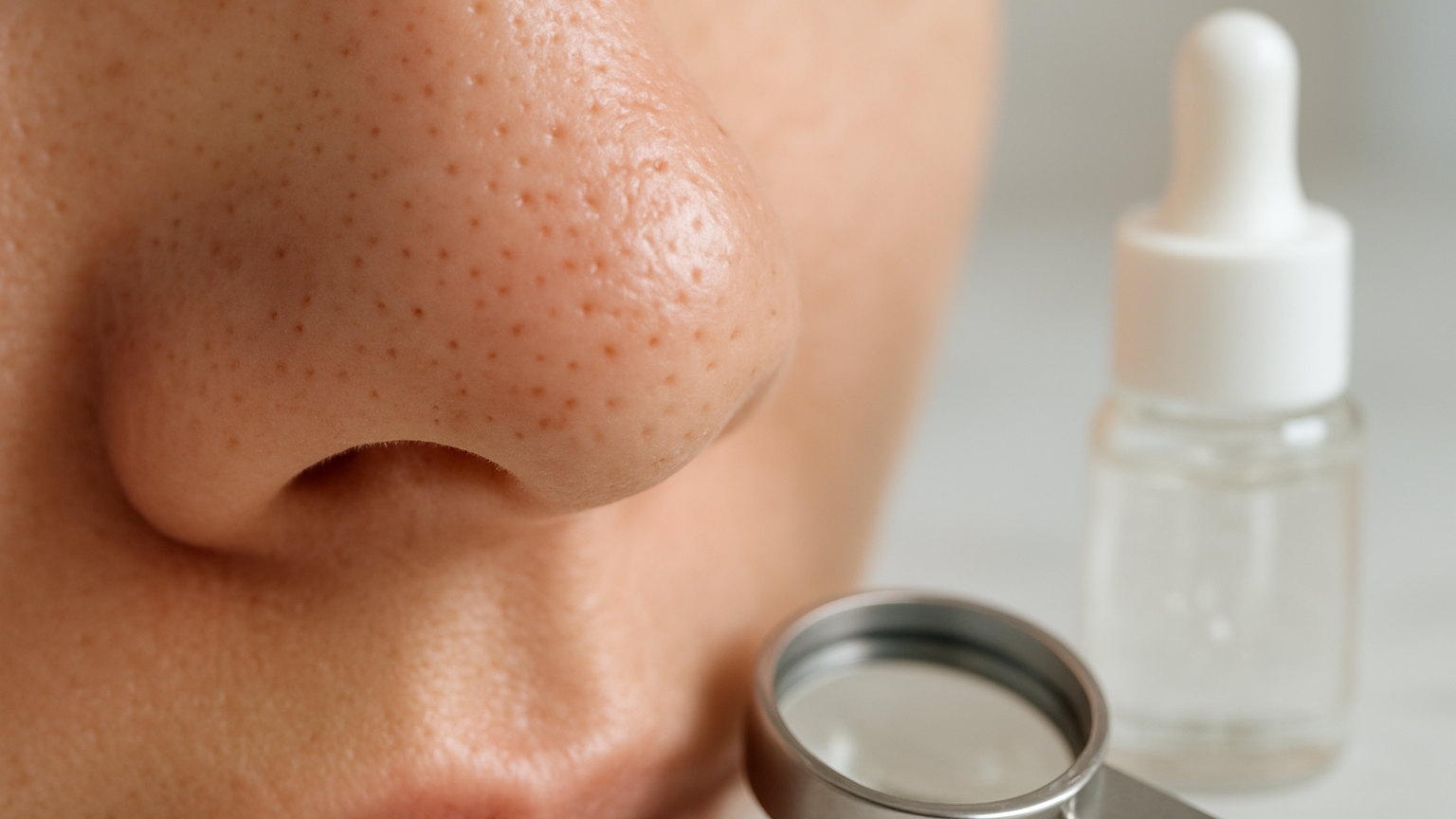
Most of the small dots scattered across the nose, chin and inner cheeks are not blackheads. They are sebaceous filaments, and they are a normal structure that everybody has. Knowing the difference matters because one of them can be treated and the other can only be managed, and a great deal of money is spent by people trying to permanently remove something that is meant to be there.
What is a sebaceous filament?
It is the natural lining of a pore. Every follicle contains a thin, tube-shaped collection of sebum and cells whose job is to channel oil from the gland up to the surface of the skin. It is not a blockage, it is plumbing.
They become visible when pores are larger, which is largely genetic and partly a function of how much oil the skin produces. That is why they are most obvious on the nose and the centre of the face, where pores are naturally biggest, and why they are more noticeable in oily skin types and in people over about twenty-five, as pores widen slightly with age.
How do you tell them apart?
Colour first. Blackheads are genuinely black or very dark brown, because the plug has oxidised on contact with air. Filaments are grey, tan or a light yellowish colour.
Then pattern. Filaments are evenly spaced and roughly uniform in size, following the natural distribution of pores. Blackheads are irregular, appearing here and not there, and often in clusters where congestion has built up.
Then texture. Run a clean finger over the area. Blackheads are slightly raised and feel gritty. Filaments sit flush with the skin and feel like nothing at all.
Finally, behaviour. If something is extracted and the pore afterwards looks visibly empty and stays that way for weeks, it was a blackhead. If it refills within a fortnight in exactly the same pattern, it was a filament.
Why do they come back so quickly?
Because refilling is their function. A sebaceous filament regenerates within about thirty days, and in oilier skin considerably faster than that. Removing one is not solving a problem, it is emptying a channel that will fill again by design.
This is the single most useful thing to understand about the nose. The feeling of fighting a losing battle is accurate, and the battle was never winnable. Once you stop expecting permanent clearance, the sensible goal becomes keeping them small enough not to be noticeable.
Does squeezing help?
Briefly, and at a cost. Squeezing empties the filament for a few days and stretches the pore wall while doing it. Repeated over months, that stretching makes the pore permanently wider, which makes the filament inside it more visible than it was before you started.
Pore strips work the same way. They pull out the top of the filament, which looks dramatic on the strip, and take the surface layer of skin with it. The result a week later is the same dots in a slightly larger pore.
What actually reduces their appearance?
Salicylic acid, used consistently rather than occasionally. Because it is oil-soluble it works inside the pore, keeping the contents loose and the filament less densely packed, so it reflects less light and reads as smaller. A low-strength leave-on product used daily does more than a strong treatment used once a week.
A retinoid helps over a longer period by normalising how the follicle lining sheds and, with sustained use, genuinely reducing pore diameter slightly. Expect months rather than weeks.
Niacinamide is worth including. It reduces oil production, which lowers how quickly filaments refill, and improves the appearance of pore size over eight to twelve weeks.
Sunscreen belongs on the list, which surprises people. Sun damage breaks down the collagen that holds pore walls taut, and slack pore walls make every filament more obvious.
When is it a blackhead worth treating?
If the dots are irregular, raised, genuinely dark and stay gone once removed, you are dealing with congestion rather than anatomy, and that responds properly to treatment. Salicylic acid, a retinoid, or both used on alternate nights will clear it over six to twelve weeks.
Persistent clusters of blackheads in the same place month after month, particularly alongside inflamed spots, are worth raising with a GP, since a prescription retinoid does in weeks what an over-the-counter one takes months to achieve.


