
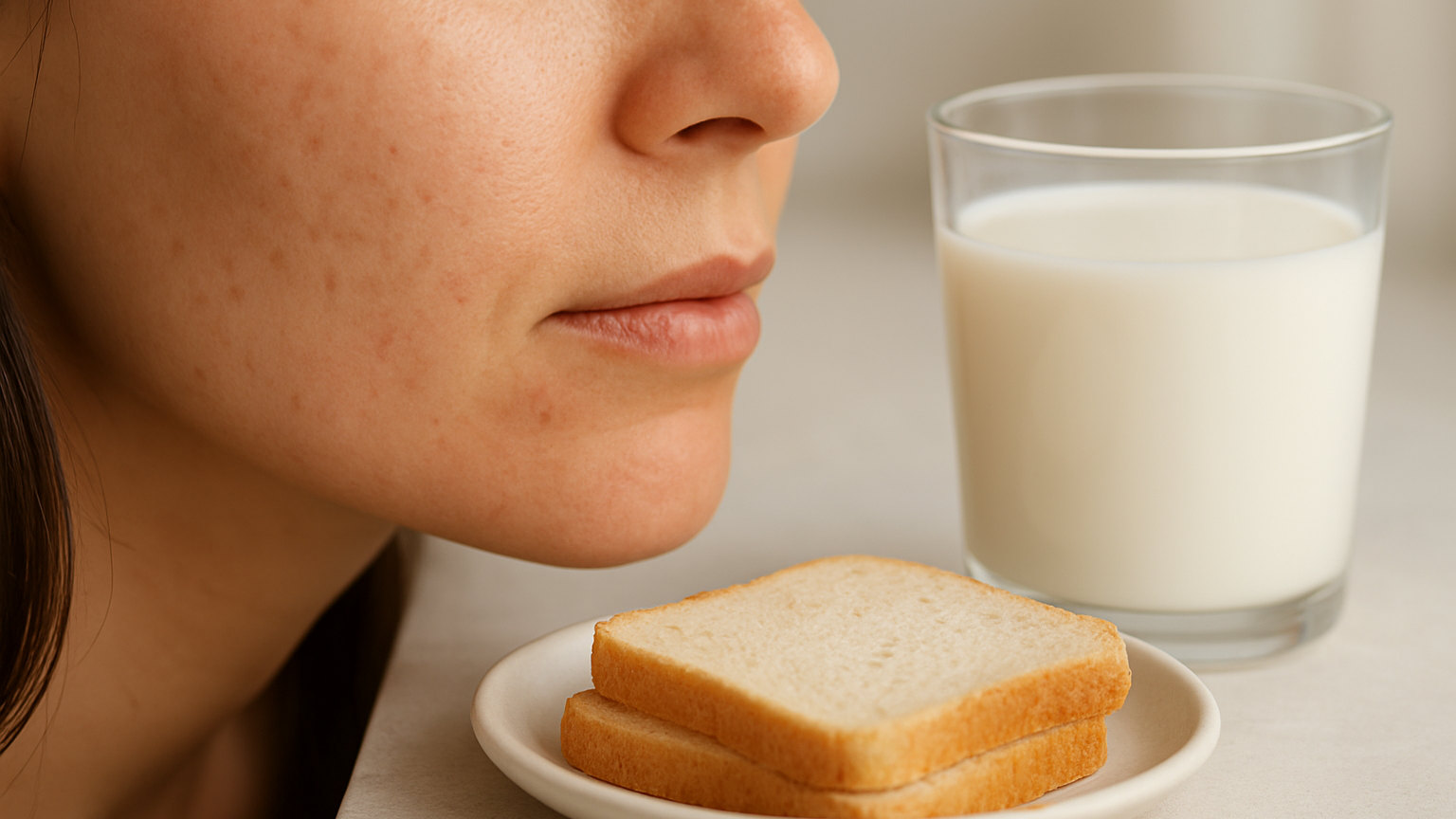
Diet is the part of acne advice where confident claims outnumber good evidence by a wide margin. Some of what people have been told for decades has essentially nothing behind it. Two things do have reasonable support, and both are more modest than the internet suggests.
Does chocolate cause spots?
Probably not, and the belief is older than the evidence for it. The studies most often cited in support are small, poorly controlled, and in several cases funded by parties with an interest in the answer.
Where an association does appear, it is difficult to separate the cocoa from the sugar and milk it arrives with, which are the two components that have plausible mechanisms behind them. Dark chocolate with a high cocoa content and little sugar is not implicated in the way milk chocolate sometimes is, which points fairly clearly at what is doing the work.
Greasy food is the same story. Eating fat does not increase sebum production. The persistent idea that it does comes from the reasonable-sounding but incorrect assumption that oil eaten becomes oil secreted.
What does the evidence say about sugar?
This is the strongest association of the lot. Diets high in refined carbohydrate and sugar, meaning a high glycaemic load, are consistently associated with more acne across several controlled trials.
The mechanism is credible. High-glycaemic foods raise blood glucose sharply, which raises insulin, which raises insulin-like growth factor 1. IGF-1 stimulates sebum production and increases androgen activity, and both of those sit at the start of the process that forms a spot.
The trials that switched participants to a lower-glycaemic diet found meaningful reductions in spot count over twelve weeks. The effect is real, but it is a reduction rather than a resolution, and it took three months to appear.
Is dairy a problem?
Skimmed milk shows a consistent association in observational research. Whole milk shows a weaker one, and cheese and yoghurt show little to none.
That pattern is the interesting part. If dairy itself were the problem, full-fat products would be worse rather than better. The likelier explanations are the whey and casein proteins, which raise IGF-1, and the fact that skimmed milk is often more processed and consumed in larger quantities.
It is worth stressing that these are observational studies. They show that people who drink more skimmed milk report more acne, not that the milk caused it. Nobody has yet run the trial that would settle it properly.
Why do elimination diets seem to work?
Several reasons that have nothing to do with the food removed.
Acne fluctuates naturally, so any change made during a bad patch will appear to help as the patch passes on its own. People who cut out a food group usually change several other things at the same time, including eating less processed food overall. And the act of paying close attention to skin for six weeks tends to coincide with more consistent skincare.
None of that means the person is imagining the improvement. It means the food is often not the reason for it.
Which changes are worth making?
Reducing overall glycaemic load is the one with the best support and the fewest downsides, since it is a sensible dietary change regardless of your skin. That means less sugar and refined carbohydrate rather than a rigid regime.
If you drink a lot of skimmed milk, switching to whole milk or a plant alternative for eight to twelve weeks is a low-cost experiment. Keep a note of spot counts rather than relying on impressions.
What is not worth doing is cutting out entire food groups indefinitely on the strength of association studies, particularly for teenagers, who need the calcium.
When is diet not the answer?
When acne is moderate or severe, and always when it is cystic or scarring. No dietary change has ever been shown to do what a topical retinoid or a hormonal treatment does.
Diet sits alongside treatment as something that may reduce the load on your skin by a modest amount. Treating it as the primary lever tends to delay effective treatment by months, and that is time that acne of this kind uses to leave marks.


