
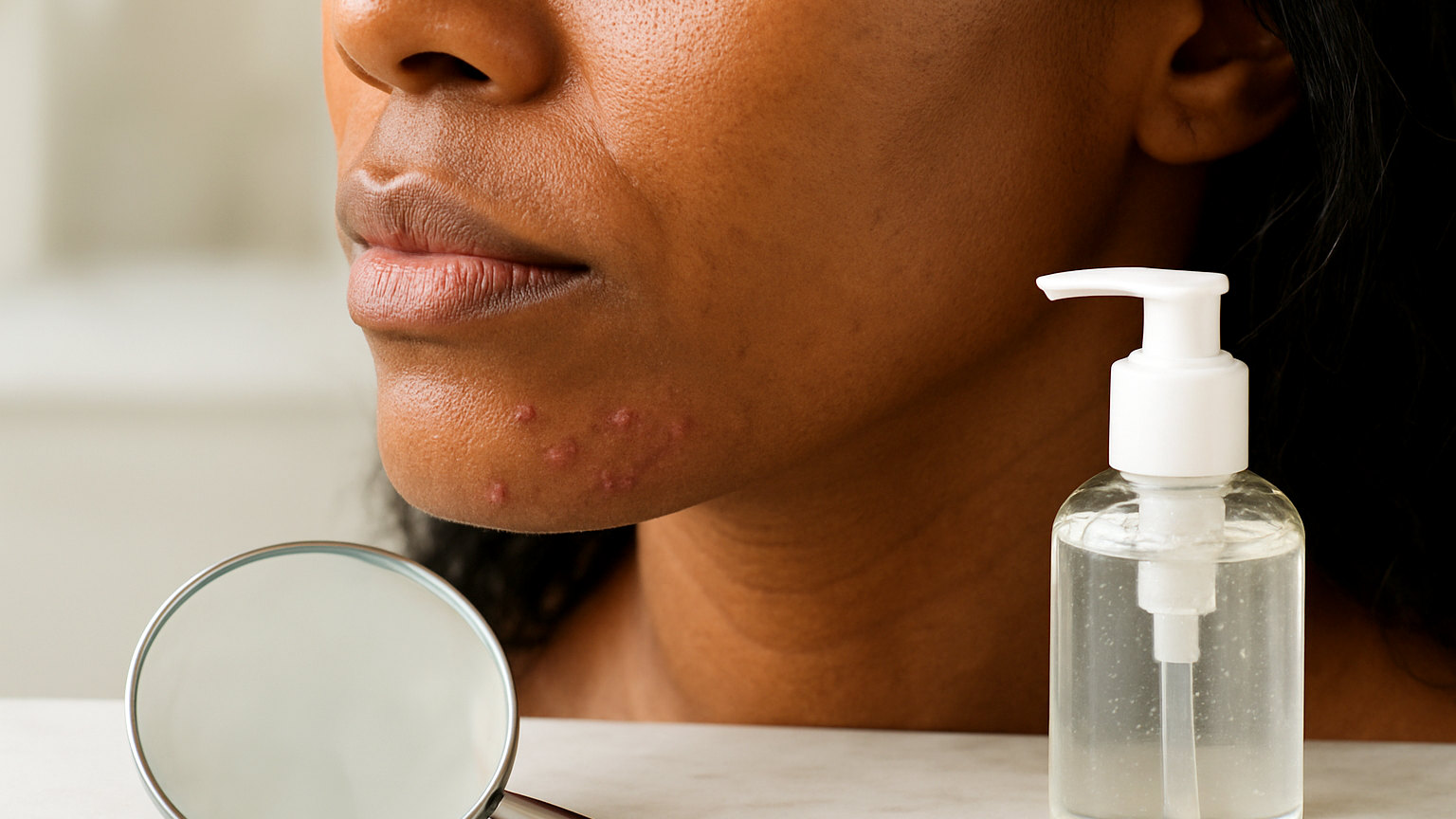
Spots that cluster along the chin and jawline, arrive in roughly the same week each month, and sit deep under the skin rather than coming to a head are the textbook pattern of hormonal acne. The location is not a coincidence, and recognising the pattern changes what you should reasonably expect a skincare product to achieve.
Why this part of the face?
Oil glands are not distributed evenly, and neither is their sensitivity. The glands across the lower third of the face carry more androgen receptors than those on the forehead and cheeks, so they respond more strongly to the same circulating hormone level. When androgens rise, or when the balance between androgens and oestrogen shifts, the chin and jaw react first and hardest.
This is also why the pattern changes with life stage rather than with your cleanser. Teenage acne tends to spread across the forehead, nose and chin, because the whole face is responding to a general surge. Adult acne concentrates below the cheekbones, because it is responding to a subtler shift that only the most sensitive glands register.
What does hormonal acne actually look like?
Deeper than other spots, and slower. Rather than a whitehead that forms and clears in three or four days, you get a firm, tender swelling under the skin that takes a week or more to build, sits there for another week, and often never develops a head at all.
They tend to recur in the same few spots, which is one of the more demoralising features: the same point on the jaw flares month after month because that follicle has been repeatedly inflamed and its wall is damaged. They also leave marks more readily than surface spots, because the inflammation is deeper and lasts longer.
When in the month should you expect them?
Usually the week before a period. Oestrogen falls in the second half of the cycle while androgen levels stay steady, so the ratio shifts and oil production rises with it. Many people can predict the flare within a day or two once they have tracked it for a few months.
Tracking is genuinely worth doing. Write down where spots appear and when, for three cycles. If the pattern is consistent, you have something concrete to show a GP, and you also stop blaming whichever product you happened to start that week. A great many perfectly good products get abandoned for a breakout that was always going to arrive.
What else shifts the balance?
Stopping the combined pill is a common trigger, and the resulting breakout can take six months or more to settle as your own cycle re-establishes. Starting a progestogen-only method can do the same. Perimenopause causes it from the other direction, as oestrogen declines and the ratio tips again. Polycystic ovary syndrome is worth mentioning to a GP if jawline acne comes alongside irregular periods, unusual hair growth or difficulty losing weight.
Stress plays a real but often overstated role. Cortisol does stimulate oil production, so a very stressful month can worsen a flare, but stress alone rarely creates this pattern from nothing.
What helps, and what is being oversold?
Topical treatment still earns its place. A retinoid used consistently reduces how readily follicles block in the first place, which lowers the number of spots that form when hormones shift. Benzoyl peroxide handles the inflammatory ones. Salicylic acid does less here than it does for blackheads, because the plug is not the leading problem.
Be sceptical of anything marketed as hormone-balancing that you apply to your face. Nothing topical reaches the endocrine system. Supplements marketed for hormonal skin are, with the partial exception of zinc, poorly supported.
What does work at the level of the cause is prescribed: a combined contraceptive pill with an anti-androgenic progestogen, or spironolactone, which blocks androgen receptors directly and is widely used off-label for exactly this pattern. Both take three to six months to show their full effect.
When is it worth booking an appointment?
If the spots are deep and painful, if they are leaving marks or dents, if the pattern tracks clearly with your cycle, or if three months of consistent topical treatment has not reduced the number of spots you get.
None of that is impatience. Deep inflammatory spots scar, and the treatments that work on the cause take months to act, so an early appointment simply gets you to the useful part sooner. It is also worth mentioning any change in periods, hair growth or weight, because that changes what a GP will want to check.


