
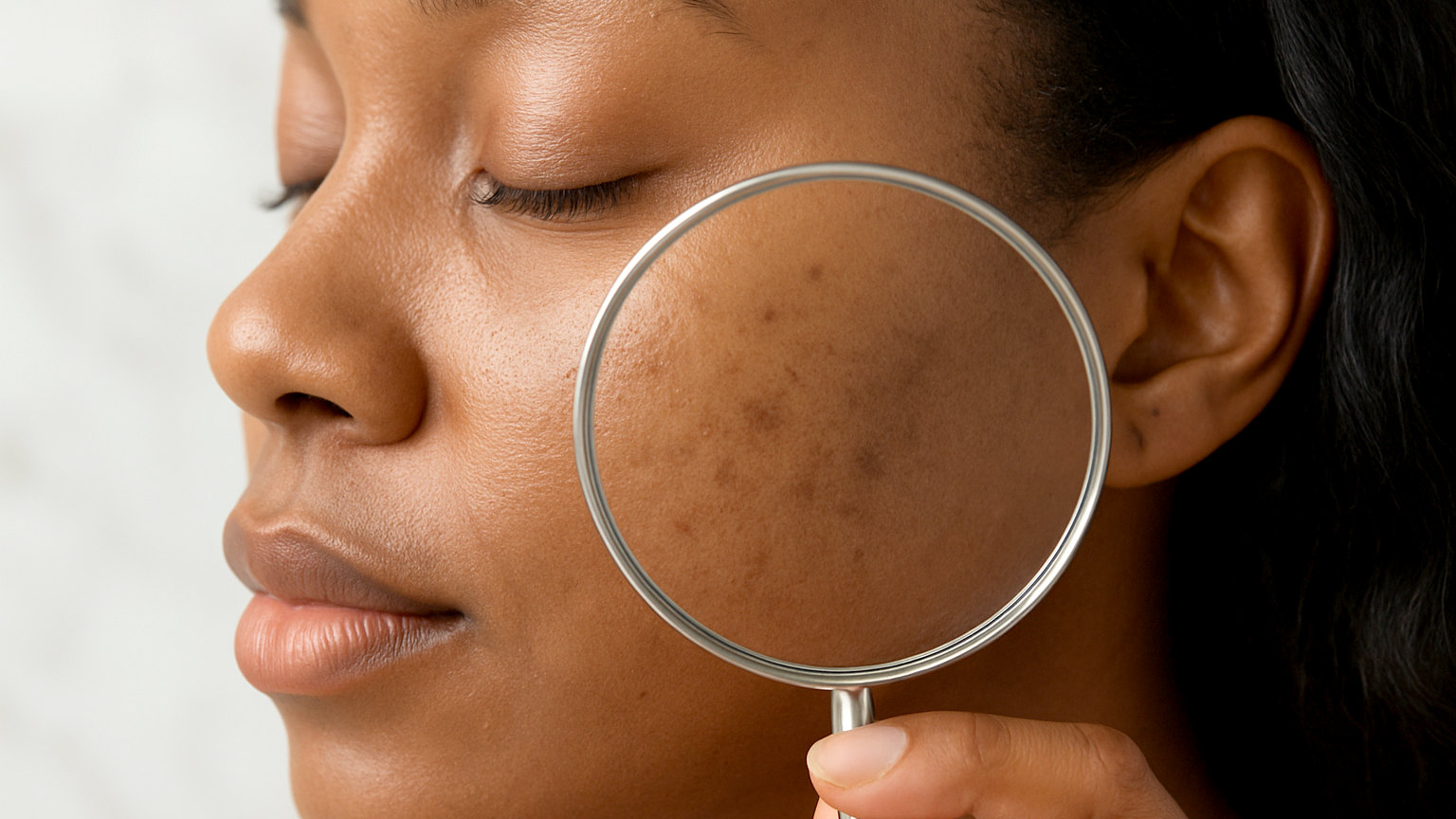
The mark left behind often bothers people more than the spot did, partly because it lasts many times longer. The first useful step is working out which of two very different things you are looking at, because one resolves on its own and the other needs treating.
Is it a mark or a scar?
Close your eyes and run a clean finger over it. If you can only see it and not feel it, it is a mark, and it will fade. If you can feel a dent, a pit or a raised lump, it is a scar, and it will not.
Marks are a colour change in otherwise normal skin. Scars are a change in the structure of the skin, where the inflammation went deep enough to damage collagen, and no serum will rebuild that. Scars need clinical treatment such as microneedling, laser resurfacing or subcision.
The vast majority of what people call acne scarring is not scarring. That is genuinely good news, because it means waiting works.
What is post-inflammatory hyperpigmentation?
A brown, tan or grey mark caused by inflammation triggering melanocytes to produce extra pigment. The pigment sits in the skin after the spot has resolved and is gradually cleared.
It is more common and more persistent in deeper skin tones, because those melanocytes are more reactive by default. In lighter skin it tends to be lighter and shorter-lived. This is why the same spot leaves a six-week mark on one person and a nine-month mark on another, and it is not a difference in skincare quality.
Why are some marks red instead of brown?
Because they are a different thing entirely. Red, pink or purple marks are post-inflammatory erythema, and they are not pigment at all. They are dilated or damaged capillaries left behind by the inflammation.
Erythema is more common in fair skin. It responds poorly to the ingredients that fade pigment, which is why people with red marks often conclude that vitamin C and niacinamide do nothing, when in fact they are treating the wrong mechanism. Time is the main treatment, and azelaic acid helps more than most.
How long do they take to fade?
Erythema usually settles in three to six months. Pigmentation typically takes three to twelve, and occasionally longer in deeper skin tones or where the original spot was deep.
Those timescales assume you are not re-inflaming the same spot and not exposing it to sun without protection. Both reset the clock, which is the main reason marks that should have faded in four months are still visible after a year.
What genuinely speeds it up?
Sunscreen, by a distance. Ultraviolet light stimulates the same melanocytes that produced the mark, so unprotected sun exposure darkens it faster than any treatment lightens it. Daily broad-spectrum SPF 30 or higher is not an optional extra here, it is the treatment.
Beyond that, ingredients with reasonable evidence include azelaic acid, which helps both pigment and redness and is unusually well tolerated; niacinamide, which interrupts pigment transfer; vitamin C, which works on pigment but not on erythema; and a retinoid, which accelerates turnover so the pigmented cells reach the surface sooner.
Preventing new inflammation matters as much as treating the old. Every fresh spot creates a fresh mark, so treating the acne is treating the marks.
Why does picking make it so much worse?
Because it extends and deepens the inflammation, which is the thing that causes the mark in the first place.
A spot left alone inflames for a few days. A spot squeezed inflames for a week or more, involves surrounding tissue, and often ruptures the follicle wall below the surface. The mark that results is darker, larger and longer-lasting than the one that would have formed anyway, and if the damage goes deep enough, it stops being a mark and becomes a scar.
This is the single largest controllable factor in how your skin looks in six months, and it costs nothing.


