
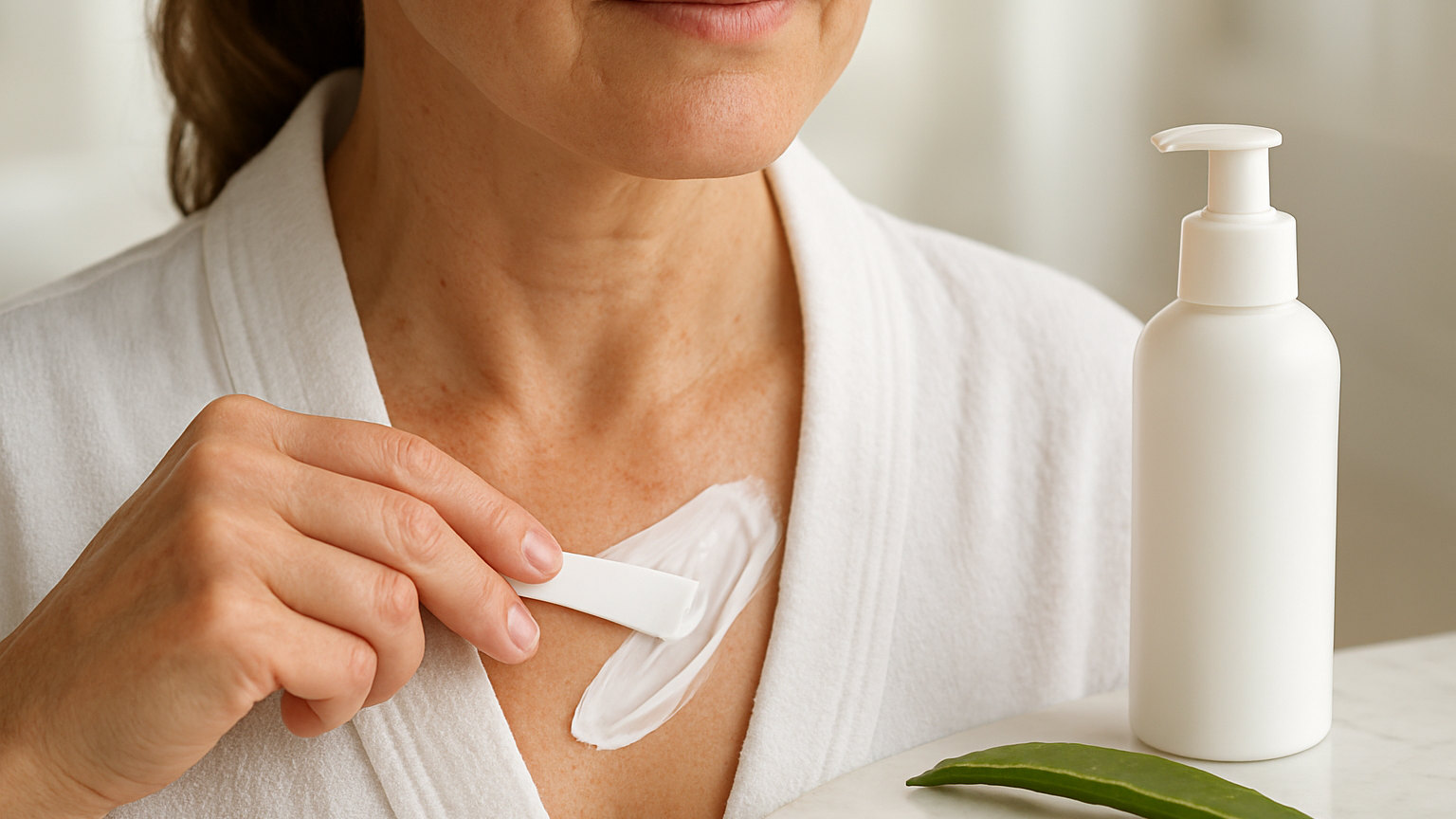
It is a common experience to look after your face carefully for a decade and then notice that your neck has not kept pace. The reasons are partly anatomical and partly a matter of what gets left out of the routine, and both are worth understanding before buying a dedicated neck cream.
What makes neck skin different?
It is thinner, with fewer layers in the epidermis and a thinner dermis beneath. It contains far fewer sebaceous glands, so it produces less oil and dries out more readily. It has less subcutaneous fat cushioning it.
It also moves constantly. Every time you turn your head, swallow or look down, the skin folds along the same horizontal lines, and with less elastin to recover with, those folds gradually become permanent.
Beneath it sits the platysma, a broad sheet of muscle that loosens with age and separates into the vertical cords visible on many necks after fifty.
Why does it get more sun damage than you think?
Because it is exposed constantly and protected sporadically. Most people apply sunscreen to the face and stop at the jaw, and the chest gets exposure through every open collar and low neckline while receiving protection only on obvious beach days.
The chest in particular shows a characteristic pattern of photoageing: mottled brown pigmentation, small red broken capillaries, and a texture that has been described as resembling crumpled tissue. This is almost entirely cumulative ultraviolet damage rather than chronological age, which means it was preventable and is partly treatable.
Is looking down at a phone really a cause?
Partly, though the term tech neck oversells a phenomenon that predates smartphones by a long way. Horizontal neck lines have always formed from repeated flexion, and reading a book does the same thing.
What has changed is the number of hours. The mechanism is real, and the practical response is unglamorous: raise the screen rather than lowering your head, and take the same approach to a laptop. The lines that result are creases from repeated folding, so reducing the folding reduces the rate at which they set.
Do you need a separate neck cream?
Almost never. There is nothing in a neck cream that could not be in a face cream, and the price per millilitre is usually higher for a smaller jar.
What the neck actually needs is the products you already own, extended downward. Take your moisturiser, your retinoid and your sunscreen past the jawline and onto the chest, every time.
The one legitimate adjustment is strength. Thin neck skin irritates more easily than the face, so a retinoid should be introduced there more slowly, perhaps twice a week for the first month, and a richer moisturiser is often needed to compensate for the lack of oil glands.
What actually improves it?
Sunscreen daily, applied to the neck and chest as a matter of routine rather than on sunny days. This prevents further damage and is the single highest-value change.
A retinoid used consistently improves texture, crepiness and pigmentation over six to twelve months. Vitamin C and niacinamide help the mottled pigmentation on the chest. Alpha hydroxy acids improve surface texture.
Sleeping on your back rather than your side reduces the vertical chest creases that form from breast tissue folding overnight, which is one of the few wrinkle causes genuinely fixed by changing position.
What is beyond skincare?
Loose platysmal bands and significant laxity are muscular and structural, and no topical addresses them. Botulinum toxin can soften the bands, energy devices produce modest tightening, and lasers treat pigmentation and broken capillaries on the chest effectively.
The honest summary is that texture, tone and pigmentation respond well to consistent skincare, while laxity does not. Starting early on the first three is what keeps the fourth from being the only thing left to address.
Why do necklaces and collars leave marks?
Because thin skin with little fat beneath it holds an impression far longer than the face does, and jewellery worn in the same position daily creates a groove along a line that is already creasing naturally.
The same applies to sleeping in a tight collar or with a chain on. None of it causes lasting damage on its own, but on skin that recovers slowly it adds to a fold that is already forming. Varying necklace length occasionally is a small, free adjustment.


