
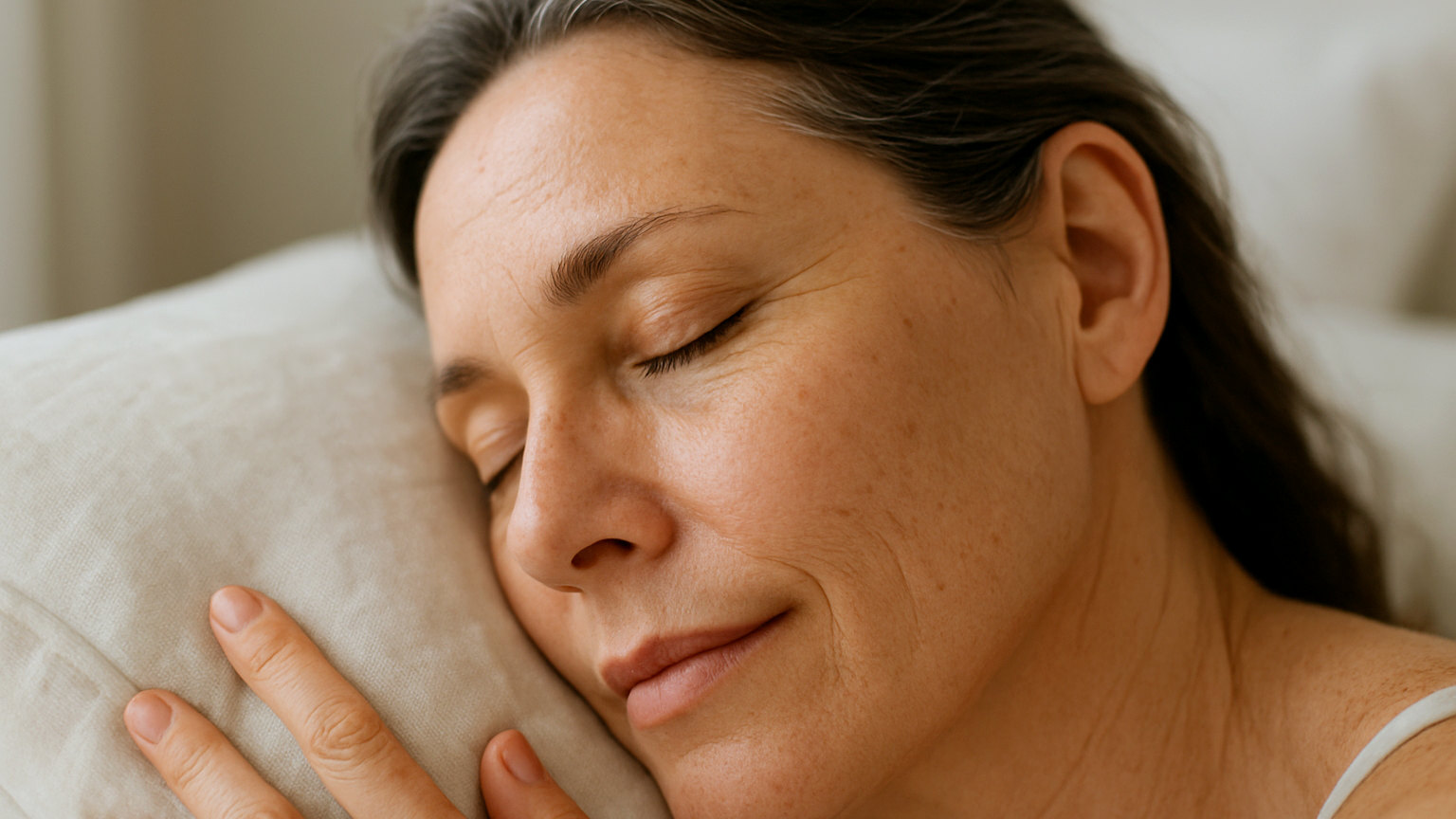
The creases visible on one side of your face in the morning are called sleep lines, and the question of whether they become permanent has a clearer answer than most wrinkle questions: yes, given enough years, and the mechanism is well described in the dermatological literature.
How do sleep lines form?
By compression and shear rather than by muscle movement, which is what makes them distinct from expression lines.
When you sleep on your side or front, the weight of your head presses your face into the pillow for hours, and the skin is pushed, folded and held there. Because the average person spends something like a third of their life in this position, the same folds are reproduced night after night in exactly the same places.
Young skin unfolds each morning within an hour or two. As collagen and elastin decline, recovery slows, and eventually the crease no longer fully releases.
How do you tell them from expression lines?
By direction and by symmetry.
Expression lines follow muscle movement and are broadly symmetrical, since you smile and frown with both sides of your face. Forehead lines run horizontally, frown lines vertically between the brows, crow's feet radiate outward.
Sleep lines are usually asymmetrical, deeper on whichever side you favour, and run in directions that make no sense for muscle: vertical lines on the cheek, diagonal creases from the corner of the mouth, and vertical furrows on the chest between the breasts.
That asymmetry is the giveaway. If one side of your face has a line the other does not, it is very likely a sleep line.
Does a silk pillowcase help?
A little, and less than it is sold as doing.
Silk and satin have a smoother surface with a lower coefficient of friction than cotton, so skin slides rather than gripping and bunching. That genuinely reduces the shear component, and it also reduces hair breakage and frizz, which is a real benefit in its own right.
What it does not reduce is compression. The weight of your head still presses your face into the pillow for seven hours, and pressure rather than friction is doing most of the work. A silk pillowcase is a small improvement, not a solution, and it will not undo lines already established.
What actually prevents them?
Sleeping on your back, which is the only intervention that removes the cause entirely.
It is also the hardest advice in skincare to follow, since sleep position is largely unconscious and most people revert within an hour. Practical approaches that help include a pillow under the knees, which makes back sleeping more comfortable for the lower back, and pillows placed either side to make rolling less easy.
Specialist pillows shaped to support the head without contacting the cheek exist and have some evidence behind them. They are not cheap, and they take weeks to get used to.
Can existing sleep lines be treated?
Partially. A retinoid used consistently improves the skin quality around them and softens shallow lines over six to twelve months. Hydration makes them temporarily less visible.
Deep, established sleep lines respond better to injectable filler than to anything topical, because they are structural creases rather than surface texture. Botulinum toxin does very little here, since there is no muscle activity to relax, which is a useful diagnostic in itself.
Changing position stops them deepening, which matters more than any treatment if you notice them early.
Is there a reason to bother beyond skin?
Several, and they may be more persuasive than the wrinkles. Back sleeping reduces morning facial puffiness by improving overnight fluid drainage. It avoids the fluid pooling that makes eyes look swollen.
It is not right for everyone, though. Back sleeping worsens snoring and obstructive sleep apnoea, and it is uncomfortable in later pregnancy. Sleep quality itself matters more for skin than sleep position does, so if changing position costs you rest, the trade is not worth making.


