
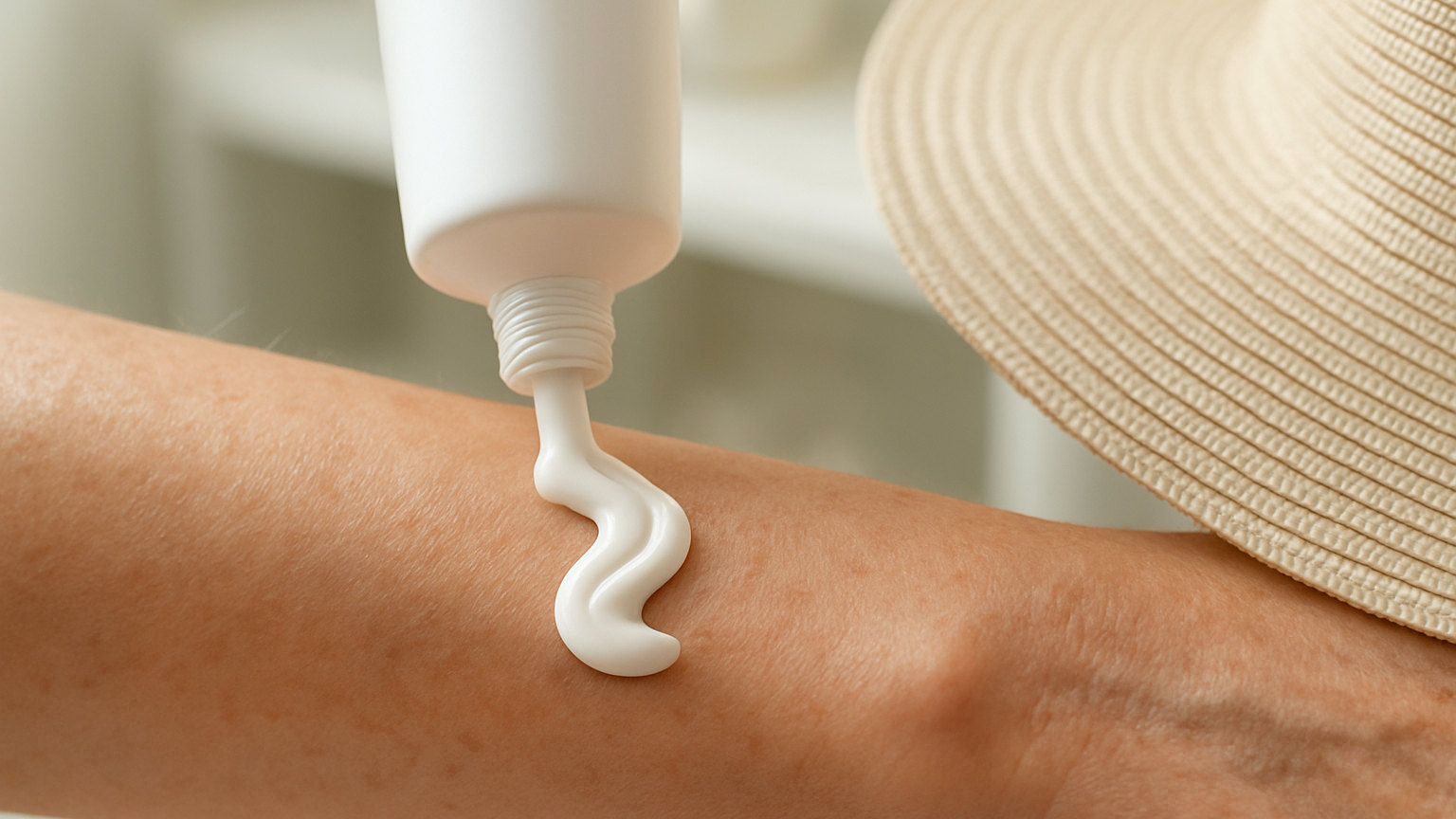
If you could only keep one product for the appearance of your skin over the next twenty years, the evidence points at sunscreen, and it is not a close contest. It is also usually the cheapest thing in the routine, which is an awkward fact for an industry selling everything else.
How much ageing does the sun actually cause?
The commonly cited figure is around eighty per cent of visible facial ageing, and while the precise number varies between studies, the direction is consistent and the effect is large.
The most persuasive evidence is not statistical but visual. Published case studies of people with decades of asymmetric exposure, such as drivers with sun through one window, show one side of the face with deep wrinkling, thickened leathery texture and pronounced pigmentation, and the other side comparatively smooth. Same person, same age, same genetics, same diet. The only variable was ultraviolet light.
What is UVA doing that you cannot feel?
Burning is UVB, and it is the part people notice. UVA is the part that ages skin, and it produces no immediate sensation at all.
UVA penetrates to the dermis, generating free radicals that fragment collagen fibres and cause abnormal elastin to accumulate. It passes through window glass and cloud, and its intensity varies far less by season and time of day than UVB does. So a February morning at a desk by a window is doing something a January afternoon indoors is not, and nothing about it feels like sun exposure.
This is why SPF alone is an incomplete measure. SPF describes UVB protection. In the UK, look for the UVA circle logo or four or five stars.
Is there evidence it prevents ageing, or just burning?
There is direct evidence, and it is stronger than most people assume.
A well-known randomised trial in Australia followed adults over four and a half years, comparing daily sunscreen use with discretionary use. Skin ageing was assessed by microtopography rather than opinion. The daily group showed no detectable increase in ageing over the period; the discretionary group showed significantly more.
Other work has shown that consistent sunscreen use allows some repair of existing photodamage, because removing the ongoing insult lets the skin's own repair mechanisms make progress.
How much do you actually need?
More than almost anyone applies. The laboratory standard is 2mg per square centimetre, which works out at roughly a third to half a teaspoon for the face and neck.
Most people apply between a quarter and a half of that, and protection does not scale in a straightforward way, so half the amount delivers considerably less than half the stated SPF. If you want the number on the bottle, you have to use the quantity it was tested at.
The practical guide most people find easiest is two finger-lengths of product for face and neck, and reapplying every two hours during genuine sun exposure.
Do you need it in winter and indoors?
In the UK, UVB is negligible between roughly October and March, so burning is not the concern. UVA persists year-round and passes through glass.
Whether that justifies daily winter application is a reasonable question with a defensible answer either way. If you work by a window, drive regularly or spend time outdoors, it is worth it. If you leave the house in the dark and return in the dark, the benefit is small.
What is not in question is the period from spring to autumn, and any day spent outside regardless of cloud.
What about vitamin D?
A fair concern, and the answer is that studies of regular sunscreen users have not generally found clinically significant deficiency, because nobody applies it thoroughly enough or often enough to block synthesis completely.
In the UK the more pressing issue is that sunlight is too weak to produce vitamin D at all through the winter months, which is why supplementation is advised regardless of sunscreen use. Protecting your skin and taking a supplement resolves both without compromise.


