
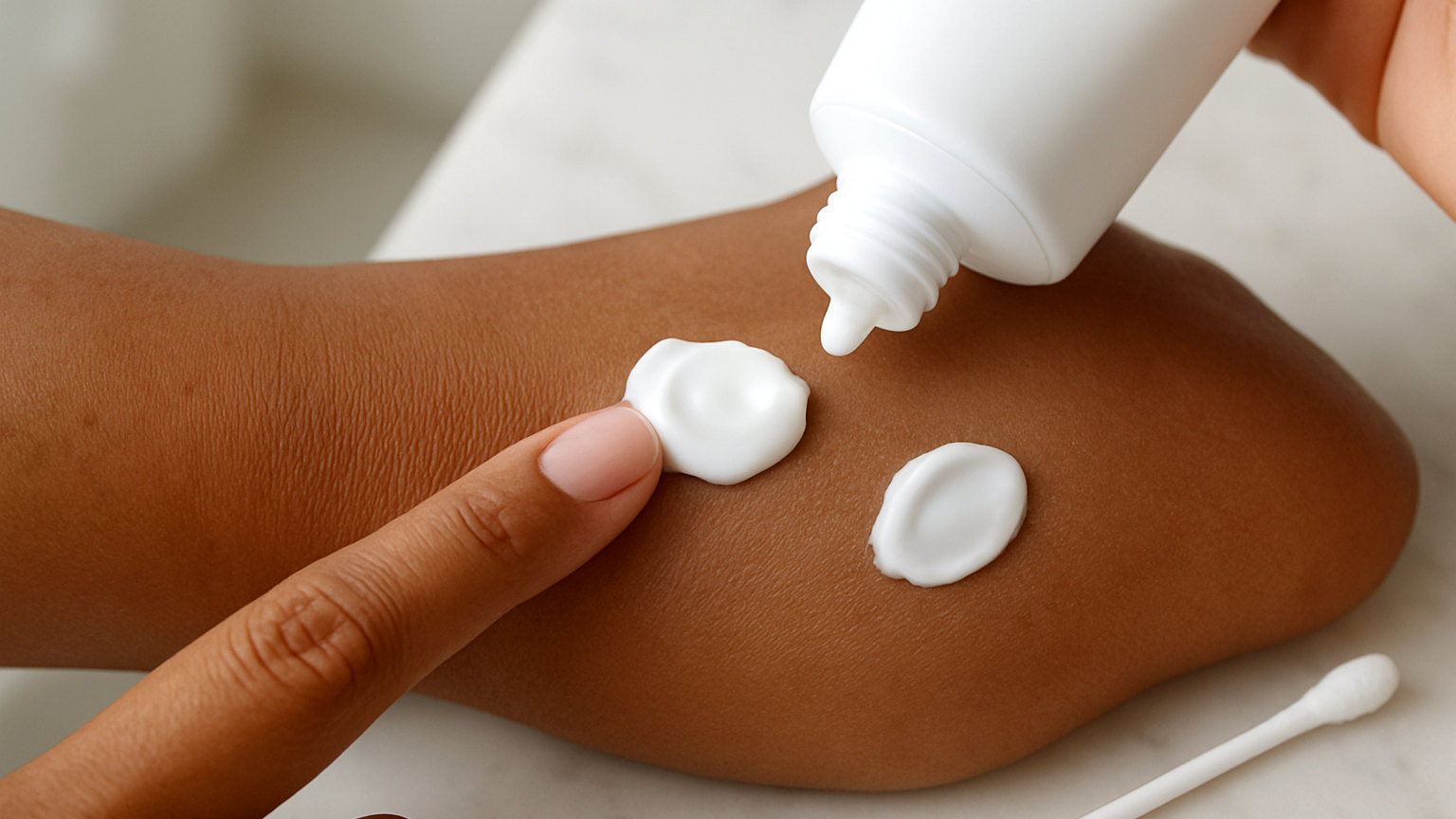
Patch testing is advised on almost every product label and carried out properly by almost nobody. The usual version, dabbing a little on the wrist and carrying on if nothing happens in ten minutes, misses precisely the kind of reaction that causes the most trouble.
Why is a single application not enough?
Because the two kinds of reaction appear on different timescales.
Irritant reactions are immediate and dose-dependent. They show up within minutes to hours, and a quick test does catch them.
Allergic reactions are immune-mediated and delayed. They typically appear twelve to forty-eight hours after exposure, and often only after repeated contact, because the immune system has to be sensitised before it responds. A product can be applied comfortably three times and produce a reaction on the fourth.
That is why a proper patch test runs for days rather than minutes.
Where should you test?
The inner forearm is the standard site: easy to see, easy to keep covered, and unlikely to be embarrassing if it reacts.
Behind the ear or along the jaw is a better guide for facial products, because the skin there is thinner and closer in character to the face. The inner forearm is more forgiving than your cheek, so a product can pass there and still sting on the face.
For anything going near the eyes, testing on the outer eyelid area is more informative, though only once the forearm test has passed.
How long should you leave it?
Apply a small amount to the same spot twice a day for five to seven days, and check the area each time before reapplying.
Seven days sounds excessive for a moisturiser and is entirely proportionate for anyone whose skin reacts frequently. Repeated application is the part that matters, since single exposure will not reveal a sensitisation reaction.
Do not wash the area vigorously between applications, and do not apply anything else to it, since the point is to isolate one variable.
What are you looking for?
Redness that persists rather than fading within an hour. Itching, which is the most useful single indicator of allergy rather than irritation. Small bumps or blisters. Scaling or peeling. Swelling. A burning sensation that does not settle.
Mild transient tingling with an acid or a retinoid is not a failure. Itching is, at any strength.
Take a photograph on day one so you have something to compare against, because gradual redness is genuinely difficult to judge from memory.
How do you introduce it afterwards?
One product at a time, with at least a week between additions. This is the step people skip when a delivery of four new things arrives, and it is why so many reactions are never traced to a cause.
Start with two or three applications a week rather than daily, particularly for actives, and increase only once a fortnight has passed without incident. Keep a note of what you started and when, because reconstructing it after a reaction is much harder than writing it down.
Does patch testing at home replace clinical testing?
No, and the distinction is worth knowing. Home patch testing tells you whether a finished product suits you. Clinical patch testing, carried out at a dermatology clinic, identifies which specific ingredient you react to, using standardised allergen panels applied under occlusion and read at forty-eight and ninety-six hours.
If you react repeatedly to products that should be innocuous, ask a GP about a referral. Knowing that you are allergic to methylisothiazolinone or to a particular fragrance compound saves years of trial and error and a great deal of money.
When is patch testing not optional?
Hair dye, always, every time, even if you have used the same product for years. Sensitisation to paraphenylenediamine can develop suddenly, and reactions can be severe. The allergy alert test on the packet exists for good reason and takes forty-eight hours.
Also treat it as essential for anything containing a known common allergen, for any product going near the eyes, and for anyone with eczema, asthma or hay fever, since that group is more prone to contact allergy generally.


