
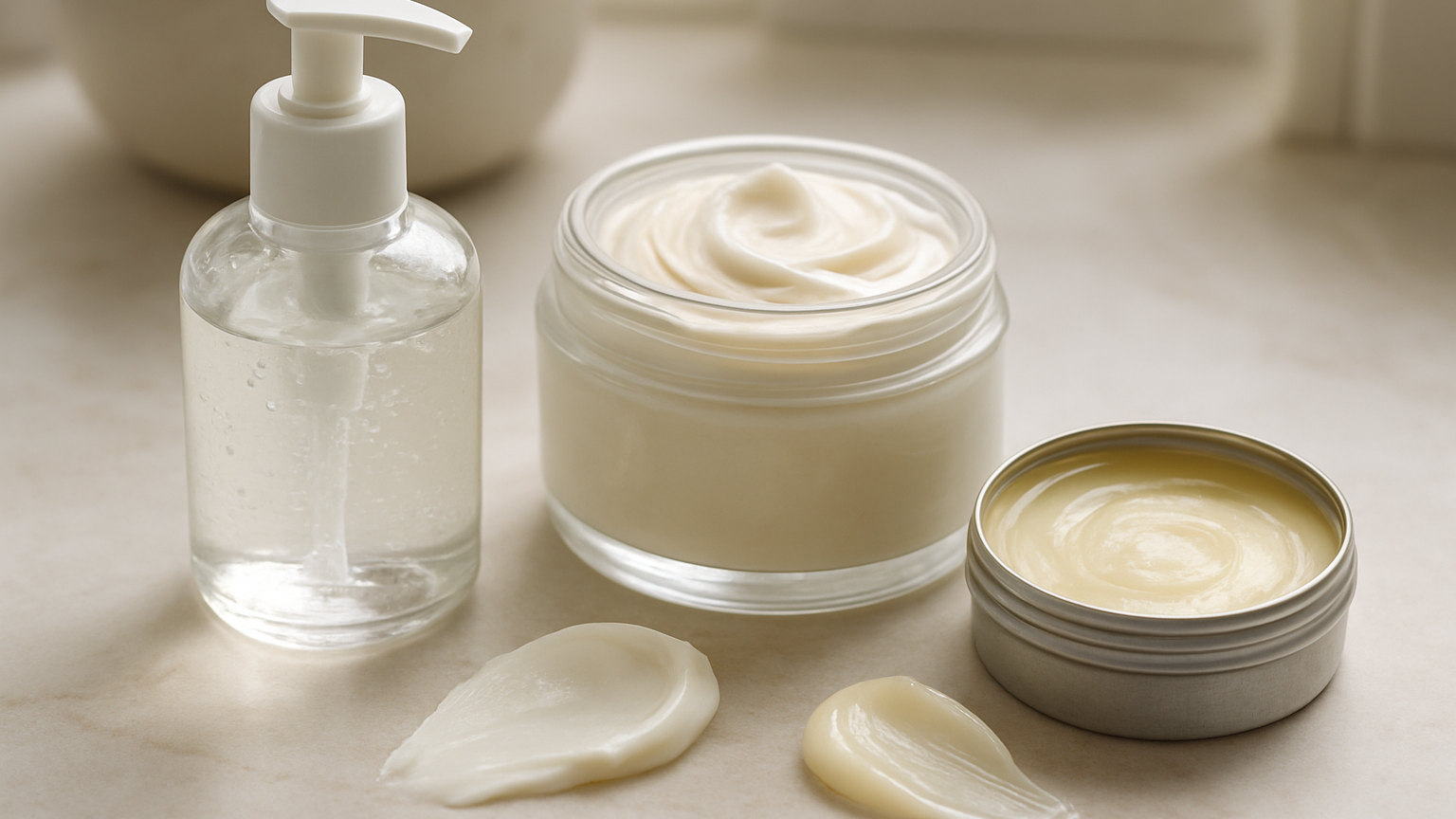
Every moisturiser ever made works by one of three mechanisms, sometimes two, occasionally all three. Once you know which category an ingredient falls into, the wall of jars in a chemist resolves into a short list, and price stops correlating with usefulness in any reliable way.
What are the three mechanisms?
Humectants attract water. They pull it from the deeper skin layers and, in humid conditions, from the air, holding it in the outer layer.
Emollients fill the gaps between skin cells, smoothing texture and softening. They are the reason a moisturiser makes skin feel supple rather than merely damp.
Occlusives form a physical film over the surface that slows water escaping. They do not add anything to the skin; they stop what is already there from leaving.
A well-formulated moisturiser generally combines all three, which is why an ingredient list looks longer than it needs to be.
Which humectants are worth having?
Glycerin, above all. It is cheap, extremely well studied, effective at low concentration and rarely irritating. Its unglamorous reputation is entirely a matter of marketing rather than performance.
Hyaluronic acid holds a great deal of water and gives an immediate plumping effect, though it works only at the surface. Urea is a genuine dual-purpose ingredient, hydrating at low concentrations and gently loosening dead skin at higher ones, which makes it excellent for rough or scaly skin.
Panthenol hydrates and soothes. Lactic acid at low concentration hydrates as well as exfoliating.
One caution applies to all of them: in very dry air, a humectant with nothing sealing it above can draw water from deeper skin and lose it to the atmosphere. Always follow with something occlusive.
Which emollients matter?
Ceramides, cholesterol and free fatty acids are the three lipids that make up the skin barrier itself, and applying them replaces what is missing rather than merely covering it. Formulations containing all three appear to repair more effectively than any one alone.
Squalane is light, stable, non-comedogenic and closely mimics a lipid the skin makes naturally, which makes it one of the few oils suitable for almost everyone.
Shea butter, plant oils and fatty alcohols such as cetyl and stearyl alcohol all soften. Fatty alcohols are worth mentioning because the word alarms people, and they bear no relation to the drying denatured alcohol used in toners.
Which occlusives are most effective?
Petrolatum, by a considerable margin. It reduces water loss through the skin by around ninety-nine per cent, more than any alternative, and it is non-comedogenic, non-allergenic and extremely cheap.
Its poor reputation is aesthetic and reputational rather than scientific. Cosmetic-grade petrolatum is highly purified and has an excellent safety record. Applied over a moisturiser at night on very dry skin, nothing outperforms it.
Dimethicone is lighter, sits well under makeup and is a reasonable alternative. Lanolin is highly effective, particularly for lips and hands, though it causes allergy in a minority. Beeswax and mineral oil work similarly.
What is not worth paying for?
Collagen as an ingredient, which is too large to penetrate and functions as an ordinary humectant. Elaborate botanical blends, which increase the number of things that can irritate you. Anything promising to feed or detoxify the skin, neither of which describes a real process.
Also worth ignoring is the price gap at the top of the market. A well-formulated moisturiser containing glycerin, ceramides and dimethicone costs a few pounds, and the version at forty times the price contains largely the same materials with better packaging.
How should you layer them?
Thinnest to thickest, and onto damp skin. Humectant serum first, within a minute of cleansing while the skin is still wet. Moisturiser second, which supplies emollients and some occlusion. An occlusive last if your skin needs it, at night.
The damp-skin point is not a detail. Applying a humectant to bone-dry skin in a heated room gives it very little water to work with, and the difference in outcome is noticeable.
Does texture tell you anything?
Broadly, yes. Gels are humectant-heavy with minimal occlusion, suiting oily or dehydrated skin. Lotions add emollients. Creams contain more oil and more occlusion. Ointments and balms are largely occlusive.
Matching texture to your skin and to the season matters more than the specific brand. The same person often needs a lotion in July and a cream in January, and treating that as a failure of the product misunderstands what changed.


