
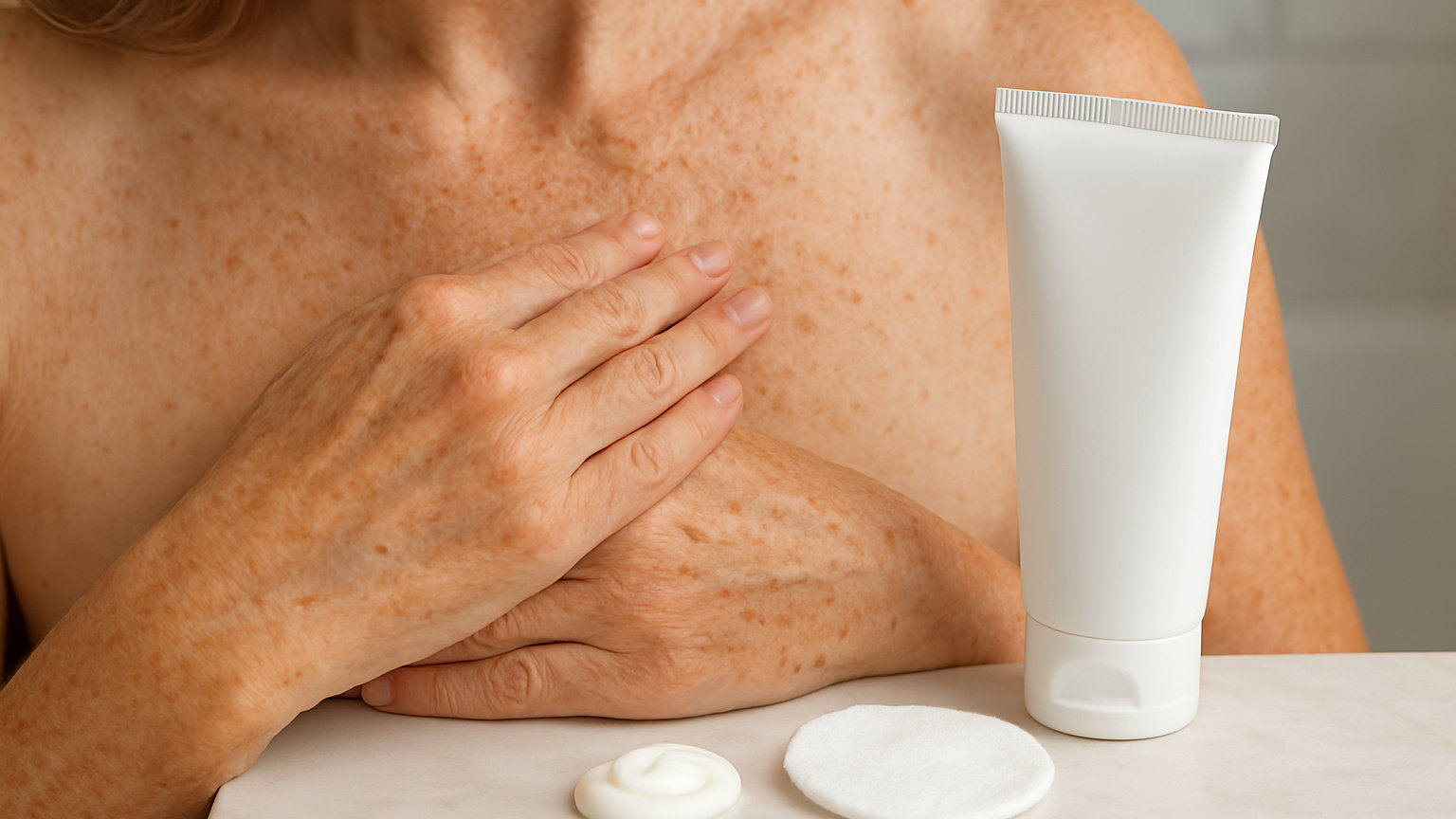
People often maintain a careful facial routine for a decade and then notice that their hands and chest have not kept pace. These areas receive comparable ultraviolet exposure to the face and a fraction of the protection, and they show it earlier and more obviously.
Why these areas specifically?
Exposure without protection. The backs of the hands are uncovered in almost all weather and all year, including while driving, and sunscreen applied there is washed off every time you use a sink.
The chest is exposed through every open collar and low neckline, and receives protection mainly on days people consciously think of as sunny. Both areas get the cumulative dose without the daily habit.
The skin itself is also less forgiving. The back of the hand has very little subcutaneous fat and few sebaceous glands, and the chest is thin with sparse oil glands, so both lose water readily and repair more slowly.
What are these spots called?
Solar lentigines, though liver spots and age spots persist in ordinary speech. Neither of the common names is accurate: they have nothing to do with the liver, and age is a proxy for accumulated sun exposure rather than the cause itself.
They are flat, well defined, tan to dark brown, usually a few millimetres across, and they do not fade over winter. Ultraviolet exposure has increased both the number of melanocytes in that patch and how much pigment each produces.
What else appears on the chest?
A distinct pattern called poikiloderma of Civatte, which is common enough to be worth naming.
It presents as mottled red-brown discolouration across the sides of the neck and upper chest, with visible small blood vessels and a slightly crinkled texture, and it characteristically spares the shaded area under the chin. That sparing is the giveaway, and it makes the cause unambiguous.
It is cumulative photodamage rather than a disease, and it responds better to prevention than to treatment.
Does treatment work as well here?
Less well and more slowly than on the face, for reasons worth knowing before you judge a product to have failed.
Skin on the hands and chest turns over more slowly, has fewer follicles and glands through which ingredients penetrate, and has a thinner dermis with less capacity to repair. It also irritates more readily, so the strengths tolerated on the face often cannot be used.
Expect six to twelve months rather than three, and expect improvement rather than clearance.
What should you use?
The same ingredients as on the face, introduced more slowly. A retinoid at low strength two or three nights a week, building gradually. Vitamin C in the morning. Niacinamide, which is well tolerated. Azelaic acid where irritation is a concern.
Alpha hydroxy acids suit the hands well, since surface exfoliation helps both pigmentation and the rough texture that accompanies it.
Moisturise considerably more than you would the face, because both areas dry out faster and irritated skin pigments more.
What does a clinic offer?
Intense pulsed light is particularly effective for solar lentigines and for the vascular component of chest damage, and usually needs several sessions.
Cryotherapy can remove individual spots on the hands, though it carries a risk of leaving a pale mark in its place. Chemical peels and fractional laser both work, with more downtime and more caution needed in deeper skin tones.
How do you prevent more?
Extend whatever you do for your face downward and outward, every day rather than on sunny days. Keep a sunscreen by the kitchen sink and reapply to the hands after washing them, which is the single most neglected step in this whole area.
Driving gloves sound eccentric and are genuinely effective, since the right hand and forearm of British drivers take a disproportionate share. Sunscreen on the chest before dressing takes ten seconds and is the habit most people never form.
When should a spot be checked?
If it changes in size, shape or colour, has an irregular or blurred border, contains more than one colour, itches, bleeds or does not heal.
Solar lentigines are harmless, but sun-damaged skin is also where skin cancers appear, and the hands, chest and shoulders are common sites. Anything that looks different from your other spots is worth a GP appointment rather than a fading serum.


