
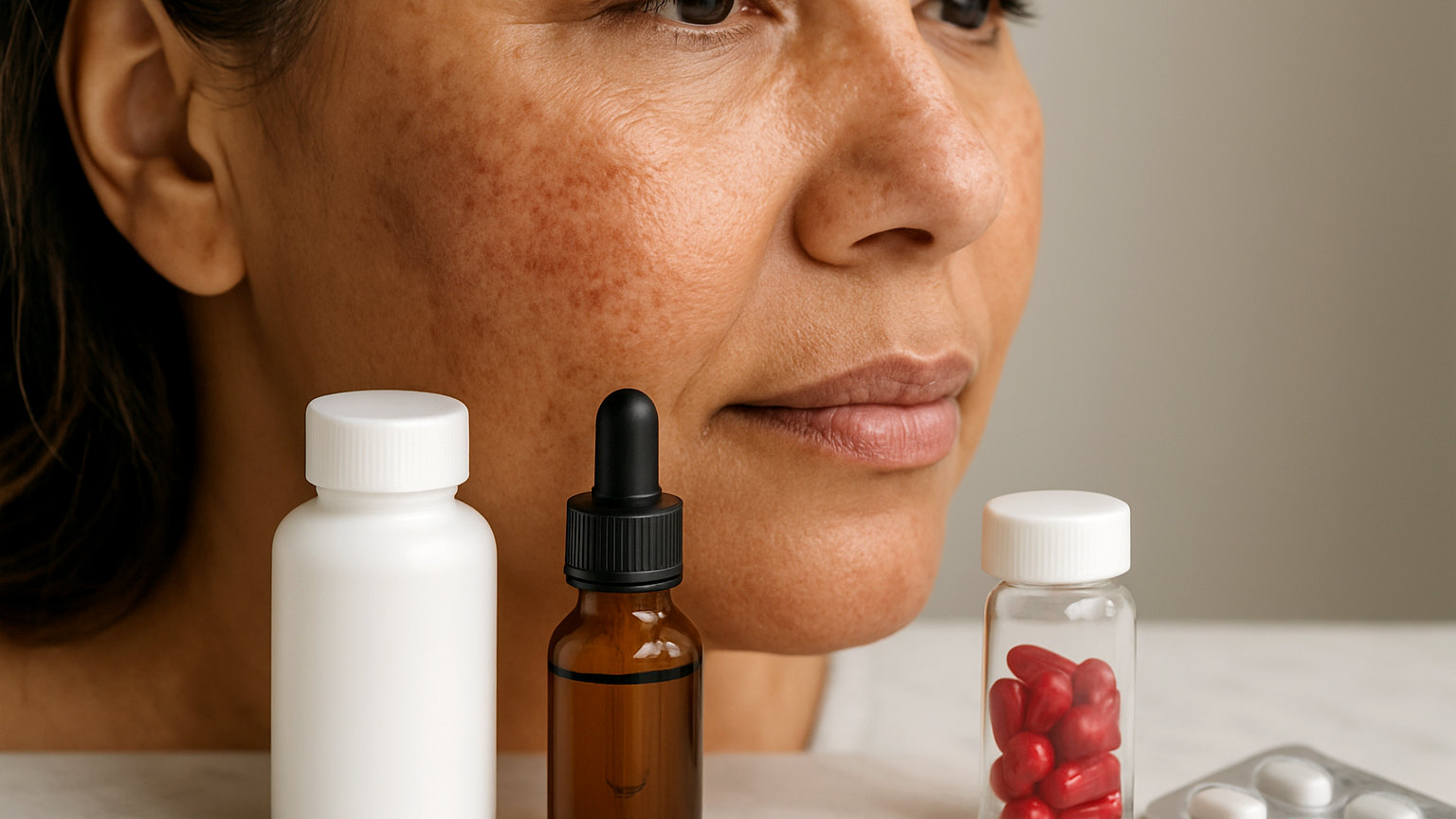
The oral market for pigmentation runs from reasonably evidenced to actively dangerous, with very little labelling to distinguish between them. It is worth going through them individually, because the differences are considerable.
What is polypodium leucotomos?
An extract of a fern, sold as an oral supplement and sometimes marketed as a sunscreen in a pill, which it is not.
It has a genuinely reasonable evidence base. Controlled studies have found that it increases the dose of ultraviolet light required to produce redness, reduces markers of ultraviolet damage in skin, and improves melasma when used alongside topical treatment and sunscreen.
The important qualification is that it supplements protection rather than replacing it. Anyone taking it instead of applying sunscreen has misunderstood what the studies showed.
Does oral tranexamic acid work?
It has the strongest evidence of anything oral for melasma specifically, with multiple trials showing meaningful improvement.
It is a prescription medicine, licensed primarily for heavy menstrual bleeding and used off-label for melasma at low doses. It is not suitable for everyone: it carries a clotting risk, so it is avoided in anyone with a history of thrombosis, on the combined pill, pregnant, or with certain other risk factors.
That is precisely why buying it online without a prescription is a poor idea. The assessment of whether it is safe for you is the valuable part, not the tablet.
What about glutathione?
This is the one to be genuinely wary of. Glutathione is an antioxidant produced naturally in the body, and it has been heavily marketed for skin lightening, particularly as intravenous injections.
Oral glutathione is poorly absorbed and the evidence for any effect on skin tone is weak. Intravenous glutathione for lightening is not licensed for that purpose in the UK and has been the subject of safety warnings internationally, following reports of severe adverse reactions including kidney injury, liver dysfunction, Stevens-Johnson syndrome and deaths.
Injectable products bought online or administered outside a clinical setting carry the additional risks of contamination and of unsterile technique. There is no version of this worth the risk.
Do vitamins help?
Only where there is a deficiency, which is the general rule for most vitamin supplementation.
Vitamin C is required for collagen synthesis and acts as an antioxidant, but oral supplementation in someone with adequate intake has not been shown to reduce pigmentation. Applied topically at effective concentration it does considerably more.
Vitamin D deficiency is common in the UK and worth addressing for health reasons generally, though not as a pigmentation treatment. Vitamin E and various carotenoids have been studied with modest and inconsistent results.
What about collagen and other blends?
Collagen supplements have some evidence for skin hydration and elasticity and essentially none for pigmentation, which is a different mechanism entirely.
Multi-ingredient beauty supplements combining several extracts at unstated doses are difficult to assess and rarely contain any ingredient at the concentration used in trials. The pattern is consistent across the category: the evidence tends to exist for a single ingredient at a specific dose, and the product contains a fraction of that alongside a dozen others.
How are supplements regulated?
Far more loosely than medicines. They do not require proof of efficacy before sale, the contents are not independently verified, and claims are policed only loosely.
That matters because it means a supplement can legally contain considerably less of an active ingredient than the label suggests, and imported products have repeatedly been found to contain undeclared pharmaceuticals.
Where should supplements sit?
Last, after sunscreen, topical treatment and dealing with triggers. Polypodium leucotomos is a reasonable addition for someone already doing those things properly, particularly with melasma.
Anyone considering oral tranexamic acid should go through a GP or dermatologist. Anyone considering glutathione injections should not. And anyone pregnant, breastfeeding or taking medication should check with a pharmacist before starting anything, since interactions are more common than the packaging implies.
A reasonable test before buying anything oral is to ask what dose the supporting studies used and whether the product contains it. In most cases that question is enough to settle the matter on its own.


