
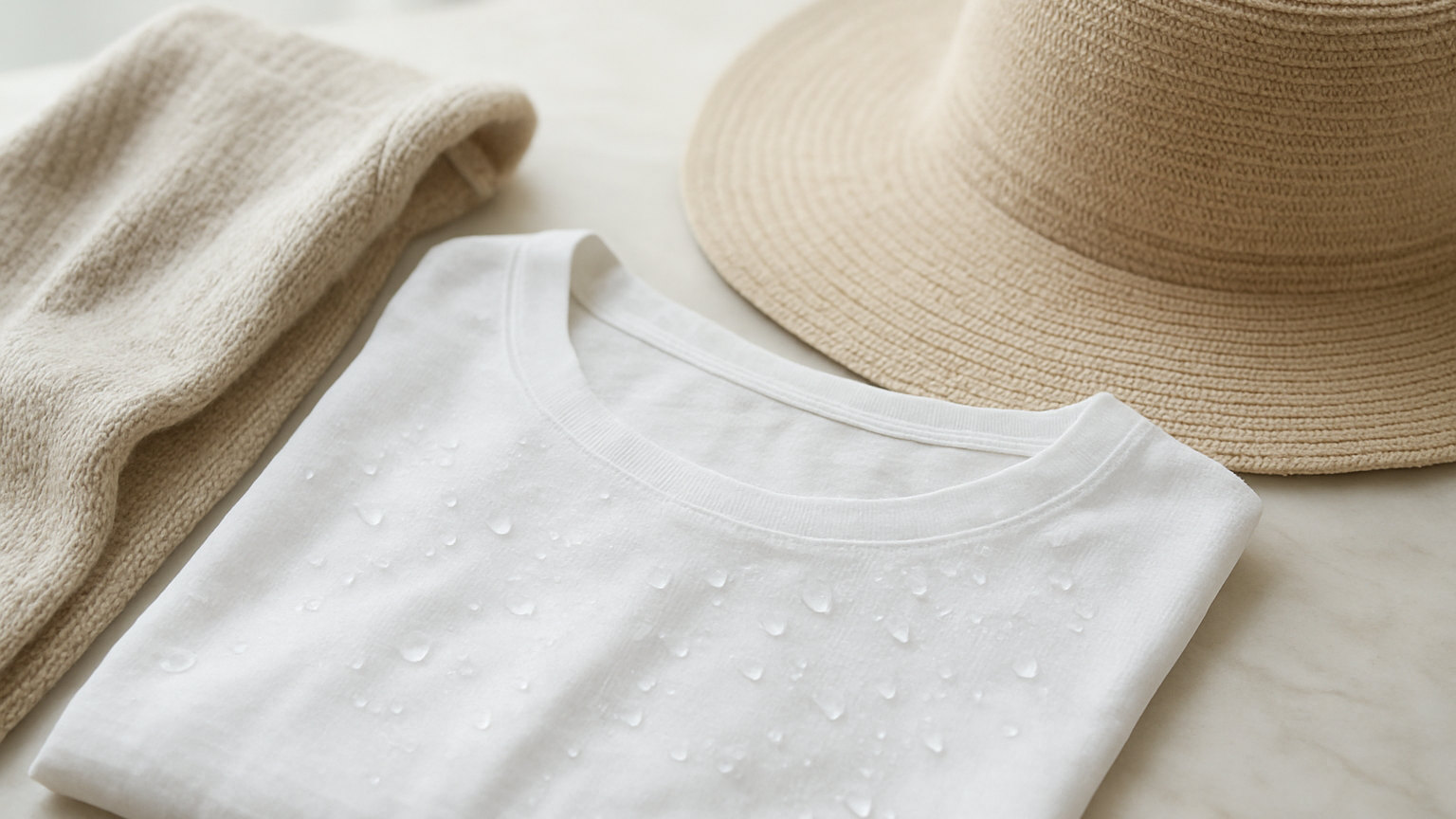
Clothing is the most reliable sun protection available, for the straightforward reason that it does not wear off, cannot be applied too thinly and does not need reapplying every two hours. Not all of it works as well as people assume.
What does UPF mean?
Ultraviolet protection factor, the fabric equivalent of SPF. UPF 50 means roughly one fiftieth of ultraviolet radiation passes through, which is about 98 per cent blocked.
Unlike SPF, which measures only ultraviolet B, UPF accounts for both UVA and UVB. Ratings of 15 to 24 are considered good, 25 to 39 very good, and 40 to 50 or above excellent.
How much does ordinary clothing block?
It varies enormously, from very little to almost everything, depending on four factors.
Weave density matters most. Tightly woven fabric blocks more than loose knit. Hold it up to a light: what you can see through, ultraviolet can pass through.
Colour matters more than expected. Dark and intensely coloured fabrics absorb more ultraviolet than white or pale ones, so a dark shirt outperforms a white one of the same weave.
Fabric type matters. Polyester and denim perform well, while lightweight cotton and linen perform poorly. Thickness helps.
A typical white cotton t-shirt provides roughly UPF 5 to 7, which is far less than most people believe.
Why is wet fabric worse?
Because water in the spaces between fibres allows more ultraviolet to pass, and wet fabric also clings and stretches, opening the weave.
A wet white t-shirt can lose a substantial share of what protection it had, which matters because that is exactly the situation people rely on it: swimming, or covering up after getting out of the water.
A UPF-rated swim top or rash vest is designed to maintain its rating when wet, which is why it is worth having for a beach holiday rather than relying on a normal shirt.
Does UPF clothing wear out?
Somewhat. Repeated washing and stretching opens the weave over time, and fading reduces the absorption that colour provides.
Interestingly, washing can improve protection initially, since cotton shrinks slightly and the weave tightens. Some laundry additives containing optical brighteners also increase ultraviolet absorption modestly.
A garment that has become thin, stretched or visibly faded is no longer performing as rated.
Which hat should you wear?
One with a brim all the way round, at least seven to eight centimetres wide. That covers the face, ears and back of the neck, which are three of the most common sites of sun damage.
A baseball cap protects the forehead and little else. It leaves the ears, the neck and the sides of the face fully exposed, and it is the most commonly worn hat in exactly the situations where those areas burn.
Fabric matters as much as shape, since a loosely woven straw hat with visible gaps lets a good deal through.
What about sunglasses?
Genuinely important and often treated as a style choice. Ultraviolet damage to the eyes is cumulative and contributes to cataracts and to cancers of the eyelid, which is a thin-skinned area rarely protected by sunscreen.
Look for a UV400 marking or a statement of 100 per cent UV protection, and the UKCA or CE mark. Larger lenses and wraparound styles protect more of the surrounding skin. Dark lenses without UV protection are worse than none, since they cause the pupil to dilate.
How does this fit alongside sunscreen?
Clothing covers what it covers, completely and reliably. Sunscreen handles the rest.
The sensible arrangement is to cover as much as is comfortable, use a proper hat and sunglasses, seek shade between eleven and three, and apply sunscreen to whatever remains exposed. Relying on sunscreen alone means depending on a product almost everyone under-applies.
Is shade enough on its own?
Better than nothing and not complete. Ultraviolet scatters, so a substantial proportion reaches you indirectly from the sky and from reflective surfaces even when the sun is blocked.
Under a beach umbrella on bright sand, people still burn, because sand reflects a meaningful share upward. Dense shade from a building or a thick tree canopy performs considerably better than a parasol. Shade is best treated as reducing exposure rather than removing it.


