
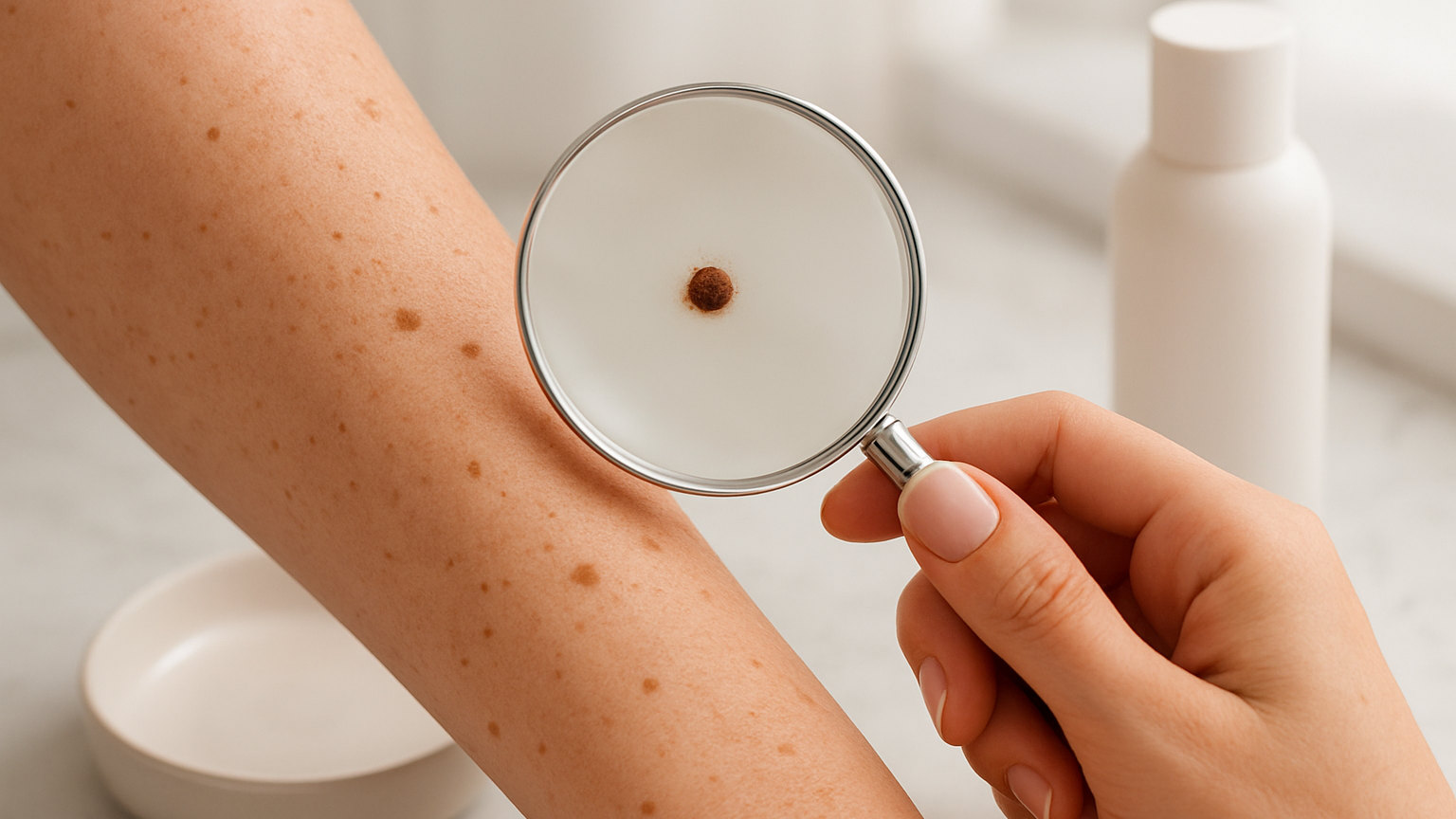
This is the reason sun protection matters rather than an aside to it. Most changes people notice turn out to be nothing, and the small number that are not are considerably more treatable when found early, which makes a five-minute check every couple of months a reasonable habit.
What is the ABCDE rule?
A memory aid for the features that warrant attention.
Asymmetry, where one half does not match the other. Border irregularity, meaning edges that are ragged, notched or blurred rather than smooth. Colour variation, with more than one shade, or patches of black, brown, red, white or blue within one lesion.
Diameter, traditionally over six millimetres, though small melanomas exist and size alone is not reassuring. Evolving, meaning any change in size, shape, colour, elevation or sensation.
Evolution is the most important of the five. A mole that is changing warrants attention regardless of how it scores on the others.
What is the ugly duckling sign?
Often more useful in practice than ABCDE. Most people's moles resemble each other, following a personal pattern.
The ugly duckling is the one that looks different from the rest: darker, larger, oddly shaped, or simply not like its neighbours. Scanning for the outlier rather than assessing each mole individually is faster and catches things people otherwise talk themselves out of.
What else should prompt a visit?
Any spot that itches, bleeds, oozes, crusts or does not heal within a few weeks.
A new mole appearing after about the age of thirty, since most moles form earlier. A sore that keeps returning in the same place. A rough, scaly patch that persists, which may be an actinic keratosis, a pre-cancerous change.
A pearly or waxy bump with visible small blood vessels, which is a common appearance of basal cell carcinoma, the most frequent and least dangerous skin cancer.
How should you actually check?
In good light, with a full-length mirror and a hand mirror, working systematically rather than randomly.
Face, ears including behind them, scalp with hair parted in sections. Neck, chest and torso, lifting anywhere skin folds. Arms including armpits, and both sides of the hands including under the nails. Back and buttocks using the hand mirror or asking someone. Legs, and the soles of the feet and between the toes.
Photographs are genuinely useful. A picture with something for scale beside a mole, repeated every few months, detects change far more reliably than memory.
Which areas do people miss?
The scalp, the soles of the feet, between the toes, under nails, the back, and behind the ears. All are commonly overlooked and all are sites where melanoma occurs.
Areas that rarely see sun still need checking, since some melanomas arise in places with little exposure, including under nails and on the soles.
Who is at higher risk?
People with fair skin that burns easily, red or fair hair, and many freckles. Anyone with more than fifty moles or several unusual ones.
A personal or family history of skin cancer. A history of severe or blistering sunburn, particularly in childhood. Sunbed use. Immunosuppression, including after an organ transplant.
Skin cancer occurs in all skin tones. In deeper skin it more often appears on the palms, soles and under nails, and it is frequently diagnosed later, which makes checking those areas particularly worthwhile.
What happens if you see a GP?
They will examine the lesion, often with a dermatoscope, and either reassure you, arrange review, or refer you. In the UK, suspected skin cancer is referred on an urgent pathway with an appointment target of two weeks.
Do not delay because you feel you may be wasting anyone's time. Most referrals turn out to be benign, and that is how the system is meant to work.
Are mole-checking apps reliable?
Not reliable enough to rule anything out. Several apps claim to assess lesions from a photograph, and independent evaluations have generally found their accuracy well below that of a clinician, with a meaningful rate of missed melanomas.
A reassuring result from an app is not a reason to skip an appointment about something that is changing. Where phones genuinely help is as a camera: consistent photographs over months are excellent at detecting change, which is the thing that matters most.


